
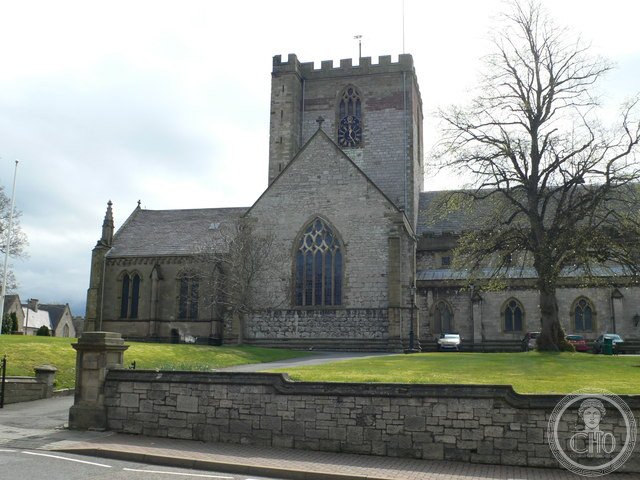
Bruciata dai soldati di Edoardo I e ricostruita nella valle del Clwyd, questa piccola cattedrale gotica custodisce la memoria di William Morgan, che qui tradusse la prima Bibbia completa in lingua gallese.
At a glance
St Asaph Cathedral, in the Vale of Clwyd in Denbighshire, North Wales, is widely described as the smallest ancient cathedral in Britain, though its history stretches back some 1,400 years. A church was first established on or near the site by Saint Kentigern in the 6th century; his disciple Asa, or Asaph, later gave the see its name. The building seen today dates mainly from the 13th century, begun after the original stone cathedral was burned by soldiers of Edward I during the Second Welsh War of 1282. The cathedral was damaged again during Owain Glyndŵr’s rebellion in the early 15th century and stood partly ruined for around seventy years before repair. St Asaph is closely associated with Bishop William Morgan, who completed the first full translation of the Bible into Welsh in 1588, a work of lasting importance for the Welsh language.
Key facts
- Widely cited as the smallest ancient cathedral in Britain, with roots reaching back around 1,400 years.
- Originally founded by Saint Kentigern in the 6th century; succeeded by his disciple Saint Asaph, who gave the see its name.
- The present building dates mainly from the 13th century, rebuilt after the earlier cathedral was burned by Edward I’s forces in 1282.
- Damaged during Owain Glyndŵr’s rebellion in the early 15th century and left partly ruined for about seventy years.
- Bishop William Morgan (1545–1604) completed the first complete Welsh-language Bible translation, published in 1588, largely while serving at St Asaph.
- In 1930, an underground stream caused severe subsidence beneath the tower, requiring urgent structural repairs completed by 1935.
- A. G. Edwards, appointed bishop of St Asaph in 1889, went on to become the first Archbishop of Wales in 1920.
History
The Christian foundation at St Asaph dates to the 6th century, when a church was established here by Saint Kentigern, a missionary bishop later associated with Glasgow. Tradition holds that Kentigern’s disciple Asa — venerated as Saint Asaph, and said to be a grandson of the Welsh nobleman Pabo Post Prydain — succeeded him and gave the diocese its lasting name. Little is known in detail of the earliest buildings on the site.
The cathedral’s medieval fortunes were shaped by Wales’s wars with the English crown. The stone cathedral standing in the 13th century was burned by soldiers of Edward I during the Second Welsh War in 1282, and a new building was begun on the same site soon after — the core of the structure visitors see today. Further damage came during the rebellion of Owain Glyndŵr in the early 15th century, after which the cathedral reportedly stood in a state of disrepair for roughly seventy years before adequate repairs were carried out.
St Asaph’s later history is closely tied to the Welsh Bible. William Morgan, appointed Bishop of St Asaph, completed the first full translation of the scriptures into Welsh from the original Greek and Hebrew, published in 1588 — a translation that helped secure the survival of the Welsh language into the modern era. In 1930, a subterranean stream caused serious subsidence beneath the tower, prompting urgent engineering repairs finished by 1935, and the cathedral underwent further restoration through the Victorian period and into the 20th century.
What you see
St Asaph is a compact cruciform church — nave and aisles of five bays, transepts, choir, and a central tower — built in the Decorated Gothic style typical of the early 14th century. Its scale is deliberately modest compared with the great English cathedrals, a product of St Asaph’s history as a small, remote Welsh see rather than a grand seat of temporal power; this modesty is precisely what earns it the distinction of Britain’s smallest ancient cathedral.
Inside, the timber ceiling of the nave is heavily ribbed to suggest the profile of a stone lierne vault without its structural weight, a practical solution characteristic of Welsh Gothic building. Among the cathedral’s treasures is a copy of William Morgan’s 1588 Welsh Bible, displayed as a reminder of the building’s role in the survival of the language, alongside a window bearing the coats of arms of prominent Welsh families connected to the diocese’s history.
Practical information
- Opening hours: daily, approximately 09:00 (10:00 on Sundays) to 17:00.
- Admission: free entry.
- Time needed: 30–40 minutes; a Translators’ Tearoom on site serves light refreshments.
- Address: St Asaph Cathedral, High Street, St Asaph, Denbighshire, LL17 0RL, Wales.
Getting there
St Asaph lies in the Vale of Clwyd in North Wales, about 5 miles from Rhyl and its railway station on the North Wales Coast Line; from Rhyl, local bus or taxi covers the remaining distance. The nearest airport is Liverpool John Lennon, roughly 45 miles east. By road, St Asaph sits just off the A55 expressway. GPS coordinates: 53.257074, -3.442099.
Nearby
- Rhuddlan Castle — a 13th-century concentric castle built by Edward I on the River Clwyd, about 3 miles north of St Asaph, where the Statute of Rhuddlan was issued in 1284.
- Denbigh Castle and Town Walls — a ruined hilltop fortress with surviving medieval walls, roughly 15 minutes from St Asaph.
- Bodelwyddan Castle — a 19th-century country house near St Asaph, built in Gothic revival style.
Sources
- Wikipedia, “St Asaph Cathedral”
- St Asaph Cathedral, official site (stasaphcathedral.wales)
- VisitWales, “St Asaph Cathedral”
Find it on the map
See this place and what’s around it →📷 Become a Cultural Heritage Online photographer
Share your photos of places: they stay published under your name as the author. The more they're seen, the more you get noticed — and soon a contest will reward the most appreciated photos.
Log in or sign up free to add a photoIs this page about you?
This page is read by travellers and heritage enthusiasts who find it on Google. Tell us how you are connected to this place and we will take it from there.