
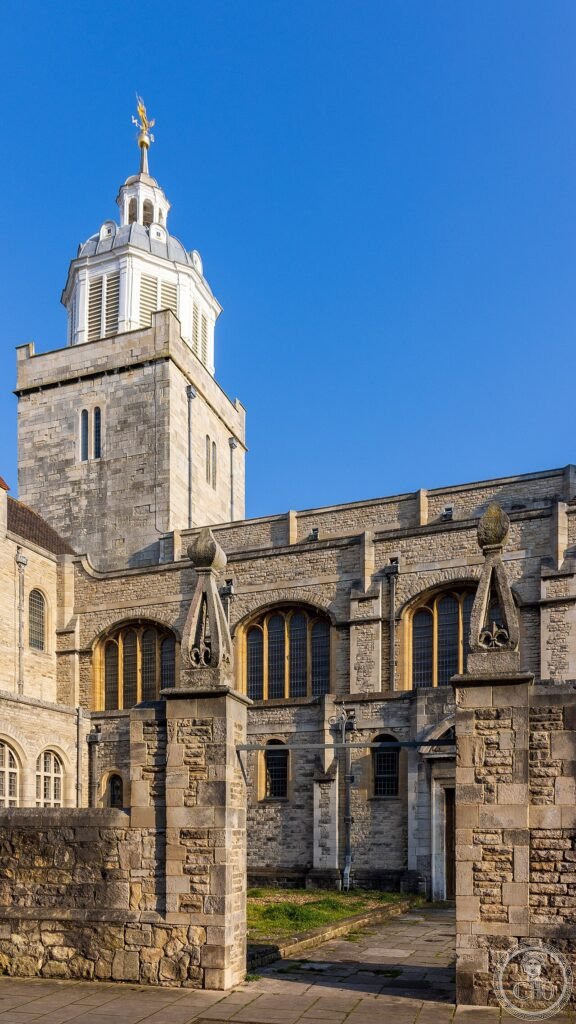
A medieval chancel, a Georgian nave and a rose-windowed twentieth-century extension meet under one roof, on a tower that once doubled as a lighthouse for ships entering the harbour below.
At a glance
Portsmouth Cathedral, formally the Cathedral Church of St Thomas of Canterbury, began as a small chapel given to Augustinian canons around 1180 and grew, over eight centuries, into the seat of the Diocese of Portsmouth. Its medieval chancel and transepts survive alongside a nave rebuilt in the 1680s after Civil War damage, and a twentieth-century extension designed by Charles Nicholson and completed decades later by Michael Drury. The building did not reach its present form until 1991, when Queen Elizabeth The Queen Mother consecrated the finished cathedral. It is a Grade I listed building and remains a working parish church in Old Portsmouth, a short walk from the harbour.
Key facts
- Founded around 1180, when Jean de Gisors gave land in Portsmouth to Augustinian canons of Southwick Priory for a chapel dedicated to St Thomas of Canterbury.
- Medieval core: the chancel (c. 1180–90) and transepts (c. 1190–1220) survive from the original building.
- Nave and tower rebuilt in 1683–93, in classical style, after damage sustained during the Civil War siege of Portsmouth in 1642.
- Cathedral status granted in 1927, when the parish church became the pro-cathedral of the newly formed Diocese of Portsmouth; full cathedral status followed by 1935.
- Twentieth-century extension designed by Charles Nicholson (built 1935–39) and completed after a fifty-year pause by Michael Drury (1990–91).
- Grade I listed building, recognised by Historic England for its layered medieval, Georgian and modern fabric.
- Consecrated in its finished form in November 1991 by Queen Elizabeth The Queen Mother.
History
Around 1180, the Norman merchant Jean de Gisors, lord of the manor of Titchfield, gave land in his new town of Portsmouth to the Augustinian canons of Southwick Priory to build a chapel dedicated to St Thomas of Canterbury — Thomas Becket, murdered in his own cathedral only a decade earlier. The chapel was formally dedicated in 1188. Its chancel and transepts, still standing today, are among the oldest fabric in Portsmouth. The church survived a French raid on the town in 1337 during the Hundred Years’ War, and later a period of closure in the fifteenth century connected to the killing of a visiting bishop by sailors in the town, before reopening in the early 1500s. Elizabeth I is recorded as having worshipped there in 1591.
Civil War fighting during the 1642 siege of Portsmouth damaged the medieval tower and nave. Charles II authorised a public fundraising campaign after the Restoration, and between 1683 and 1693 the old nave and tower were pulled down and replaced with a new aisled nave and west tower in classical style. A cupola with a lantern for shipping was added to the tower in 1703, and the tower has carried a ring of bells, since augmented, ever since.
The parish church became the pro-cathedral of the new Diocese of Portsmouth, carved out of the Diocese of Winchester, on 1 May 1927, and reached full cathedral status by 1935. To match its new role, Charles Nicholson designed a substantial eastward extension in a round-arched, Byzantine-influenced style; it went up between 1935 and 1939, then stopped when the Second World War began, leaving a temporary brick wall in place of a finished east end for half a century. Work resumed only in 1990, when the architect Michael Drury completed the extension — adding a further nave bay, twin west towers, a rose window and an ambulatory — and the finished cathedral was consecrated in November 1991.
What you see
From the street, the cathedral reads as three buildings joined end to end: a low medieval chancel and transepts in stone, a taller Georgian nave in brick and classical proportion, and, beyond it, the pale ashlar of Nicholson and Drury’s twentieth-century extension with its rose window and paired towers. The medieval tower at the crossing, pierced at its base to open a view straight through the building, once carried a lantern to guide ships into the harbour — a detail that ties the cathedral to the naval city around it as directly as any monument on the waterfront.
Inside, the nave is kept deliberately open, without fixed pews, so the space can serve as readily for a concert or exhibition as for a service. Furnishings span the same eight centuries as the walls: a mid-thirteenth-century wall painting of Christ in judgement survives in the north transept, an Andrea della Robbia ceramic relief of the Virgin and Child hangs nearby, and a 1693 carved pulpit and a 1718 organ case represent the Georgian rebuilding. Twentieth-century additions include a bronze Christus by Peter Eugene Ball, bronze west doors by Bryan Kneale worked with a tree-of-life design, and organ case doors painted by Patrick Caulfield in 2001 with day and night harbour scenes echoing Portsmouth’s motto, “Heaven’s Light Our Guide.”
Practical information
- Opening hours: open daily throughout the year for worship and private visiting; hours vary around services, so checking the cathedral’s own site before travelling is worthwhile.
- Admission: entry is free; a donation of around £5 per person is welcomed to support the building’s upkeep.
- Tours: free guided highlights tours run on a regular schedule, typically in the early afternoon, though they are suspended during busy periods.
- Facilities: a cathedral shop is on site; seasonal food and drink stalls operate on the adjoining Cathedral Green.
- Time needed: allow 30–45 minutes for a self-guided visit, longer if joining a tour.
Getting there
The cathedral stands on the High Street in Old Portsmouth, England, at approximately 50.7905, -1.1043. The nearest railway stations are Portsmouth Harbour and Portsmouth & Southsea, both served by trains from London Waterloo, roughly a fifteen-to-twenty-minute walk away through the old town. The nearest airport is Southampton Airport, about 25 miles to the north-west. By road, Old Portsmouth is reached via the M27 and A3(M), following signs for Old Portsmouth or Gunwharf Quays, where the nearest car parks are located; the cathedral itself has no dedicated visitor car park.
Nearby
- Portsmouth Historic Dockyard — home to HMS Victory and the Mary Rose, about a fifteen-minute walk north along the waterfront.
- Spinnaker Tower — a 170-metre harbourside observation tower at Gunwharf Quays, roughly a ten-minute walk from the cathedral.
- Southsea Castle — a Henry VIII-era artillery fort of 1544, about a fifteen-to-twenty-minute walk along the seafront to the south.
Sources
- Portsmouth Cathedral, official website — About Us
- Portsmouth Cathedral, official website — Visiting Portsmouth Cathedral
- Historic England, National Heritage List for England — Cathedral Church of St Thomas, list entry 1333198
- Wikipedia — Portsmouth Cathedral
Find it on the map
See this place and what’s around it →📷 Become a Cultural Heritage Online photographer
Share your photos of places: they stay published under your name as the author. The more they're seen, the more you get noticed — and soon a contest will reward the most appreciated photos.
Log in or sign up free to add a photoIs this page about you?
This page is read by travellers and heritage enthusiasts who find it on Google. Tell us how you are connected to this place and we will take it from there.