
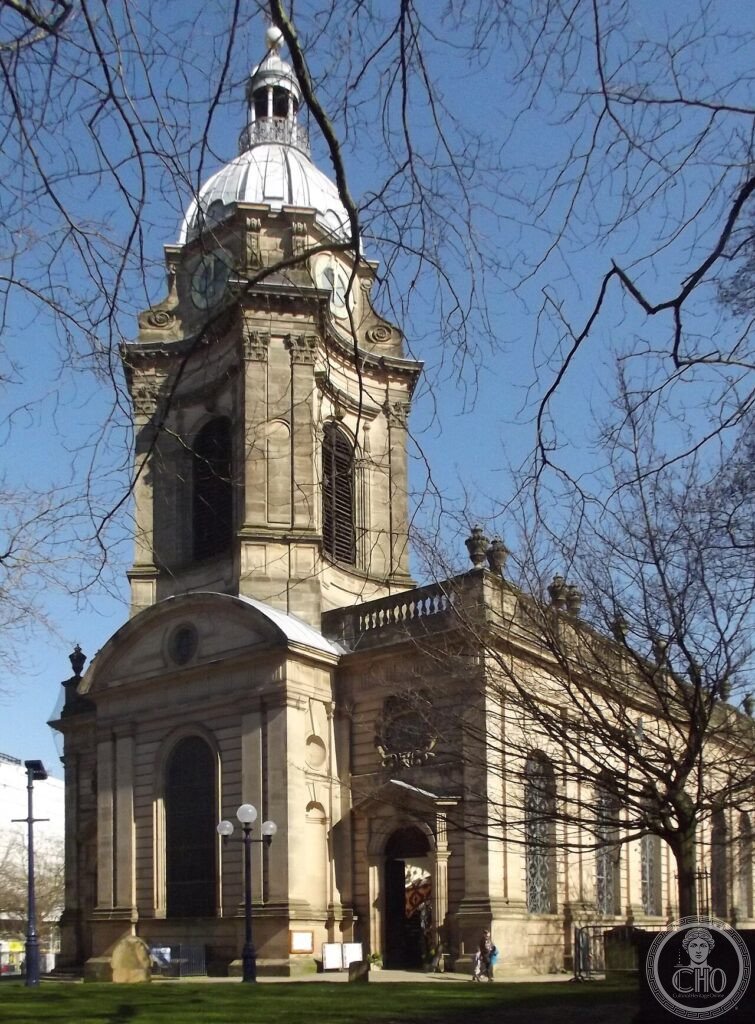
A compact Baroque church by Thomas Archer became a cathedral only in 1905, yet its four windows by Edward Burne-Jones make it one of England’s great encounters with stained glass.
At a glance
St Philip’s Cathedral stands on Colmore Row, at the top of Birmingham’s business district, built between 1711 and 1725 to designs by the architect Thomas Archer. Conceived as a new parish church for the town, it was consecrated in 1715 and elevated to cathedral status only in 1905, when the Diocese of Birmingham was created through the efforts of the statesman Joseph Chamberlain and Bishop Charles Gore. The building is modest in scale next to England’s medieval cathedrals, but its Baroque design, closer to Roman models than to Christopher Wren’s London churches, gives it a distinctive presence in the city centre. Its greatest treasure is a set of four stained-glass windows designed by Edward Burne-Jones and made by the firm of William Morris, installed between 1885 and 1897.
Key facts
- Architect: Thomas Archer, built 1711-1725 — his first major commission
- Status: parish church until 1905, then cathedral of the newly created Diocese of Birmingham
- Style: English Baroque, drawing on the Roman churches of Francesco Borromini rather than Christopher Wren
- Listing: Grade I listed building
- Stained glass: four windows designed by Edward Burne-Jones, made by Morris & Co, installed 1885-1897
- Wartime damage: bombed and gutted on 7 November 1940; restoration completed by 1948
- Location: Cathedral Square, Colmore Row — the oldest building in Birmingham city centre still used for its original purpose
History
Birmingham’s population had grown from around 6,000 in 1660 to roughly 15,000 by the early 1730s, and its existing parish church, St Martin’s, could no longer serve the town. A second parish church was commissioned on land donated by Elizabeth Phillips, whose family name it took, and built between 1711 and 1725 to designs by the architect Thomas Archer. It was consecrated in 1715, while the west tower, with its lead-covered dome and lantern, was not finished until 1725; urns were added along the roof balustrade later, in 1756. For almost two centuries the building served simply as St Philip’s parish church, one of several Anglican churches serving the growing industrial town.
The building was refaced in stone between 1864 and 1869 under the architect J. A. Chatwin, who later also designed the chancel extension that made room for new choir stalls and the large windows destined for stained glass. Its status changed again in 1905, when the Diocese of Birmingham was created and St Philip’s was designated the diocesan cathedral. The reorganisation was driven largely by the statesman Joseph Chamberlain, a former mayor of Birmingham, working with Bishop Charles Gore, the first Bishop of Birmingham. The choice gave the young diocese a cathedral already at the physical and civic centre of the city, rather than requiring a new building.
The cathedral suffered severe damage during the Second World War, bombed and gutted on 7 November 1940. Its Burne-Jones windows had been removed for safekeeping before the raid and survived intact; restoration of the building was completed by 1948. The windows themselves underwent a full programme of conservation completed in 2023, returning their colours to something closer to their original brilliance.
What you see
Archer’s exterior reads as Baroque of an unusually Continental cast for England: tall windows are separated by pilasters in low relief, rising to a balustrade where an urn crowns each pilaster, and the single west tower climbs in diminishing stages to its lead dome and lantern. The design owes more to the Roman churches of Francesco Borromini than to the domestic classicism Christopher Wren favoured for the City of London’s rebuilt parish churches, which is part of why the building still reads as unusual among English cathedrals.
Inside, the plan is a plain rectangular hall church with fluted pillars and wooden galleries, deliberately unfussy so that the four Burne-Jones windows dominate. Above the altar at the east end, the central Ascension is flanked by the Nativity and the Crucifixion; at the west end, above the entrance, the Last Judgement faces the congregation as they leave. Edward Burne-Jones was born in Birmingham in 1833 and baptised in this church; his designs, translated into glass by the workshop of William Morris, give the cathedral’s plain Baroque box an interior of Pre-Raphaelite colour rare in an English parish-turned-cathedral church. Among the furnishings, the organ case of 1715 by Thomas Schwarbrick of Warwick and wrought-iron chancel rails in the style associated with smiths such as Jean Tijou or Robert Bakewell survive alongside the windows as reminders of the building’s original, more modest ambitions as a parish church.
Practical information
- Opening hours: Monday-Friday 7:20am-5pm, Saturday 8:20am-5pm, Sunday 8:20am-5:15pm (hours vary around services)
- Admission: free; donations toward the building’s upkeep are welcomed
- Time needed: 30-45 minutes to see the windows and interior at an unhurried pace
Getting there
St Philip’s Cathedral stands on Colmore Row in Birmingham city centre, a short walk from Birmingham Snow Hill station and around 10 minutes on foot from Birmingham New Street, the city’s main rail hub with direct trains to London and across the Midlands. Birmingham Airport, about 13km southeast, connects to New Street by rail in roughly 15 minutes. Drivers should note that the cathedral sits inside Birmingham’s Clean Air Zone, which charges non-compliant vehicles to enter the city centre, and that streets around the cathedral square are largely pedestrianised; the nearest multi-storey car parks are on Cathedral Square and around Colmore Row. GPS: 52.481180, -1.898908.
Nearby
- Birmingham Town Hall — Grade I listed Victorian concert hall a few minutes’ walk south, modelled on a Roman temple.
- Birmingham Museum & Art Gallery — major Pre-Raphaelite collection, fitting company for the cathedral’s Burne-Jones windows.
- Council House — the city’s Victorian civic headquarters, facing Victoria Square close to the cathedral.
- Jewellery Quarter — historic manufacturing district a short walk northwest, with its own cluster of listed workshops and chapels.
Sources
- Wikipedia, “St Philip’s Cathedral, Birmingham”
- Birmingham Cathedral, official website — history and stained-glass windows pages, birminghamcathedral.com
- National Churches Trust, “Birmingham Cathedral” church record
- Historic England, National Heritage List for England, list entry 1076173, “Cathedral Church of St Philip”
Find it on the map
See this place and what’s around it →📷 Become a Cultural Heritage Online photographer
Share your photos of places: they stay published under your name as the author. The more they're seen, the more you get noticed — and soon a contest will reward the most appreciated photos.
Log in or sign up free to add a photoIs this page about you?
This page is read by travellers and heritage enthusiasts who find it on Google. Tell us how you are connected to this place and we will take it from there.