
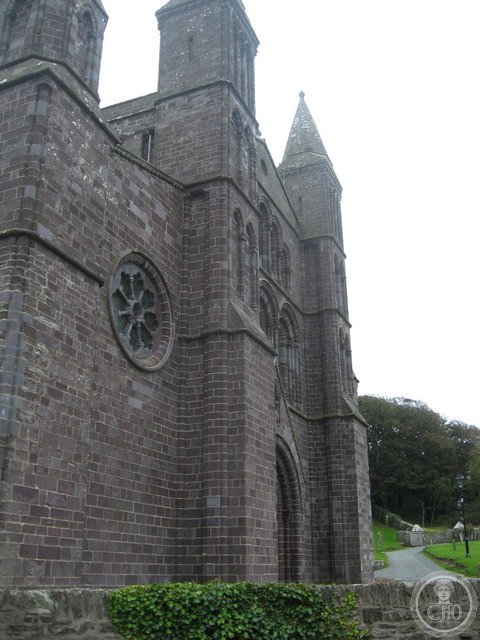
Nascosta in una valle per sfuggire alle incursioni vichinghe, la cattedrale più sacra del Galles custodisce le reliquie di San David e un pavimento che pende visibilmente da un capo all’altro della navata.
At a glance
St David’s Cathedral stands in a river valley in St Davids, Pembrokeshire — officially Britain’s smallest city, built around the cathedral itself. The site has been a place of Christian worship since Saint David founded a monastic community here around AD 589, and the cathedral has drawn pilgrims for over a thousand years: in 1123, Pope Calixtus II decreed that two pilgrimages to St Davids equalled one to Rome. The present building was begun in 1181 under Bishop Peter de Leia and largely completed in the mid-13th century, replacing an earlier church destroyed by Viking raids. Set low in the valley of the River Alun, the cathedral was deliberately built out of sight from the sea to avoid drawing the attention of raiders. Today it remains an active place of worship and the seat of the Bishop of St Davids, standing alongside the ruined Bishop’s Palace within a walled cathedral close.
Key facts
- Founded around AD 589 by Saint David (Dewi Sant), patron saint of Wales, as a monastic community at Menevia.
- Present building begun in 1181; consecrated in stages through the mid-13th century.
- The nave floor slopes nearly four metres between the east and west ends, and the building is still shifting minutely.
- In 1123, Pope Calixtus II ruled that two pilgrimages to St Davids were equal in merit to one pilgrimage to Rome.
- Edmund Tudor, father of King Henry VII, is entombed in the cathedral (his remains moved here in 1536 after the dissolution of Carmarthen Priory).
- Architect John Nash restored the west front in 1793, but the work proved structurally unsound; George Gilbert Scott carried out a major restoration between 1862 and 1870.
- St Davids Cathedral’s choir was among the first in a UK cathedral to combine girls and men as its main choral ensemble.
History
Saint David established a monastery on this site around AD 589, and it grew into one of the most important religious and intellectual centres in Wales. Its remote position on the western tip of Pembrokeshire did not spare it from attack: the community was raided repeatedly between the 7th and 11th centuries by Viking and other seaborne raiders, a threat serious enough that the cathedral was later sited low in a valley, screened from view of the sea. An earlier stone cathedral was consecrated in 1131 under Bishop Bernard, who also secured papal recognition of St Davids as a major pilgrimage destination.
The building seen today was begun in 1181 under Bishop Peter de Leia, replacing the earlier structure, and construction continued through the 13th century. The cathedral suffered further setbacks over the centuries, including earthquake damage and the collapse of the central tower in 1220, which was subsequently rebuilt. In the late 18th century, architect John Nash was commissioned to restore the unstable west front, but his work was itself found to be substandard within decades. A far more extensive restoration was carried out by George Gilbert Scott between 1862 and 1870, stabilising the structure and reworking the west front again.
Alongside the cathedral stands the ruined Bishop’s Palace, built largely under Bishop Henry de Gower between 1328 and 1347, one of the most lavish medieval bishops’ residences in Britain. Together, the cathedral and palace form the historic core of St Davids, still functioning today as a working cathedral and the seat of the Diocese of St Davids within the Church in Wales.
What you see
The most immediately striking feature inside St David’s Cathedral is the floor itself: it rises and falls by nearly four metres from the west end to the high altar, a consequence of centuries of subsidence and unstable foundations on which the building continues to move almost imperceptibly. The Norman and Early English nave, with its round-headed arcades and later Gothic vaulting, leads the eye up this slope past an elaborately carved 16th-century oak ceiling, one of the finest of its kind in Wales, added after the central tower’s collapse forced a lighter timber solution rather than stone vaulting.
Beyond the crossing, the presbytery holds the shrine of Saint David and a 13th-century tomb traditionally associated with the saint’s relics, restored as a site of pilgrimage in recent decades. Nearby, the tomb of Edmund Tudor, Earl of Richmond and father of Henry VII, is a reminder of the cathedral’s long entanglement with the Tudor dynasty. The choir stalls, misericords, and the adjoining ruins of the Bishop’s Palace — visible through the cathedral close — complete a complex that has been in continuous use for pilgrimage and worship for close to a millennium and a half.
Practical information
- Opening hours: Monday to Saturday, 10:00–16:00; Sunday, 13:00–15:00 (subject to services).
- Admission: free entry; a voluntary donation of £5 per adult visitor is suggested.
- Time needed: allow 45–60 minutes for the cathedral, longer with the adjoining Bishop’s Palace.
- Address: St Davids Cathedral, St Davids, Haverfordwest, Wales SA62 6RD.
Getting there
St Davids sits at the western tip of Pembrokeshire, reached from Haverfordwest railway station (about 16 miles away, connected by local bus or taxi) or by car via the A487, which runs along the Pembrokeshire coast. The nearest airport is Cardiff Airport, roughly 90 miles to the east. Within St Davids itself, the cathedral lies at the bottom of a valley below the city centre, with pay-and-display parking at Oriel y Parc, Merrivale, and Quickwell Hill. GPS coordinates: 51.882030, -5.268429.
Nearby
- St Davids Bishop’s Palace — the ruined medieval palace of the bishops of St Davids, standing beside the cathedral within the same close, built chiefly under Bishop Henry de Gower (1328–1347).
- Chapel of St Non — a ruined chapel on the coast near St Davids, traditionally marking the birthplace of Saint David.
Sources
- Wikipedia, “St Davids Cathedral”
- St Davids Cathedral, official visitor information (stdavidscathedral.org.uk)
Find it on the map
See this place and what’s around it →Events here — now on & upcoming
- Feast of Saint David — March 101 Mar 2027See the event →
📷 Become a Cultural Heritage Online photographer
Share your photos of places: they stay published under your name as the author. The more they're seen, the more you get noticed — and soon a contest will reward the most appreciated photos.
Log in or sign up free to add a photoIs this page about you?
This page is read by travellers and heritage enthusiasts who find it on Google. Tell us how you are connected to this place and we will take it from there.