
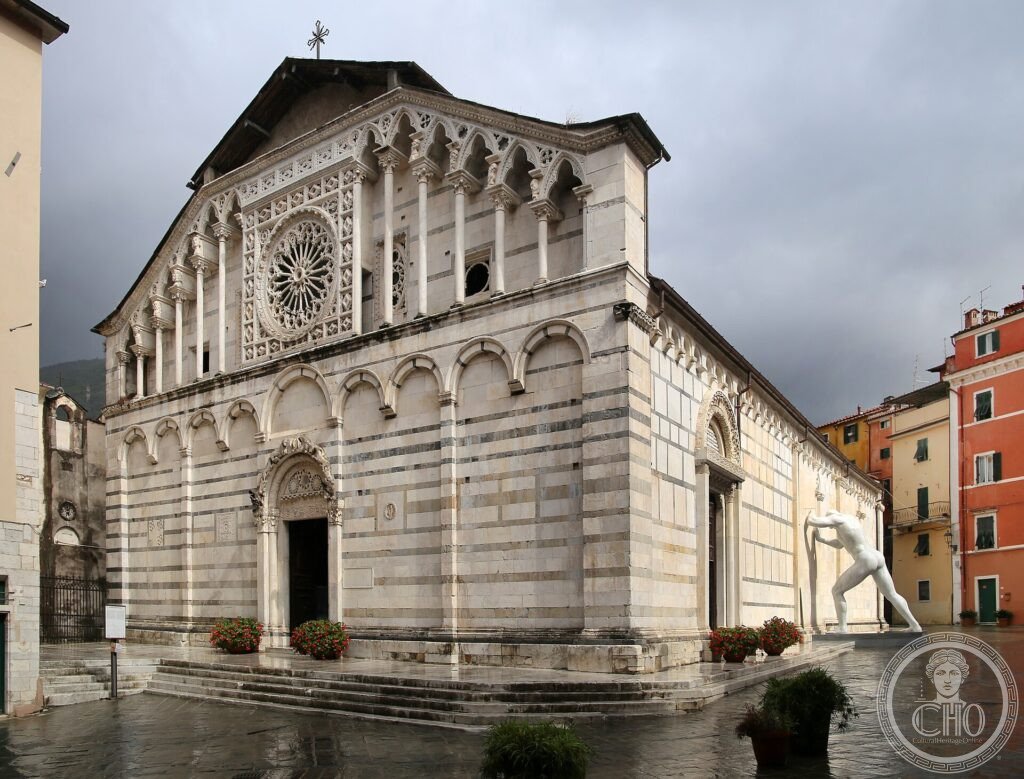
Costruito con il marmo delle cave vicine, il duomo di Carrara racconta tre secoli di cantiere: dal romanico lombardo al rosone gotico dei maestri pisani.
At a glance
The cathedral of Carrara, dedicated to Saint Andrew, is the first medieval building constructed entirely in Apuan marble — not only its decoration but its structural walls, columns, and even its bell tower are cut from the stone quarried in the hills above the town. A church on the site is attested before the year 1000: a document of 998 records the bishop of Luni officiating at the parish church of Sant’Andrea, and a notarial act of 1035 names the “Ecclesia Sancti Andree de Carraria.” Raised to a baptismal parish in 1093 and placed under the Augustinian canons of San Frediano of Lucca from 1151, the building grew over roughly three centuries in three distinct construction campaigns, ending with Pisan-trained masons who completed the upper facade and its rose window in the second half of the fourteenth century. The result is a building that shifts, as it rises, from Romanesque solidity to Gothic lightness.
Key facts
- Earliest record: 998, the bishop of Luni officiating at the parish church of Sant’Andrea; the building named in a notarial act of 1035.
- Elevated to baptismal parish: 1093; placed under the canons of San Frediano of Lucca from 1151, a status that gave Carrara a measure of civic autonomy.
- Three construction phases: the facade base and the San Giovanni side portal, with bicolored marble inlay recalling Pisa’s Piazza dei Miracoli, from the early twelfth century; the apse documented by 1235; the upper facade and rose window completed by Pisan craftsmen in the second half of the fourteenth century.
- Material: built entirely of Apuan marble, including the bell tower, continuing a Roman quarrying and construction tradition.
- Rose window: Gothic, with radiating colonnettes each individually carved, crowning the west portal.
- Artworks: a “Madonna with Child and Saints” (1460) by Andrea Guardi, a marble pulpit begun in 1541 by Domenico del Sarto and Mastro Nicodemo, and a fourteenth-century crucifix attributed to the Lucchese painter Angelo Puccinelli.
- Campanile: 33 meters tall, housing four historic bells, the largest cast in 1923.
History
A church dedicated to Saint Andrew stood in Carrara before the year 1000. A document of 998 records the bishop of Luni — the diocese that then governed this stretch of coast — officiating at the parish church, and a notarial act of 1035 names it explicitly as the “Ecclesia Sancti Andree de Carraria.” The church was raised to a baptismal parish in 1093, and from 1151 it came under the jurisdiction of the Augustinian canons of San Frediano in Lucca, a change that granted the town a degree of autonomy unusual for the period.
Construction proceeded in three long phases spanning nearly three centuries. The first, in the early twelfth century, produced the lower facade and the side portal dedicated to San Giovanni, decorated with bicolored marble inlay in a style that echoes the cathedral complex of Pisa. A second campaign had reached the apse by 1235. The third and final phase, carried out in the second half of the fourteenth century by masons trained in the Pisan tradition, completed the upper facade with its rose window and loggia of carved busts.
Because the church was built and rebuilt using local marble as both structure and ornament, later restoration work — notably a campaign in 1947–48, continued through 1992 — has focused on returning the fabric toward its medieval appearance rather than adding new material.
What you see
What sets this cathedral apart is its material: this is a building made of marble, not merely faced with it. The lower registers of the facade carry the same bicolored geometric marble inlay found in Pisa’s Piazza dei Miracoli, evidence of the shared visual language between the two cities in the twelfth century. Above this Romanesque base, the fourteenth-century Pisan masons introduced a different vocabulary: a Gothic rose window with individually carved radiating colonnettes, no two identical, and a loggia lined with sculpted busts above the capitals.
Inside, three naves divided by columns and pillars of varied styles and capitals lead to a semicircular apse; the central nave keeps its exposed wooden roof trusses while the side aisles are cross-vaulted. The marble pulpit, begun in 1541 by Domenico del Sarto and Mastro Nicodemo, and Andrea Guardi’s 1460 “Madonna with Child and Saints” anchor an interior where structure and sculpture are cut from the same quarries visible from the piazza outside.
Practical information
- Guided tours are available by arrangement through the cathedral’s own booking service.
- The cathedral also hosts concerts and public events; check ahead if visiting around a scheduled event.
- Address: Piazza Duomo, 54033 Carrara. Contact: +39 333 8249350 / +39 0585 71942, info@duomodicarrara.it.
- Allow 20–30 minutes for the interior and facade.
Getting there
Carrara’s historic center, largely closed to cars, sits inland from the marble-quarrying valleys above the Tyrrhenian coast. The Carrara-Avenza railway station, on the Genoa–Pisa line, is about 4 km from the center; local buses cover the connection in around 13 minutes. The nearest airport is Pisa (about 55 km south). GPS: 44.0800, 10.0994.
Nearby
- Duomo di Massa (San Pietro e Francesco) (about 7 km) — the neighboring city’s cathedral, with its twentieth-century white marble facade.
- Cave di marmo di Carrara (Fantiscritti) — the marble quarries a few kilometers up the Carrione valley that supplied the cathedral’s stone and still operate today.
- Accademia di Belle Arti di Carrara — the historic marble-sculpture academy in the city center, a short walk from the Duomo.
Sources
- Wikipedia (Italian), “Duomo di Carrara”
- duomodicarrara.it, official cathedral website
- OpenStreetMap / Nominatim, geocoding verification
Find it on the map
See this place and what’s around it →📷 Become a Cultural Heritage Online photographer
Share your photos of places: they stay published under your name as the author. The more they're seen, the more you get noticed — and soon a contest will reward the most appreciated photos.
Log in or sign up free to add a photoIs this page about you?
This page is read by travellers and heritage enthusiasts who find it on Google. Tell us how you are connected to this place and we will take it from there.