
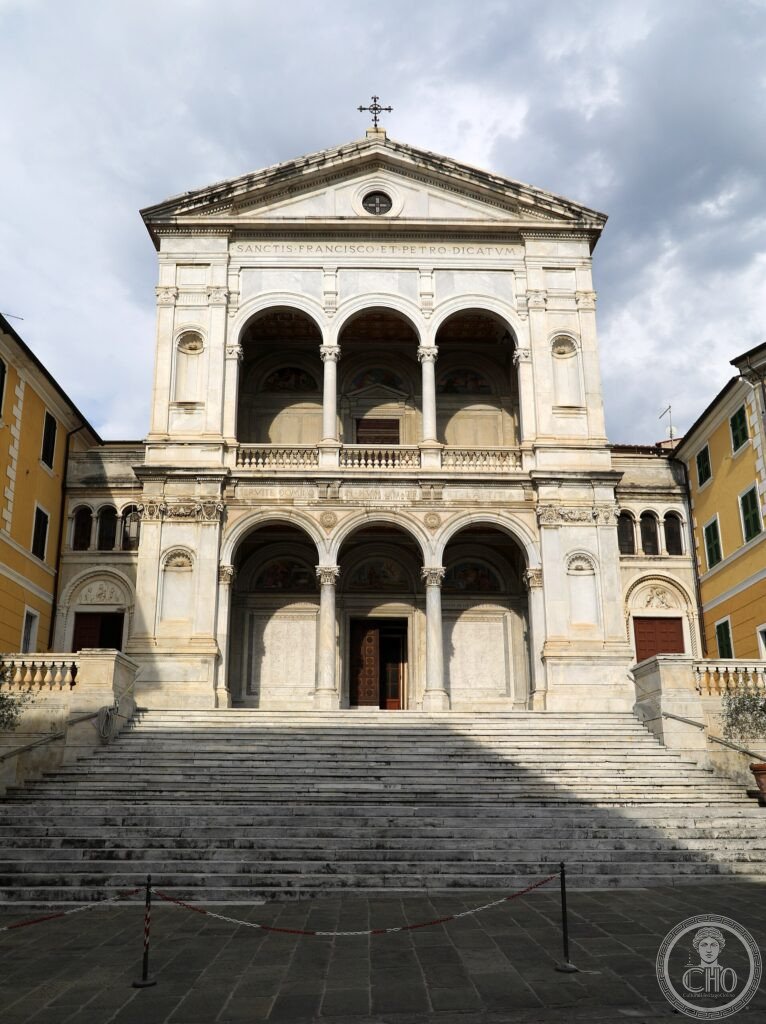
Begun as the church of the Friars Minor commissioned by the Malaspina, the cathedral of Massa still carries its double dedication to Saint Peter and Saint Francis, the memory of two churches merged into a single cathedral.
At a glance
The cathedral of Massa carries a double dedication, to Saint Peter the Apostle and Saint Francis of Assisi, that records the fusion of two separate churches into one. Its origin lies in a Franciscan convent, licensed by Pope Pius II in 1460 for Taddea Pico della Mirandola of the ruling Malaspina family, with construction of the convent church of San Francesco documented from 1477. In 1807, Elisa Baciocchi — Napoleon’s sister, then ruler of the Duchy of Massa and Carrara — suppressed the older cathedral of San Pietro, transferring its parish status to San Francesco. Massa became a diocese in its own right in 1822, making the Franciscan church its cathedral. Behind a white marble facade completed only in 1936, the interior preserves furnishings and paintings spanning four centuries, and in 1964 the building was raised to the rank of minor basilica.
Key facts
- Franciscan origin: convent licensed by Pope Pius II in 1460 for Taddea Pico della Mirandola; the church of San Francesco documented under construction by 1477.
- Double dedication: to San Pietro Apostolo and San Francesco d’Assisi, after the 1807 suppression of the old cathedral of San Pietro folded its title into this church.
- Diocese founded: 1822, when Massa became a bishop’s seat and this church its cathedral.
- Presbytery remodeled: 1837, by architect Giuseppe Marchelli, who extended and raised the apse.
- Marble facade: built 1927–1936 to a design by architect Cesario Fellini, with mosaics by Venetian mosaicist Giulio Castaman.
- Minor basilica: title conferred by papal brief on 18 November 1964.
- Artworks: a Byzantine-style wooden crucifix brought from Luni in the early thirteenth century, a devotional panel attributed to the Umbrian painter Pinturicchio, and canvases by Carlo Maratta and Giacomo Grandi.
History
The cathedral’s origin lies not in a bishop’s church but in a Franciscan convent. In 1460, Pope Pius II authorized Taddea Pico della Mirandola, of the Malaspina family that ruled Massa, to establish a convent for the Observant Friars Minor; the church of San Francesco that served it is attested under construction by 1477, absorbing the titles and endowments of a suppressed convent at Turano.
Storm damage around 1650 prompted an enlargement of the church, and between roughly 1660 and 1670 a substantial reconstruction was carried out under Giovanni Francesco Bergamini and his son Alessandro, commissioned by Duke Alberico II Cybo-Malaspina. From 1687, the Cybo-Malaspina family chapel was added and redesigned with polychrome marble, a project connected to the Lucca-based architect Domenico Martinelli, who worked within Carlo Fontana’s Roman circle.
The building’s status changed decisively in the early nineteenth century. In 1807, Elisa Baciocchi suppressed the older cathedral of San Pietro; its parish rights passed to San Francesco, which thereafter carried both dedications. When Pope Pius VII made Massa a diocese in 1822, this double-titled church became its cathedral. The presbytery was extended in 1837 under architect Giuseppe Marchelli, and between 1927 and 1936 the building finally received its present white marble facade, designed by Cesario Fellini with mosaics by Giulio Castaman. In 1964, the cathedral was elevated to the rank of minor basilica.
What you see
The white marble facade, finished only in 1936, is a twentieth-century addition to a much older building — its clean Novecento lines and mosaic decoration by Giulio Castaman contrast deliberately with the Baroque richness inside. The most consistent architectural presence throughout the interior is marble itself, worked in different centuries: from Marchelli’s nineteenth-century presbytery extension to the polychrome marble of the Cybo-Malaspina chapel, begun in 1687 under Domenico Martinelli’s direction.
Among the furnishings, the Byzantine-style wooden crucifix transferred from Luni in the early thirteenth century is the oldest object in the church, predating the Franciscan foundation itself by two centuries. It stands alongside later paintings — Carlo Maratta’s “Immacolata Concezione,” Giacomo Grandi’s “Adorazione dei Magi,” and a devotional panel attributed to Pinturicchio — that together trace the building’s slow accumulation of art across the centuries it has served the Malaspina and Cybo-Malaspina rulers of Massa.
Practical information
- Mass times: Monday–Saturday 6:30 pm (Stimmate Chapel); Sunday 10:30 am and 6:30 pm, with Vespers at 6:00 pm.
- Admission is free; the cathedral is best visited outside Mass times for a quiet look at the interior.
- Address: Piazza Duomo 1, 54100 Massa. Contact: +39 0585 810735.
- Allow 20–30 minutes for the interior and facade.
Getting there
Massa’s historic center sits inland from the Tyrrhenian coast, in northern Tuscany at the foot of the Apuan Alps. The Massa Centro railway station, on the Genoa–Pisa line, is about a 20-minute walk from the Duomo, which stands beside Piazza degli Aranci and the Palazzo Ducale in the heart of the old town; local buses and taxis also connect the station to the center. The nearest airport is Pisa (about 40 km south). GPS: 44.0380, 10.1443.
Nearby
- Palazzo Ducale di Massa — the Cybo-Malaspina family’s residence, a short walk from the cathedral in the same historic center.
- Duomo di Carrara (Sant’Andrea) (about 7 km) — the Romanesque-Gothic marble cathedral of the neighboring city.
- Rocca Malaspina — the hilltop castle overlooking Massa’s old town, seat of the family before the ducal palace was built below.
Sources
- Wikipedia (Italian), “Duomo di Massa”
- duomodimassa.it, official cathedral website, “Cattedrale” page
- OpenStreetMap / Nominatim, geocoding verification
Find it on the map
See this place and what’s around it →📷 Become a Cultural Heritage Online photographer
Share your photos of places: they stay published under your name as the author. The more they're seen, the more you get noticed — and soon a contest will reward the most appreciated photos.
Log in or sign up free to add a photoIs this page about you?
This page is read by travellers and heritage enthusiasts who find it on Google. Tell us how you are connected to this place and we will take it from there.