
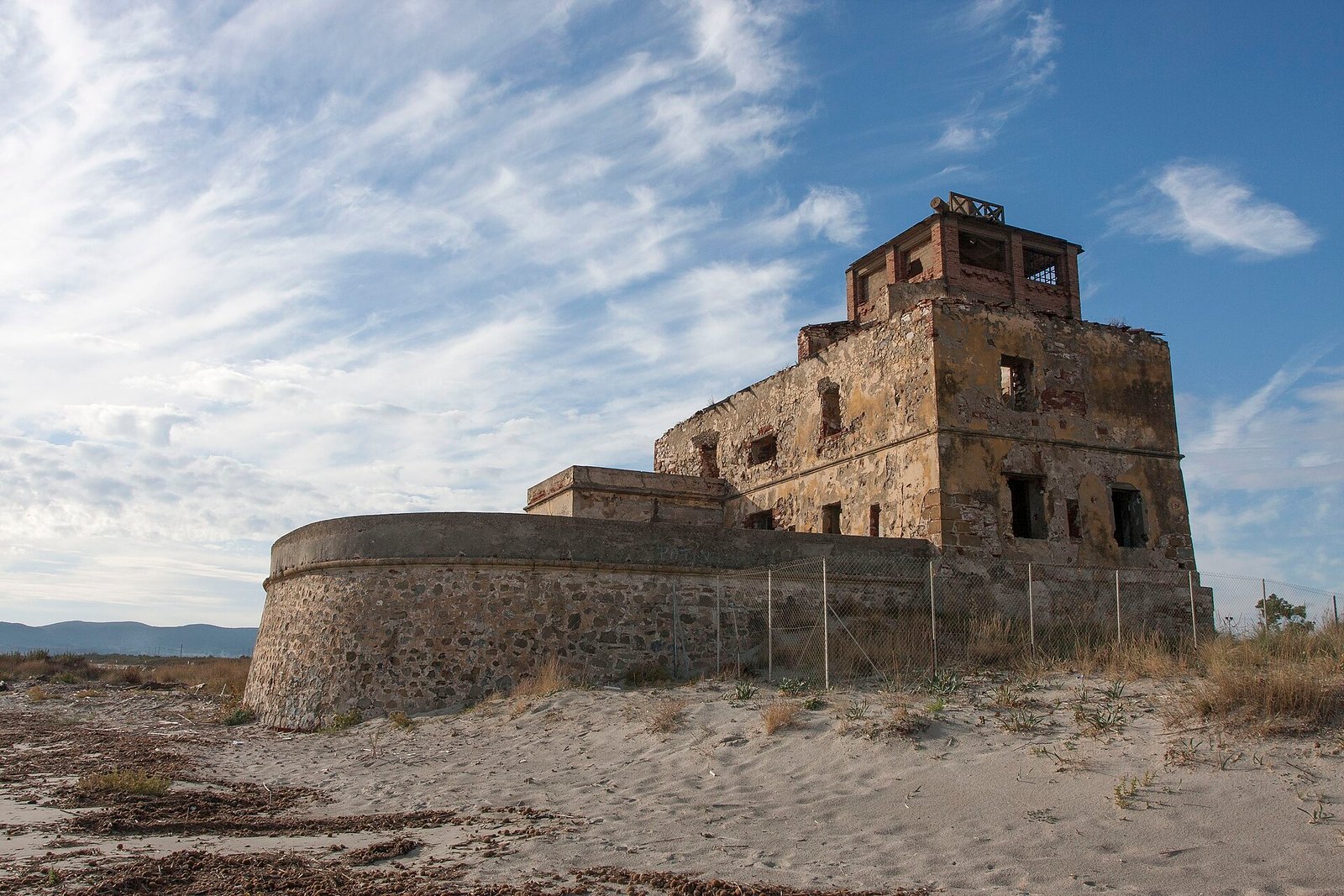
The Salt Tower (Torre del Sale) is a medieval defensive tower on the Tuscan coast of Italy, built to guard the strategically vital salt trade routes that linked the Tyrrhenian Sea to the interior of the peninsula. Salt was among the most prized commodities of the medieval economy, and coastal towers like this one served both as watchtowers against maritime threats and as checkpoints for the taxed transit of salt convoys. The tower stands as a rare surviving witness to the administrative and military infrastructure that underpinned the salt economy of medieval Tuscany.
At a glance
- Type
- Medieval defensive tower
- Period
- Medieval (approximate construction 12th–14th century)
- Style
- Tuscan medieval military architecture
- Location
- Tuscany, Italy
- Coordinates
- 42.9546° N, 10.5900° E
Overview
The Salt Tower is a tower built along the Tuscan coast to oversee the collection and transit of salt — one of the most economically significant commodities of the medieval world. It stands in a coastal Tuscan landscape shaped by the ancient saltpans and trade routes that fed the economies of the Italian city-states. The structure is part of a wider network of coastal watchtowers erected across Tuscany during the medieval and early modern periods to defend against both piracy and fiscal evasion of the salt tax.
History
Salt extraction and trade in Tuscany dates back to antiquity, but it was during the medieval period that coastal fortifications became essential tools of fiscal control. Powerful city-states and lordships imposed heavy duties on salt, making the commodity a critical source of public revenue. Towers such as this one were positioned at landing points and transit nodes to ensure that salt cargoes were registered and taxed before moving inland. Over the following centuries the tower passed through various hands as political control of the Tuscan coast shifted between local powers, Aragonese and later Medici influence.
What you see
The tower presents the characteristic compact silhouette of Tuscan coastal military architecture: thick masonry walls built from local stone, narrow apertures designed to provide defensive cover, and a commanding position relative to the surrounding coastline. The exterior stonework retains evidence of different construction and repair phases across the medieval and early modern periods. The surrounding landscape of Tuscan macchia and sea views provides important visual context for understanding the tower’s strategic significance.
Cultural significance
The Salt Tower represents the intersection of economic history, military architecture, and landscape heritage in coastal Tuscany. Salt towers and associated infrastructure were essential to the functioning of medieval Italian economies, and surviving examples form an important, if underappreciated, component of the region’s built heritage. The tower speaks to the deep entanglement of natural resources, taxation, and political power in the pre-modern Mediterranean world.
Practical information
The tower is located in Tuscany, Italy, near the Tyrrhenian coast. Access and visiting arrangements may vary; check local tourism resources or the nearest municipal authority for current opening conditions. Entry to the exterior area may be possible year-round during daylight hours.
Getting there
The site is accessible by car from the main coastal roads of Tuscany (Via Aurelia, SS1). The nearest railway stations are served by Trenitalia’s coastal line running between Livorno and Grosseto. Local bus services connect coastal towns; check with regional transport operator CTT Nord or Tiemme for timetables. Given the rural coastal setting, a private vehicle is recommended for the final approach.
Sources & resources
See the place
Find it on the map
See this place and what’s around it →📷 Become a Cultural Heritage Online photographer
Share your photos of places: they stay published under your name as the author. The more they're seen, the more you get noticed — and soon a contest will reward the most appreciated photos.
Log in or sign up free to add a photo