
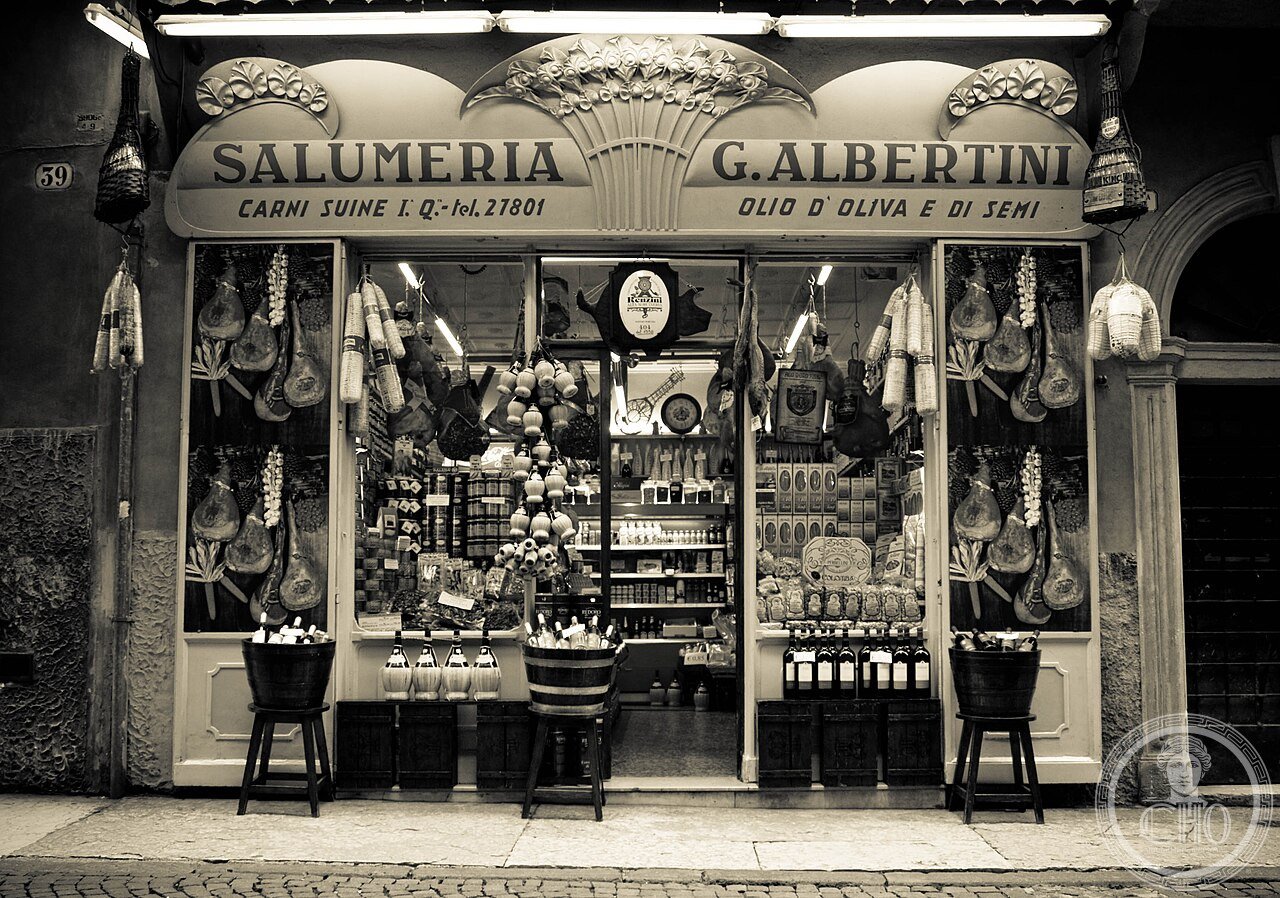
Ancient Delicatessen Albertini is a historic food shop in Verona, representing the long tradition of Italian salumerie and alimentari that served as the backbone of neighbourhood provisioning for centuries. Operating in a city renowned since Roman times for the quality of its agricultural hinterland and the diversity of its markets, the Albertini delicatessen embodies a continuity of craft food culture connecting contemporary Verona to its deep gastronomic heritage. Such establishments function both as commercial food retailers and as living repositories of culinary knowledge — artisanal salumi, aged cheeses, local wines, and preserved goods whose production methods have changed little across generations.
At a glance
- Type
- Historic delicatessen — traditional food merchant
- Period
- Established in the historic commercial tradition of Veronese food culture
- Style
- Traditional Italian salumeria and alimentari
- Location
- Verona, Province of Verona, Veneto, Italy
- Coordinates
- 45.4446° N, 10.9988° E
Overview
Verona’s food culture is rooted in the fertile agricultural plain of the Po Valley and the wine-producing hills of the Valpolicella, Soave, and Bardolino — names recognised worldwide as benchmarks of Italian viticulture. The city’s historic markets, including the medieval Piazza delle Erbe, have traded in fresh produce, cured meats, and imported goods for over a thousand years. Within this context, the ancient delicatessen occupies a central role: it is where the knowledge of producers, the expertise of the merchant, and the preferences of the local community converge in daily transaction.
History
The tradition of the salumeria in northern Italy developed alongside the rise of cured meat production — prosciutto, salame, soppressa, and mortadella — that became defining features of the regional food economy from the late medieval period onward. Verona, positioned on major trade and military routes, attracted merchants who supplied not only local residents but armies, travellers, and aristocratic households. Family-run alimentari such as Albertini represent the artisanal descendant of this tradition, accumulating over decades a store of knowledge about provenance, ageing, and seasonal availability that distinguishes them from modern retail.
What you see
A traditional Veronese delicatessen typically offers a counter laden with local salumi — soppressa veronese, Monte Veronese cheese, Grana Padano, and seasonal specialities — alongside shelves of Valpolicella, Amarone, and Custoza wines. The shop interior often retains period fittings: marble counters, glazed ceramic tiles, wooden display cases, and the characteristic scent of aged cheese and cured meat that signals an establishment operating with genuine craft commitment. Staff expertise — knowing the producer, the ageing time, the ideal pairing — is the intangible asset that distinguishes such a place from a supermarket.
Cultural significance
Historic delicatessens are increasingly recognised as cultural heritage sites in Italy, as industrialisation and retail consolidation have reduced their number dramatically. Establishments with long histories in city centres preserve not only products but knowledge systems — the understanding of seasonal cycles, artisanal producers, and regional specificity that underpins Italian gastronomic identity. Supporting such shops is an act of cultural conservation as meaningful as visiting a museum.
Practical information
- Location
- Verona, Province of Verona, Veneto, Italy
- Note
- Traditional delicatessens in Italy often close for the afternoon riposo (1:00–4:00 pm) and on Sunday afternoons
Getting there
Verona is served by Verona Porta Nuova railway station, with frequent Trenitalia and Italo connections to Venice (70 min), Milan (90 min), and Bologna (60 min). The historic centre where traditional food shops cluster is a 20-minute walk from the station or reachable by bus. By car, Verona sits at the junction of the A4 (Milan–Venice) and A22 (Brenner–Modena) motorways; parking in the ZTL-restricted historic centre requires a permit.
Sources & resources
See the place
Find it on the map
See this place and what’s around it →📷 Become a Cultural Heritage Online photographer
Share your photos of places: they stay published under your name as the author. The more they're seen, the more you get noticed — and soon a contest will reward the most appreciated photos.
Log in or sign up free to add a photoIs this page about you?
This page is read by travellers and heritage enthusiasts who find it on Google. Tell us how you are connected to this place and we will take it from there.