
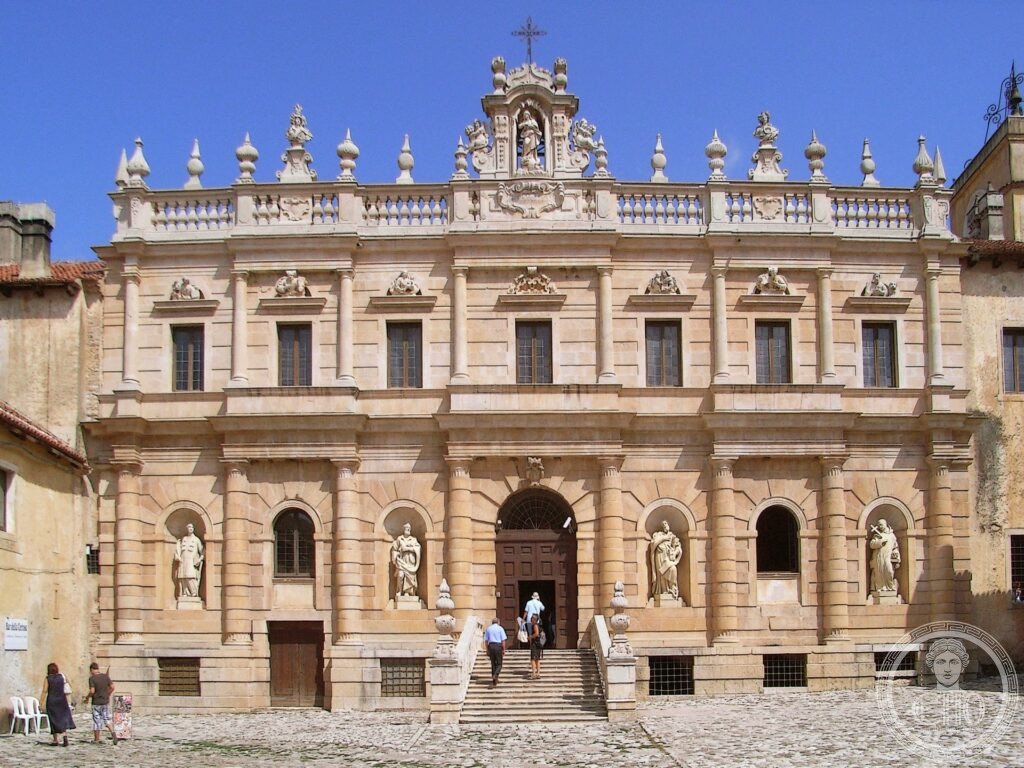
The Charterhouse of San Lorenzo (Certosa di San Lorenzo) at Padula is one of the largest monastic complexes in Italy and Europe, a Carthusian foundation begun in 1306 by Tommaso Sanseverino that expanded over four centuries into a sprawling baroque ensemble covering approximately 50,000 square metres. Its cloister — the Gran Chiostro — measures roughly 150 by 100 metres, making it one of the largest monastery courtyards in the world, flanked by 84 monk’s cells arranged around a formal garden. The charterhouse was inscribed as a UNESCO World Heritage Site in 1998 as part of the “Cilento, Vallo di Diano and Alburni” nomination and offers 360-degree virtual tours of its principal spaces.
At a glance
- Type
- Carthusian charterhouse (certosa); museum complex
- Period
- Founded 1306; major Baroque reconstruction 17th–18th century
- Style
- Gothic origins; predominantly Baroque; Rococo decorative interiors
- Location
- Padula, Province of Salerno, Campania, Italy
- Coordinates
- 40.3357° N, 15.6519° E
- UNESCO Status
- World Heritage Site (1998) — “Cilento, Vallo di Diano and Alburni”
Overview
The Certosa di San Lorenzo at Padula is the largest charterhouse in Italy and one of the grandest monastic complexes in Europe, its white baroque facades rising dramatically from the flat floor of the Vallo di Diano. Founded in the early 14th century, the charterhouse grew across four hundred years of continuous patronage into a city within a city, complete with workshops, gardens, a pharmacy, a library, and an elaborate system of hydraulic works. Today managed as a state museum, it receives visitors from across Italy and abroad drawn by its sheer scale and the richness of its decorated interiors.
History
Tommaso Sanseverino, Count of Marsico, founded the charterhouse in 1306 and endowed it generously, establishing a Carthusian community that would occupy the site without interruption for nearly five centuries. The original Gothic structures were progressively replaced or encased during a massive Baroque expansion begun in the 17th century under the direction of a succession of architects, culminating in the early 18th century remodelling of the church, the grand staircase, and the ceremonial apartments. Napoleon’s 1807 suppression of religious orders ended monastic life; the complex subsequently served as a military barracks and prison before passing to the Italian state in the late 19th century. Restoration programmes since the 1970s have progressively reopened the spaces to visitors.
What you see
The Gran Chiostro — the great cloister — is the overwhelming centrepiece: an elliptical-arched baroque loggia enclosing 84 identical monk’s cells, each with its own walled garden, arranged around a vast geometrically planted garden with a central fountain. The church retains its Baroque decorative programme of carved wood choir stalls, marble altars, and gilded surfaces, while the sacristy and chapter house display refined Rococo detailing. A monumental double staircase — among the most theatrical in southern Italian Baroque architecture — leads from the lower convent to the upper residential quarters. The museum collections include archaeological material from the Vallo di Diano, paintings, and applied arts accumulated over the centuries of monastic patronage.
Cultural significance
The Certosa di San Lorenzo is a defining monument of southern Italian Baroque and one of the few monastic complexes in Italy that has survived sufficiently intact to convey the spatial and social totality of Carthusian life. Its UNESCO inscription in 1998 — alongside the ancient Greek ruins of Paestum and the Cilento landscape — recognises it as part of a cultural landscape of exceptional universal value, representing the intersection of Greek, Roman, and medieval heritage in a single continuous territory.
Practical information
- Address
- Via Roma 1, 84034 Padula SA
- Admission
- State museum ticket; reduced rates for EU citizens 18–25; free for EU citizens under 18 and over 65 (subject to change — verify on site)
- Virtual tour
- 360° virtual tour available online via the official portal
Getting there
Padula is accessible by car from the A3 Salerno–Reggio Calabria motorway; exit at Padula/Buonabitacolo (approximately 100 km south of Salerno) and follow signs to the certosa, which is visible from the valley floor. The nearest rail station is Buonabitacolo–Padula on the Salerno–Reggio Calabria line; from there a taxi or local bus connects to the charterhouse entrance. Coach tours from Naples and Salerno also serve the site regularly.
Sources & resources
See the place
Find it on the map
See this place and what’s around it →Historical events at this place (1)
📷 Become a Cultural Heritage Online photographer
Share your photos of places: they stay published under your name as the author. The more they're seen, the more you get noticed — and soon a contest will reward the most appreciated photos.
Log in or sign up free to add a photoIs this page about you?
This page is read by travellers and heritage enthusiasts who find it on Google. Tell us how you are connected to this place and we will take it from there.