
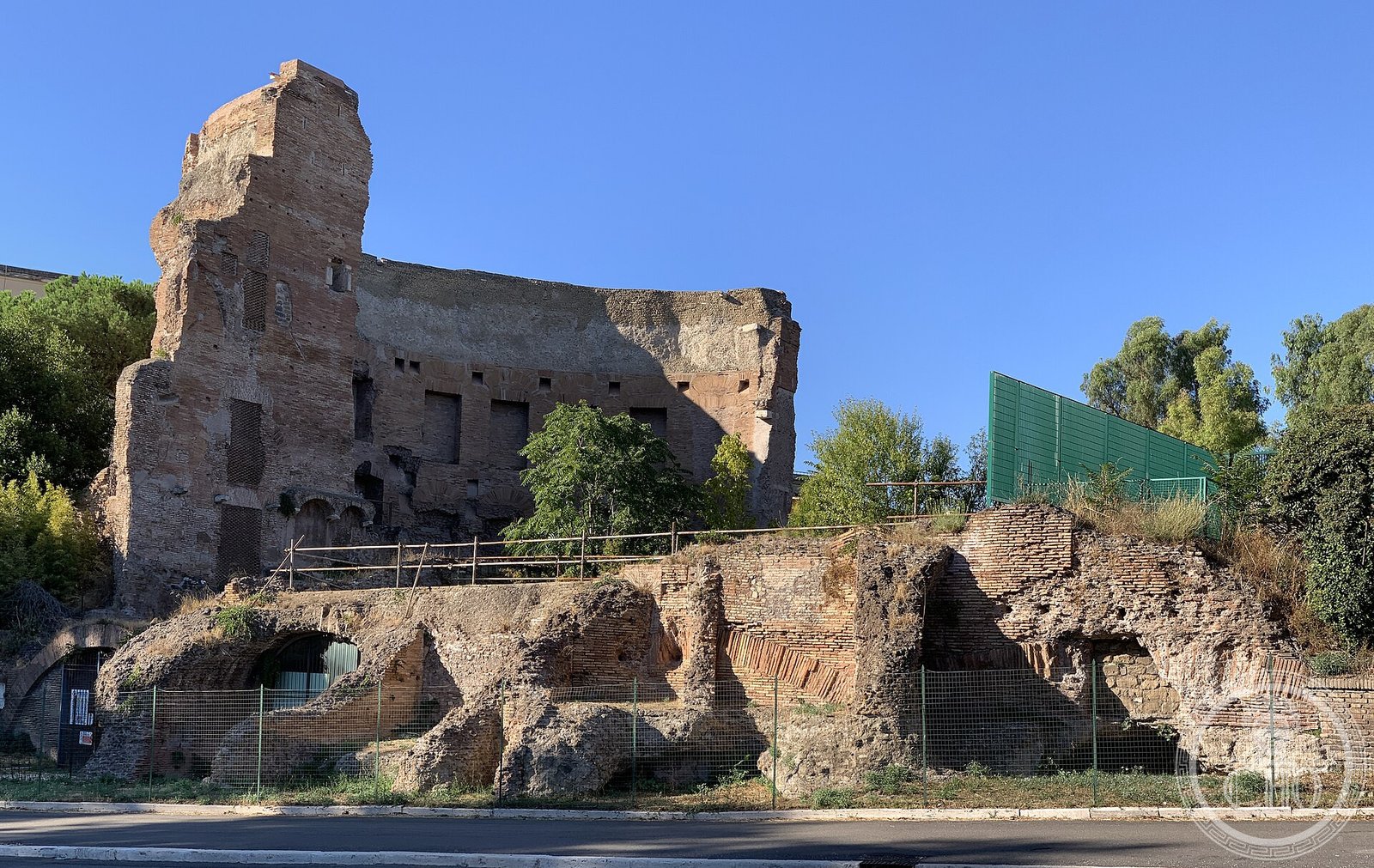
The Caelian Hill (Celio) and the adjacent Oppius spur together form one of the most layered archaeological districts of Rome, lying immediately south-east of the Colosseum. The Caelian is one of the canonical Seven Hills of Rome, densely settled from the regal period onward with aristocratic villas, temples and early Christian basilicas; the Oppius, a northern extension of the Esquiline, is best known for sheltering Nero’s Domus Aurea and the public Baths of Trajan built over it. Together the two elevations offer an unbroken walk through twelve centuries of Roman urban history, from the Servian Wall to the medieval tituli churches.
At a glance
- Type
- Archaeological and heritage landscape (two urban hills)
- Period
- Regal period (8th century BC) to medieval
- Style
- Multiple: Republican, Imperial Roman, Early Christian, Medieval
- Location
- Rione Celio / Esquilino, Roma, Italy
- Coordinates
- 41.8925° N, 12.4939° E
- Key monuments
- Santi Giovanni e Paolo, Santo Stefano Rotondo, Domus Aurea, Baths of Trajan, Temple of Claudius (podium)
- Current use
- Public park, active churches, archaeological sites (Domus Aurea by reservation)
Overview
The Caelian Hill was inhabited from at least the 8th century BC and was enclosed within the Servian Wall. In the imperial period it became a fashionable residential district for the senatorial aristocracy, whose great houses later provided the foundations for the earliest Christian places of worship in the city. The Oppius spur to the north became synonymous with imperial excess under Nero, whose vast Domus Aurea covered much of its slope before Vespasian and Trajan buried it under new baths and public works. Today, the combined green zone of the Celio-Oppius park is a rare open space in central Rome where ancient remains surface between umbrella pines and ilex groves.
History
According to Roman tradition the Caelian was incorporated into the city by King Tullus Hostilius after the destruction of Alba Longa. Republican-era records mention several important shrines and the residences of leading families. Following the Great Fire of 64 AD, Nero seized much of the Oppius for his Domus Aurea, a palace-landscape complex of unprecedented scale; after his death Vespasian opened the site’s lake as the Colosseum’s foundation and Trajan later capped the Domus Aurea’s vaults with the Baths of Trajan (dedicated 109 AD). On the Caelian, the senatorial house of the Valerii and the praetorian barracks gave way to tituli churches — Santi Giovanni e Paolo, Santo Stefano Rotondo, Santi Quattro Coronati — that survive as functioning parishes to this day.
What you see
Visitors moving through the Celio-Oppius area encounter an extraordinary density of superimposed remains. At Santi Giovanni e Paolo the 4th-century house-church sits above a Roman insula visible through the floor; adjacent is the temple podium of Claudius, converted into a garden terrace of the Celimontana Villa. Santo Stefano Rotondo, a rare circular Early Christian basilica of the 5th century, still preserves vivid 16th-century frescoes of martyrdoms. On the Oppius, the Domus Aurea is accessible by guided tour (advance booking required), revealing painted vaulted corridors that directly inspired Renaissance artists including Raphael and Pinturicchio. The Baths of Trajan above are visible as massive brick ruins in the public park.
Cultural significance
The Caelian and Oppius together represent the palimpsest quality that defines Rome as a heritage city: each successive civilisation — Republican, Imperial, Early Christian, Medieval — built directly upon and within its predecessor’s fabric. The Domus Aurea’s grotesque vault paintings were the direct source of the “grotesque” decorative vocabulary that swept through Renaissance Europe after their rediscovery in the 1480s, making this hill’s influence felt from Raphael’s Vatican Logge to the ceilings of English country houses.
Practical information
- Area
- Rione Celio and Esquilino, central Rome
- Domus Aurea
- Guided tours by advance reservation only; check Coopculture website for tickets and dates
- Churches
- Santi Giovanni e Paolo, Santo Stefano Rotondo, Santi Quattro Coronati: generally open to visitors, check individual hours
- Park
- Villa Celimontana park open daily (hours vary by season)
Getting there
The area is a 10-minute walk south-east of the Colosseo metro station (Line B). Bus lines 3 and 117 serve the Celio; tram 3 stops at Piazza del Colosseo. The area is entirely walkable from the Colosseum, the Palatine Hill, and the Circus Maximus, making it a natural extension of any tour of Rome’s ancient centre.
Sources & resources
- Caelian Hill — Wikipedia
- Domus Aurea — Wikipedia
- Cultural Heritage Online — Italy travel guides and heritage places
See the place
Find it on the map
See this place and what’s around it →Historical events at this place (4)
📷 Become a Cultural Heritage Online photographer
Share your photos of places: they stay published under your name as the author. The more they're seen, the more you get noticed — and soon a contest will reward the most appreciated photos.
Log in or sign up free to add a photo