
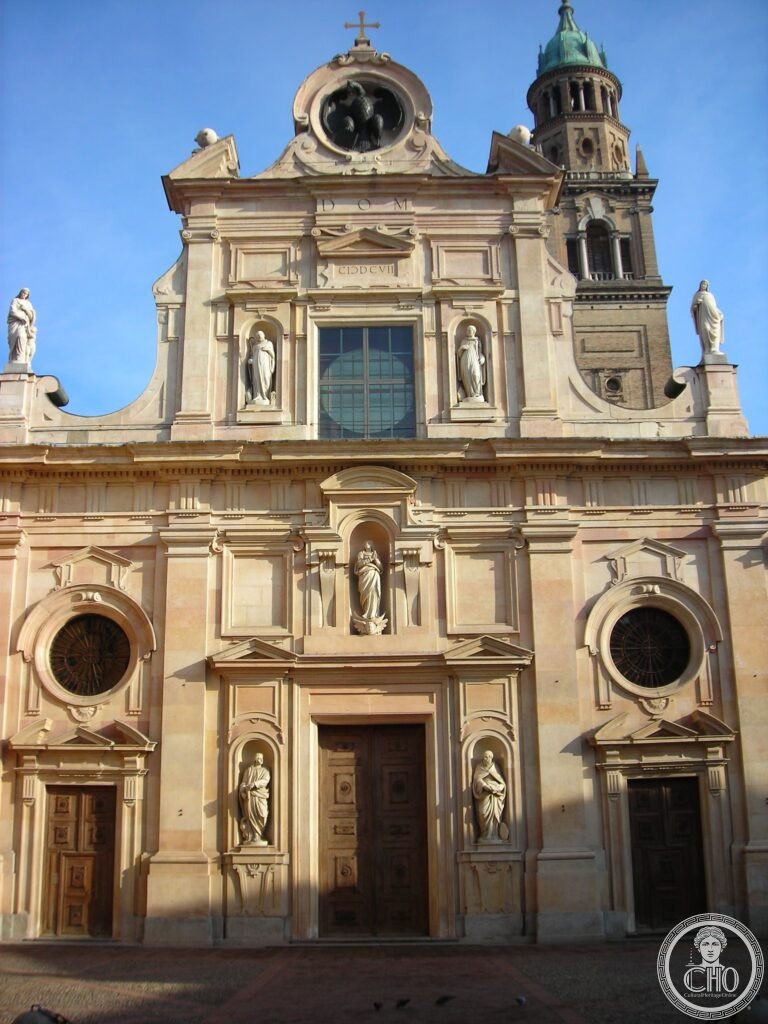
San Giovanni Evangelista is a Mannerist-style Roman Catholic church and former Benedictine monastery complex on Piazzale San Giovanni, immediately behind the apse of Parma Cathedral in the historic centre of Parma. The church is celebrated above all for its remarkable ceiling frescoes by Antonio Allegri da Correggio, painted between 1520 and 1524, which established his reputation as one of the most innovative painters of the Italian Renaissance.
At a glance
- Type
- Roman Catholic conventual church and former Benedictine monastery
- Period
- Monastery founded in the 10th century; current church rebuilt from 1498; façade 1604–1607
- Style
- Mannerist; Late Renaissance interior; Baroque façade
- Location
- Piazzale San Giovanni, Parma, Emilia-Romagna, Italy
- Coordinates
- 44.8028° N, 10.3323° E
Overview
San Giovanni Evangelista stands as one of the most artistically significant religious buildings in Parma, forming part of the celebrated episcopal complex alongside the Cathedral and the Baptistery. The Benedictine monastery surrounding the church was a major centre of religious and intellectual life in the Emilia region for several centuries. Today the church and its famous frescoes draw scholars and visitors from across the world.
History
A Benedictine community was established on this site in the 10th century, and the monastery grew in importance throughout the medieval period. The present church building dates from a reconstruction begun in 1498, following earlier structures on the same ground. The distinctive Baroque façade was added between 1604 and 1607, while the interior retains the Mannerist spatial character of its late-15th-century rebuild. The monastery buildings that surround the church’s piazza have been partially repurposed over time, but the monastic cloister and pharmacy survive.
What you see
The interior is dominated by Correggio’s celebrated dome fresco depicting the Vision of Saint John the Evangelist on Patmos (c.1520–1524), a landmark in the development of illusionistic ceiling painting. Additional frescoes by Correggio and his workshop decorate the nave and side chapels. The church also contains works by Francesco Maria Rondani and Parmigianino. The adjacent apothecary — the Spezieria di San Giovanni — retains its original Renaissance furnishings and is open as a museum.
Cultural significance
San Giovanni Evangelista is a canonical stop on any serious study of Italian Renaissance painting, particularly the development of foreshortening and illusionistic dome decoration. Correggio’s frescoes here directly prefigure the great Baroque ceiling painting of the following century, influencing artists from Annibale Carracci to Giovanni Battista Tiepolo. Together with the Cathedral, the Baptistery, and the Camera di San Paolo, the complex forms one of Italy’s densest concentrations of early-16th-century painting in a single historic quarter.
Practical information
- Address
- Piazzale San Giovanni, 43121 Parma PR, Italy
- Opening hours
- Check official website or the Parma tourism office for current hours; the Spezieria museum has separate ticketing
- Admission
- Church entry is generally free; combined ticket for Spezieria and monastic areas available — check current prices locally
Getting there
The church is a short walk from Parma city centre and the main railway station (Parma FS), which has direct connections to Milan, Bologna, and Turin. On foot, follow Via Garibaldi east from the station towards the Cathedral; Piazzale San Giovanni is immediately behind the apse. Several city bus lines stop near the Cathedral square. Parking is available in the historic centre’s nearby public car parks.
Sources & resources
- San Giovanni Evangelista, Parma — Wikipedia
- Cultural Heritage Online — more Italian heritage destinations
See the place
Find it on the map
See this place and what’s around it →📷 Become a Cultural Heritage Online photographer
Share your photos of places: they stay published under your name as the author. The more they're seen, the more you get noticed — and soon a contest will reward the most appreciated photos.
Log in or sign up free to add a photo