
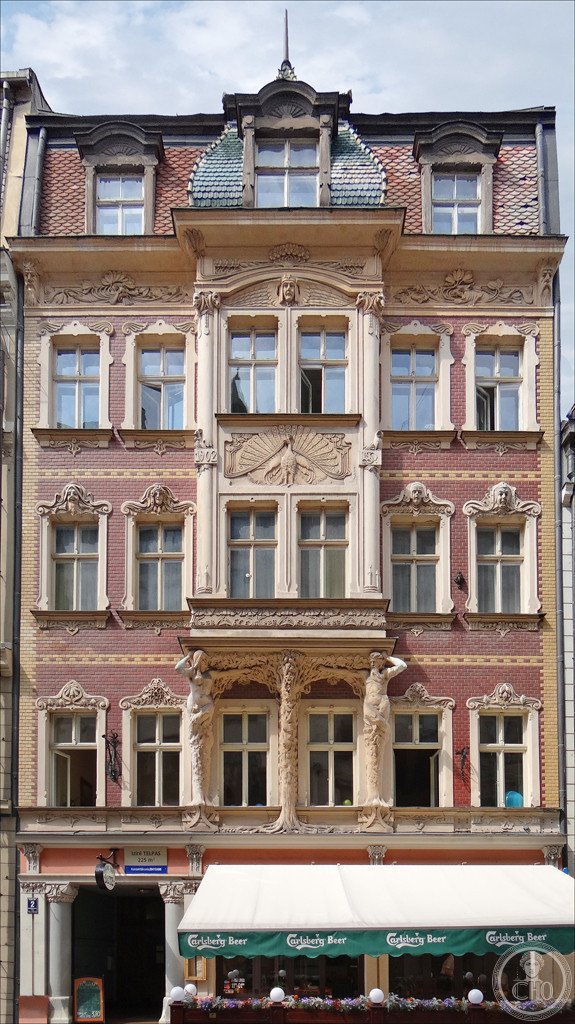
Riga — The World Capital of Art Nouveau
No city on earth preserved more Art Nouveau architecture than Riga: over 800 buildings, a UNESCO-listed historic centre, and a single street — Alberta iela — that concentrates the movement’s most dramatic sculptural facades within 500 metres.
At a glance
Between 1896 and 1914, Riga’s rapid industrialisation and a prosperous Baltic-German merchant class generated a building boom of extraordinary intensity. Architects trained in St Petersburg, Berlin and Helsinki poured Art Nouveau ornament into the city’s new apartment blocks, producing a concentration of the style unmatched in Vienna, Paris or Brussels. The facades of Alberta iela, Elizabetes iela and Strēlnieku iela display every register of the movement: the romantic-national variant with its Latvian folk motifs, the German Jugendstil with geometric precision, and the eclectic baroque of Mikhail Eisenstein’s heavily sculptured buildings. Riga’s historic centre was inscribed on the UNESCO World Heritage list in 1997, and the city has since developed one of Europe’s best Art Nouveau interpretation centres.
Key facts
- Country: Latvia
- Key period: 1896–1914 (Art Nouveau / Jugendstil)
- Key figure: Mikhail Eisenstein (1867–1920) — civil engineer and architect, father of film director Sergei Eisenstein; designed the most ornate buildings on Alberta iela
- Scale: over 800 Art Nouveau buildings in the historic centre — the highest concentration in the world
- UNESCO heritage: Historic Centre of Riga (World Heritage since 1997)
- Essential sites: Alberta iela (especially Nos. 2, 2a, 4, 6, 8, 13), Riga Art Nouveau Centre (Alberta iela 12), Elizabetes iela 10b
History
Riga entered the twentieth century as one of the Russian Empire’s most productive industrial cities — a Baltic port whose timber, flax and manufactured goods moved through a bourgeoisie of Baltic-German, Jewish and Latvian merchants. The prosperity generated a building market that architects filled rapidly with the new Art Nouveau idiom. Mikhail Osipovich Eisenstein, a civil engineer from St Petersburg appointed to Riga’s city administration, became the most prolific designer of the movement’s dramatic phase: his five buildings on Alberta iela (1903–1906) feature masks of ecstatic or terrified women, leonine keystones, writhing floral columns and coloured glass panels that make them the most theatrically sculptured facades in the Art Nouveau world.
Parallel to Eisenstein’s ornamental excess, Latvian architects trained in Germany and Finland were developing a more restrained national variant rooted in folk motifs and the rational Jugendstil lineage. Kostāntīns Pēkšēns and Eižens Laube designed buildings that wove Latvian sun crosses, amber patterns and oak-leaf friezes into the structural vocabulary — an architectural equivalent of the Latvian National Awakening that would lead to independence in 1918. The war years and Soviet occupation froze Riga’s development, inadvertently preserving the Art Nouveau district intact through the entire twentieth century.
What you see
Alberta iela is a ten-minute walk from the city centre and best approached from the park end (No. 13) working towards Strēlnieku iela. Eisenstein’s Alberta iela 4 (1904) is the most photographed: its six-storey facade combines a Medusa head at the apex, sphinxes flanking the entrance, screaming masks at window level and a lower register of elaborately carved foliage. No. 2a, by the same architect, is slightly more restrained but features a double-headed eagle and a large relief female figure.
The Riga Art Nouveau Centre at Alberta iela 12 occupies a building designed in 1903 by Kostāntīns Pēkšēns — who also used it as his own residence. The museum’s furnished rooms reconstruct a prosperous Riga apartment of 1903 with original wallpapers, tiled stoves, furniture and household objects; the guided tour (available in English) is the most efficient introduction to the period. Elizabetes iela 10b, three blocks south, is Eisenstein’s most restrained building and the one most cited for its coherent synthesis of structure and ornament.
Practical information
- Riga Art Nouveau Centre: open daily 10:00–18:00; booking at jgm.lv
- Alberta iela: freely accessible at all times; best light on the north-facing facades in morning
- Riga Card: covers public transport and museum admission
- Walking tours: guided Art Nouveau tours depart from the Tourist Information Centre, Ratslaukums 6; book in advance in summer
- Time needed: half-day for Alberta iela + Art Nouveau Centre; full day with Elizabetes and Strēlnieku districts
Getting there
Riga International Airport (RIX) is 13 km southwest of the centre; bus 22 reaches the old city in 30 minutes. The Art Nouveau district is a 20-minute walk from the central station or a 5-minute tram ride from the old city. Direct flights connect Riga to most major European cities; train connections from Tallinn (4h) and Vilnius (4h) operate daily. The Art Nouveau district lies immediately north of the Art Déco–era Esplanade park, within the “quiet centre” that UNESCO protects alongside the medieval old city.
Related in CHO
- Vienna — Capital of the Vienna Secession
- Brussels — Victor Horta and Art Nouveau Architecture
- Nancy — The École de Nancy and French Art Nouveau
Sources
Find it on the map
See this place and what’s around it →📷 Diventa un fotografo di Cultural Heritage Online
Condividi le tue foto dei luoghi: restano pubblicate con la tua firma come autore. Più vengono viste, più ti fai conoscere — e presto un concorso premierà le foto più apprezzate.
Accedi o registrati gratis per aggiungere una foto