
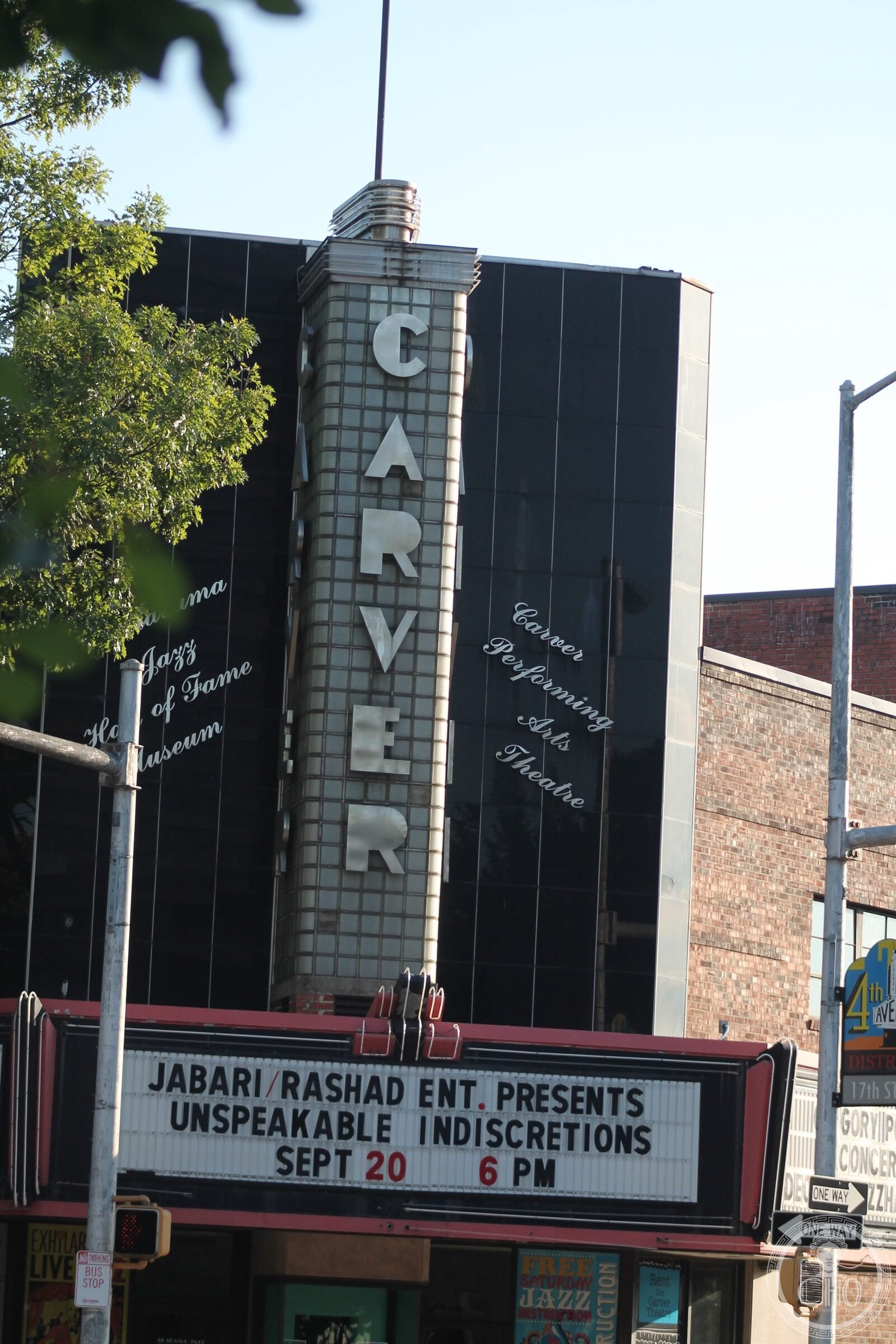
Named for the scientist who transformed Southern agriculture with ingenuity and patience, the Carver Theatre opened in 1935 as the cultural anchor of Birmingham’s African-American business district — an Art Deco landmark where music, film, and community flourished against the grain of Jim Crow.
At a glance
The Carver Theatre stands on 4th Avenue North in what was once called Birmingham’s “Colored Business District” — a six-block corridor of Black-owned banks, insurance companies, barbershops, and entertainment venues that served as an economic and cultural refuge during the era of legal segregation. Built in 1935 in a clean Art Deco idiom and named for George Washington Carver, the theater presented African-American performers who could not appear in the city’s white-only venues. The 4th Avenue corridor later became part of the fabric of Birmingham’s civil rights movement. After decades of decline and urban-renewal damage, the Carver has been restored as a performing arts center, and the 4th Avenue Historic District is now recognized on the National Register of Historic Places as a record of Black commercial life under segregation.
Key facts
- Address: 1631 4th Avenue North, Birmingham, AL 35203
- Completed: 1935
- Style: Art Deco commercial theater
- Named for: George Washington Carver (1864–1943), agricultural scientist and educator
- District: 4th Avenue Historic District, Birmingham
- Designation: National Register of Historic Places (as contributing structure)
- Current use: Performing arts center and cultural venue
History
Birmingham in the 1930s was one of the most rigidly segregated cities in the South. The 4th Avenue North corridor emerged as a response: a concentrated district of Black-owned businesses that provided services, employment, and cultural life independent of the white commercial city. At its peak, 4th Avenue was home to the Pythian Temple, the American Mutual Savings Bank, a constellation of barbershops and beauty parlors, and a series of entertainment venues including the Carver Theatre, which opened in 1935.
The Carver served as a showcase for African-American performing arts at a time when Black artists — regardless of national fame — could not perform in Birmingham’s white-only venues or stay in its white-only hotels. Jazz, blues, and gospel performers played the Carver and the surrounding 4th Avenue clubs, sustaining a musical culture that fed into the broader story of American popular music. The district became part of the geography of Birmingham’s civil rights movement in the early 1960s: the 16th Street Baptist Church, bombed in September 1963, stands three blocks away.
Urban renewal in the 1970s and the desegregation-era dispersal of Black commercial activity devastated the 4th Avenue corridor. The Carver Theatre closed along with many of its neighbors. Preservation efforts eventually secured the historic district’s National Register listing, and the theater has since been restored to serve as a performing arts center — a visible anchor in the district’s ongoing revival.
What you see
The Carver Theatre presents a three-story Art Deco facade to 4th Avenue North: brick and terra cotta composition, with a stepped parapet and geometric ornamental banding above the main entrance. The projecting marquee — restored to carry the Carver name in its original form — defines the streetscape of the historic corridor. The building’s scale is deliberately neighborhood-scaled: not a grand downtown palace but a community theater built for daily use, with the Art Deco ornamental vocabulary applied economically but with intention.
The interior, as restored, preserves the auditorium’s general proportions and the atmosphere of a 1930s neighborhood movie house. The renovation has made the space functional for live performances while retaining the spatial clarity that gave the original building its usefulness: clear sightlines, manageable acoustics, and a stage suited to a range of programming. The building reads as evidence of what 4th Avenue was at its height — a district that took its institutions seriously.
Practical information
- Events: Check the venue’s current programming schedule for performances and community events
- 4th Avenue District: The surrounding block is part of Birmingham’s civil rights heritage trail; the district merits a full afternoon on foot
- Best time: The district is most active during daytime on weekdays and during events; check local listings
- Context: Combine with a visit to the Birmingham Civil Rights Institute (across from the 16th Street Baptist Church, three blocks west) for full historical depth
Getting there
The Carver Theatre is in downtown Birmingham, on 4th Avenue North between 16th and 17th Streets. Birmingham-Shuttlesworth International Airport is roughly eight miles northeast; the journey by car or rideshare takes 15–20 minutes. From the city center, the 4th Avenue Historic District is easily walkable. The Birmingham Civil Rights Institute and Kelly Ingram Park are three blocks west; the historic Sloss Furnaces industrial site is one mile east.
Nearby
- 16th Street Baptist Church — the 1963 bombing of this Romanesque Revival church by Ku Klux Klan members killed four young girls and galvanized national support for the Civil Rights Act of 1964; the church continues as an active congregation and civil rights memorial a few blocks from the Carver
- Birmingham Civil Rights Institute — a major museum documenting Birmingham’s civil rights history and the national struggle for equality, directly across from the 16th Street Baptist Church
- Kelly Ingram Park — the square that served as the gathering point for civil rights marches in 1963, facing the Civil Rights Institute and the 16th Street Baptist Church
- Sloss Furnaces National Historic Landmark — a preserved iron-production facility (1882) that tells the story of Birmingham’s industrial origins and the labor that built the city
Sources
- National Register of Historic Places, 4th Avenue Historic District nomination
- Alabama Historical Commission, 4th Avenue Business District documentation
- Birmingham Civil Rights National Monument, official interpretive materials
- Glenn T. Eskew, But for Birmingham: The Local and National Movements in the Civil Rights Struggle (1997)
- Encyclopedia of Alabama, “4th Avenue Business District, Birmingham”
Find it on the map
See this place and what’s around it →Record researched and written by Luigi De Marchi for Cultural Heritage Online, 2026.
📷 Become a Cultural Heritage Online photographer
Share your photos of places: they stay published under your name as the author. The more they're seen, the more you get noticed — and soon a contest will reward the most appreciated photos.
Log in or sign up free to add a photoIs this page about you?
This page is read by travellers and heritage enthusiasts who find it on Google. Tell us how you are connected to this place and we will take it from there.