
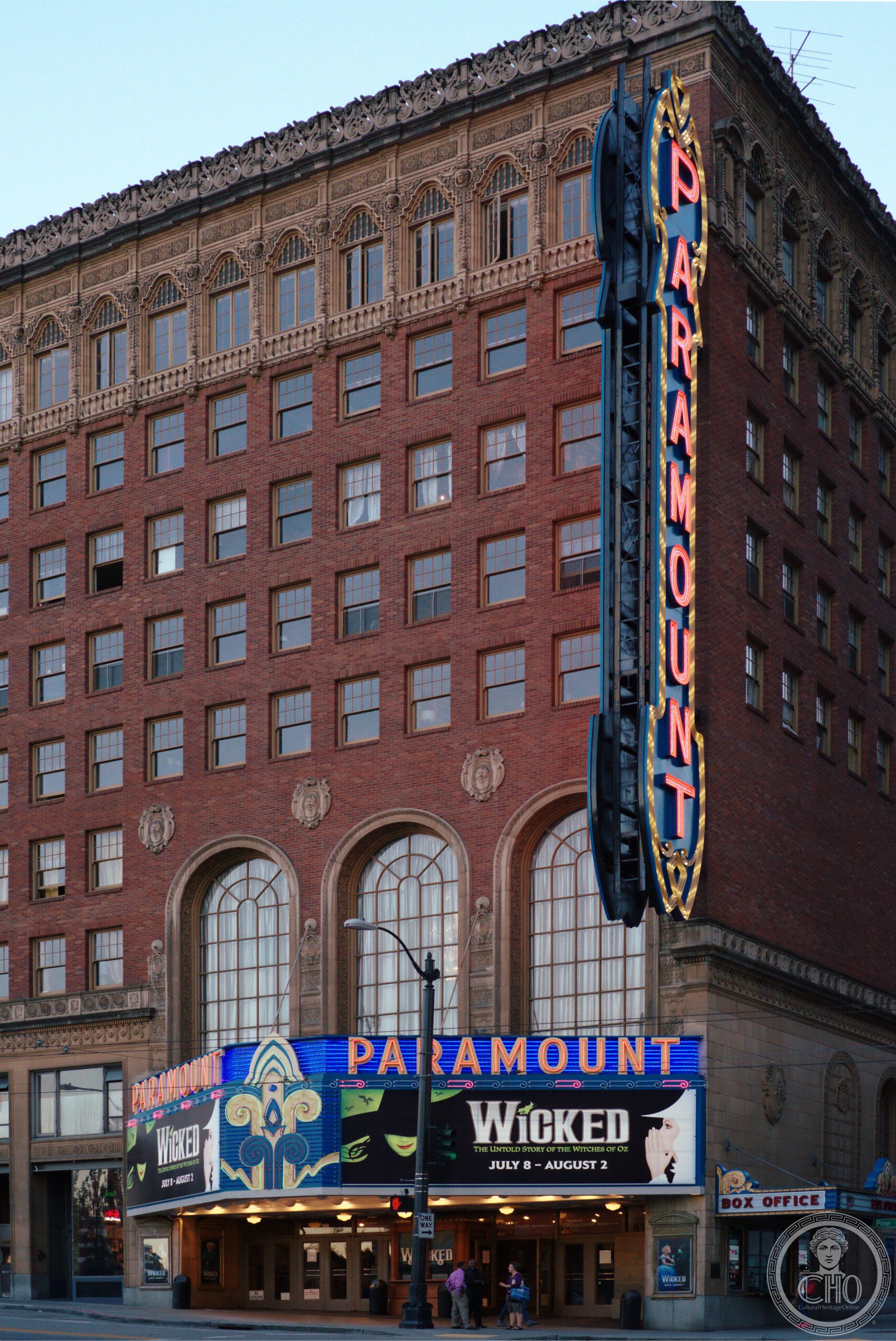
Designed by the Chicago firm Rapp & Rapp for the Paramount Pictures circuit, Seattle’s 1928 Paramount Theatre has survived a century of programming changes to become the Pacific Northwest’s finest surviving large-scale movie palace, now operated by the nonprofit Seattle Theatre Group.
At a glance
Cornelius and George Rapp, the Chicago architects who designed the grand Paramount theatres in New York and Chicago, brought their Italian Renaissance vocabulary to Seattle when the Paramount Pictures circuit commissioned this building in the mid-1920s. Opening on 1 March 1928 at 911 Pine Street, the 2,807-seat auditorium anchored the Pine Street entertainment corridor that connected Seattle’s downtown retail core to the Capitol Hill neighbourhood above. The building’s ornate plasterwork, painted ceiling medallions and organ grilles in gilded metal reflect the Rapp brothers’ signature approach: a rich decorative program applied to a disciplined classical structure. Under the nonprofit stewardship of Seattle Theatre Group, the Paramount has reclaimed its position as the city’s principal mid-sized performance venue for touring Broadway shows, rock concerts, and classical programmes.
Key facts
- Opened: 1 March 1928
- Architects: Rapp & Rapp, Chicago (Cornelius W. and George L. Rapp)
- Style: Italian Renaissance with Art Deco elements — classical ornament, gilded plasterwork
- Capacity: 2,807 seats
- Client: Paramount Pictures / Famous Players–Lasky
- Address: 911 Pine Street, Seattle, WA 98101
- GPS: 47.6138°N, 122.3360°W
- Status: National Register of Historic Places; Seattle City Landmark; operated by Seattle Theatre Group
History
The Paramount Pictures circuit operated theatres across the country in the 1920s under a business model that the Department of Justice would eventually break up as an illegal vertical monopoly: the studio produced films, distributed them to its own theatres, and showed them to first-run audiences in buildings it owned. The theatres themselves were designed to express the circuit’s prestige, and Rapp & Rapp were the firm entrusted with the flagship Paramount houses in the major markets. The New York Paramount (1926) established the template that Seattle’s building would follow.
Seattle in 1928 was a city in the midst of transformation — the timber and fishing economies of the Puget Sound region were diversifying into manufacturing and trade, and downtown Pine Street was becoming the city’s entertainment axis. The Paramount opened to a city that was still absorbing the final years of the silent-film era; within a year of its premiere season, the talkies had arrived and the building had adapted its technical equipment to the new format.
The theatre remained active through the Depression and the wartime boom years, changing ownership more than once as the Paramount Pictures circuit was forced to sell its theatre holdings in the late 1940s following the federal antitrust consent decree. Seattle Theatre Group, a nonprofit organisation, acquired the building in the 1990s and completed a restoration that has kept the Italian Renaissance interior in active use while updating acoustic and technical systems for contemporary performing arts.
What you see
The Pine Street facade is a three-bay classical composition in cream terra cotta, with the central bay marked by the building’s vertical sign and a projecting entrance canopy in ornamental ironwork. The Rapp brothers’ signature is most visible in the lobby: a two-story hall with a coffered ceiling in ivory and gold, paired marble columns and painted roundels in the pilaster spandrels. A wide staircase with a wrought-iron balustrade ascends to the mezzanine level, from which the auditorium opens in full.
The auditorium ceiling is a composition of large painted medallions in a classical geometric field, in shades of rust, gold and ivory that deepen toward the stage. The proscenium arch is framed by a gilded order of engaged columns, with organ grilles of decorative metalwork on each flank. The side walls are articulated by pilasters and painted panels that carry the Renaissance vocabulary consistently across the full room. Box seating is provided in two tiers, each box fronted by a balustrade in gilded iron.
Practical information
- Access: 911 Pine Street, Seattle WA 98101 — between 9th and Stewart Streets, at the Pine/Pike retail corridor
- Events: touring Broadway, rock and pop concerts, classical events; tickets via Seattle Theatre Group and major platforms
- Transit: multiple bus lines on Pike/Pine; Metro/Sound Transit light rail at Westlake Center, 3 blocks west
- Parking: Westlake Center parking garage 3 blocks west; Convention Center garage 2 blocks east
- Time needed: 2.5–4 hours for an evening performance
Getting there
The Paramount Theatre is at the heart of Seattle’s retail and entertainment core, eight blocks east of Pike Place Market and two blocks from the Washington State Convention Center. Seattle–Tacoma International Airport (SEA) is approximately 14 miles south via I-5 — 35–50 minutes by car, or 35 minutes by Link Light Rail to Westlake Station. The light rail stops at Westlake, three blocks west of the Paramount, connecting to the airport and to the University of Washington campus. On foot from Pike Place Market, the theatre is a pleasant 10-minute walk east on Pine Street up the hill toward Capitol Hill.
Nearby
- Pike Place Market — Seattle’s historic public market and tourist landmark, eight blocks west along Pine and Pike Streets — the oldest continuously operating farmers’ market in the United States.
- Fifth Avenue Theatre (1926) — Seattle’s other great movie palace of the 1920s — in a Chinese Imperial style — two blocks south on Fifth Avenue. See the CHO guide.
- Seattle Art Museum — Main branch of the Seattle Art Museum, eight blocks west on First Avenue between University and Union Streets, with the Jonathan Borofsky “Hammering Man” sculpture out front.
- Capitol Hill — Seattle’s dense residential and entertainment district rises immediately east from the Paramount along Pine and Pike Streets — a 10-minute walk to the neighbourhood’s restaurants and music venues.
Sources
- Seattle Theatre Group official site — history and events information
- National Register of Historic Places nomination, Paramount Theatre, Seattle
- David Wilma, HistoryLink.org — Paramount Theatre, Seattle essay
- Seattle Times archives — opening week coverage, March 1928
- Douglas Gomery, Shared Pleasures: A History of Movie Presentation in the United States (1992)
Find it on the map
See this place and what’s around it →📷 Become a Cultural Heritage Online photographer
Share your photos of places: they stay published under your name as the author. The more they're seen, the more you get noticed — and soon a contest will reward the most appreciated photos.
Log in or sign up free to add a photoIs this page about you?
This page is read by travellers and heritage enthusiasts who find it on Google. Tell us how you are connected to this place and we will take it from there.