
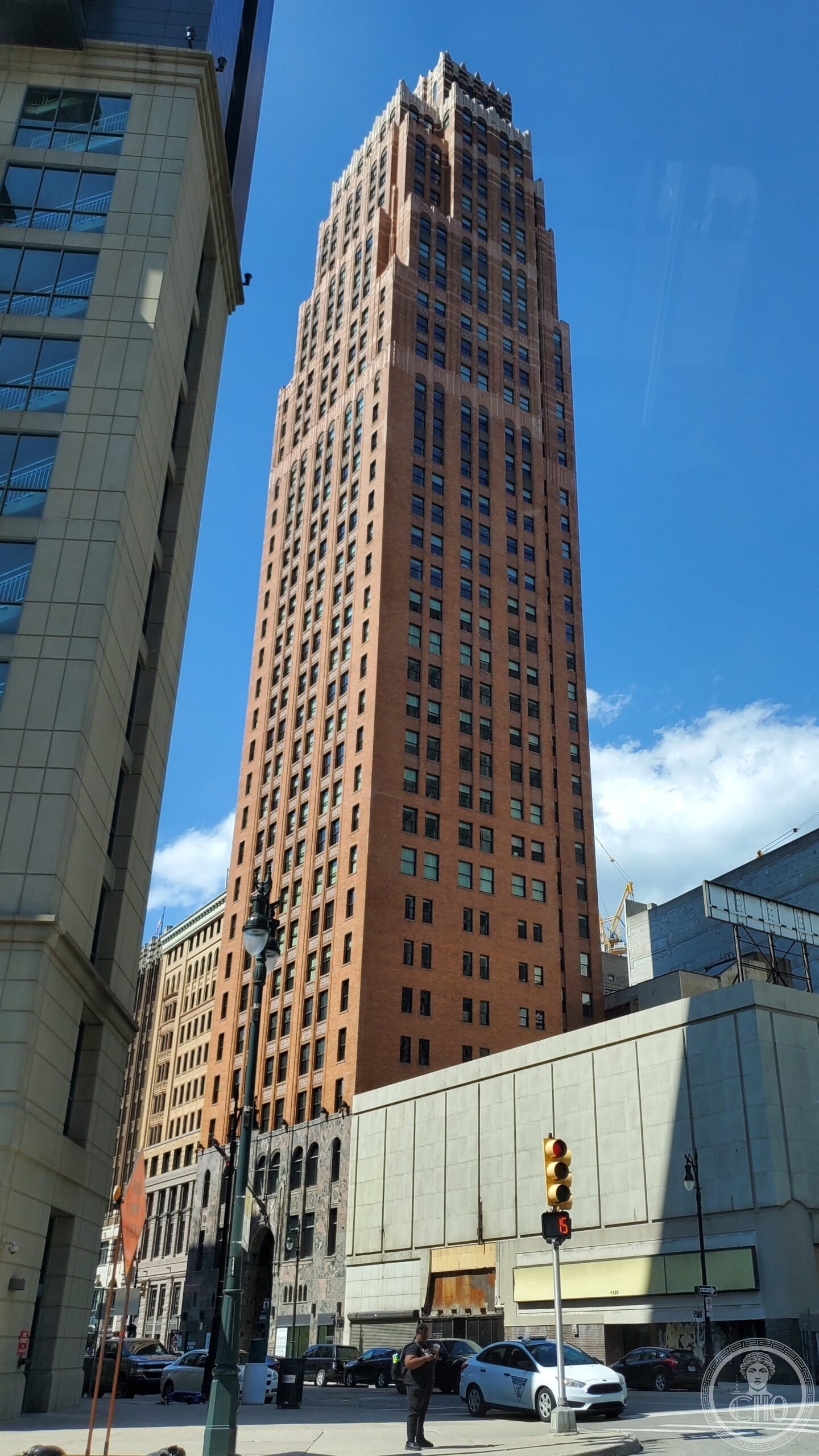
David Stott Building (1929), Detroit
At 38 stories and 476 feet, the David Stott Building is one of the most elegantly proportioned Art Deco skyscrapers of Detroit’s late-1920s building boom — a slender tower of limestone and terracotta whose stepped silhouette still anchors the city’s historic downtown.
At a glance
Rising from 1150 Griswold Street in the heart of Detroit’s central business district, the David Stott Building was completed in 1929 at the peak of the city’s confidence as the world’s automotive capital. Commissioned by David Stott, a prominent Detroit businessman, the tower was designed to serve the city’s growing demand for prestige office space. Its limestone-clad facade, bronze entrance detailing, and precisely calibrated setbacks embody the mature Art Deco idiom: ornament concentrated at the crown and base, the shaft left plain to maximise the reading of vertical mass against the sky. The building was listed on the National Register of Historic Places and has been the subject of sustained restoration efforts, part of Detroit’s broader effort to reclaim and repurpose its landmark commercial architecture.
Key facts
- Address: 1150 Griswold Street, Detroit, MI 48226
- Completed: 1929
- Height: 38 stories, approximately 476 feet (145 m)
- Style: Art Deco
- Original client: David Stott, Detroit businessman
- NRHP: Listed
- Status: Undergoing residential conversion
History
The late 1920s produced an extraordinary cluster of tall buildings in downtown Detroit. Within a few blocks of the David Stott Building rose the Guardian Building (1929) and the Penobscot Building (1928), making the city’s central core one of the densest concentrations of Art Deco skyscrapers in the United States. The Stott was not the tallest of the group — that distinction went to the Penobscot — but it was among the most refined in its use of cladding and ornament. The building served as a commercial office tower through the mid-twentieth century, then declined along with Detroit’s broader downtown as population and investment shifted to the suburbs after the 1950s.
By the early twenty-first century the Stott, in common with many of Detroit’s historic towers, stood largely vacant. Preservation advocacy and the city’s economic recovery have brought new attention to these buildings. The Stott has been identified as a candidate for adaptive reuse as residential units, continuing the pattern seen at the Book Tower and Book-Cadillac Hotel nearby. The cast-bronze entrance panels, the ornate lobby ceiling, and the terracotta ornament at the crown have all been assessed as deserving preservation in any conversion scheme.
What you see
The Stott’s silhouette is its most distinctive feature: a series of stepped setbacks reduce the tower footprint at regular intervals above the base floors, creating a pyramidal profile that reads clearly against the Detroit skyline from a distance. The base is faced in dark limestone with bronze-framed entrance portals; the transition from base to shaft is marked by a band of terracotta ornament in low relief, typical of the period’s restraint in applying decoration.
The shaft rises cleanly with minimal horizontal interruption, the piers emphasised to accentuate verticality. Near the crown, the setbacks tighten and the ornament becomes more elaborate — stylised foliage and geometric patterning in cream-coloured terracotta against the limestone field. The lobby retains original bronze elevator doors and marble flooring that, even partially obscured by later additions, confirm the quality of the original fit-out.
Practical information
- Status: The building is currently undergoing conversion and interior access may be restricted; check current status before visiting.
- Exterior viewing: The Griswold Street facade can be viewed freely from the street; the best wide view is from Campus Martius Park two blocks south.
- Time needed: 15–20 minutes for exterior appreciation and comparison with the adjacent Guardian Building.
- Context: Best visited as part of a Detroit Art Deco walking tour including the Guardian Building, Fisher Building, and Penobscot Building.
Getting there
The David Stott Building stands on Griswold Street between W. Michigan Avenue and W. Congress Street in downtown Detroit. The QLine streetcar stops at Campus Martius Park, approximately two blocks south. Detroit’s People Mover elevated rail serves several nearby stations including Cadillac Center and Financial District, both within a five-minute walk. Detroit Metropolitan Wayne County Airport is approximately 45 minutes west by road.
Nearby
- Guardian Building (1929) — Wirt Rowland’s polychrome Art Deco tower on Griswold Street, three blocks north, notable for its Pewabic tile interior.
- Penobscot Building (1928) — 47-story Art Deco skyscraper one block east, for decades Detroit’s tallest building.
- Campus Martius Park — central public square two blocks south, the geographic and civic heart of downtown Detroit.
- Fisher Building (1928) — Albert Kahn’s Art Deco landmark in the New Center district, two miles north.
Sources
- National Register of Historic Places, David Stott Building nomination, U.S. National Park Service.
- Eric J. Hill and John Gallagher, AIA Detroit: The American Institute of Architects Guide to Detroit Architecture, Wayne State University Press, 2003.
- Wikipedia contributors, “David Stott Building,” Wikipedia, The Free Encyclopedia.
- Preservation Detroit, Detroit’s Historic Skyscrapers documentation project.
Find it on the map
See this place and what’s around it →📷 Diventa un fotografo di Cultural Heritage Online
Condividi le tue foto dei luoghi: restano pubblicate con la tua firma come autore. Più vengono viste, più ti fai conoscere — e presto un concorso premierà le foto più apprezzate.
Accedi o registrati gratis per aggiungere una fotoDo you manage this place?
This page is read by travellers and heritage enthusiasts who find it on Google. Keep it accurate — and make it work for you. Free for non-profit heritage institutions.