
.jpg)
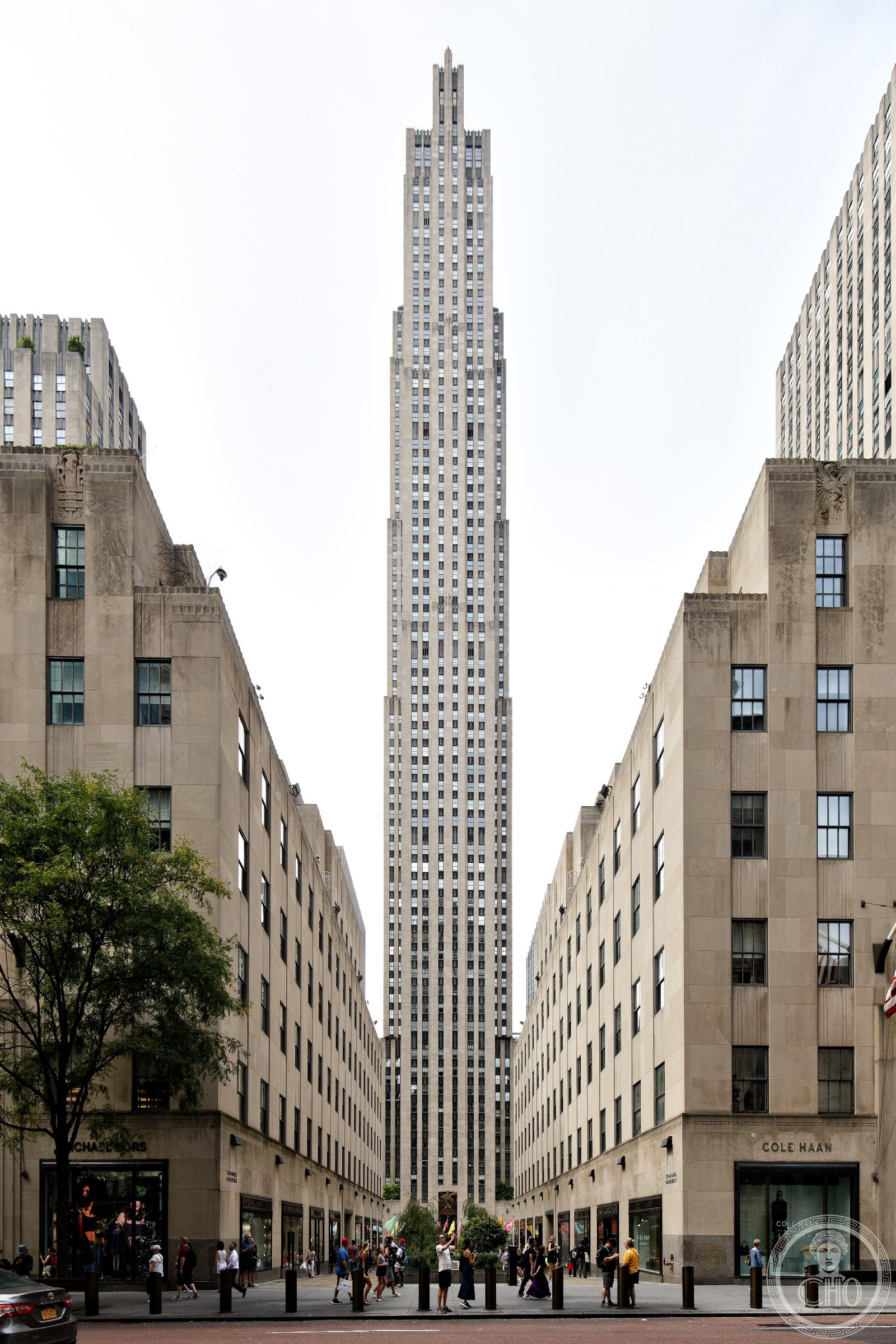
The centrepiece of Rockefeller Center — the largest private building project in American history — 30 Rockefeller Plaza rises 850 feet above Midtown Manhattan as the anchor tower of the 14-building complex assembled by John D. Rockefeller Jr. in the early 1930s, its slab-like limestone facade and stepped crown setting the urban grammar for the entire Radio City development.
At a glance
30 Rockefeller Plaza (known popularly as 30 Rock) is the tallest of the original buildings in Rockefeller Center and the focal point of its axial composition. Designed by the Associated Architects — the collaborative office formed by Raymond Hood, along with Reinhard & Hofmeister and Corbett, Harrison & MacMurray — and completed in 1933, the building rises 70 stories and 850 feet above Sixth Avenue, its limestone shaft of vertical piers tapering to a flat crown that differs fundamentally from the decorative spires of the Chrysler or Empire State: 30 Rock is the city’s great monument to Art Deco restraint rather than ornament. The building has been the home of NBC’s New York broadcast operations since its opening; the “Top of the Rock” observation deck at the 67th–70th floors offers views across Midtown that include both the Empire State and the Chrysler Buildings.
Key facts
- Completed: 1933
- Architects: Associated Architects: Raymond Hood (lead design), Reinhard & Hofmeister, Corbett Harrison & MacMurray
- Developer: John D. Rockefeller Jr.
- Style: Art Deco
- Address: 30 Rockefeller Plaza, New York, NY 10112
- Height: 850 ft (259 m) / 70 floors
- Notable: Anchor of Rockefeller Center; NBC Studios; “Top of the Rock” observation deck; Lee Lawrie’s “Wisdom” limestone relief above main entrance
- Designation: NYC Individual Landmark; Rockefeller Center on National Register of Historic Places
History
The story of Rockefeller Center begins with a cultural catastrophe: in 1929, the Metropolitan Opera Company was seeking a new home, and John D. Rockefeller Jr. had leased a large block of Midtown real estate from Columbia University with the intention of funding the project. When the Depression destroyed the Met’s fundraising capacity and the opera withdrew, Rockefeller was left with a three-block lease and no anchor tenant. Rather than default, he decided to redevelop the entire site himself — creating what would become the largest private construction project of the Depression era, a $250 million development that employed 75,000 workers during its construction from 1930 to 1939.
Raymond Hood, the most creative force among the Associated Architects, brought to Rockefeller Center a design philosophy that differed from his earlier, more decoratively exuberant work on the American Radiator Building (1924) and the Daily News Building (1930). For 30 Rock he developed an aesthetic of vertical emphasis through unbroken piers of Indiana limestone, with almost no historical ornament beyond the carefully proportioned setbacks and the sculptural programme of the public spaces. The building’s famous south facade, designed to frame the Promenade below and the ice rink (added 1936) in front of it, creates one of the few successful outdoor urban rooms in New York — enclosed on three sides by buildings at human scale, with 30 Rock rising above as a vertical anchor.
NBC’s occupancy of the building from 1933 onwards has shaped its cultural identity as much as its architecture: the studio tours, the “30 Rock” television series (2006–2013), and the history of American broadcasting are inseparable from the building’s public image. The “Top of the Rock” observation deck, reopened in 2005 after a decades-long closure, is now one of the most visited paid attractions in New York, offering a panoramic view that includes Central Park to the north and the lower Manhattan skyline to the south.
What you see
The approach to 30 Rock from Fifth Avenue along the Channel Gardens — the sunken promenade flanked by the Maison Franccedil;aise and the British Empire Building — is the most deliberately choreographed urban sequence in Rockefeller Center: the garden terminates in the sunken plaza (winter ice rink, summer restaurant), and 30 Rock rises straight ahead, its limestone facade framed by the lower flanking buildings like a stage backdrop. The entrance to the building is through the lobby on 49th Street, where Lee Lawrie’s limestone relief of “Wisdom” — a robed figure holding a compass, a beam of light emanating downward — occupies the entire facade above the entry portal, with the inscription “Wisdom and knowledge shall be the stability of thy times.”
The interior lobby is one of the great Art Deco public spaces of New York: long and narrow, its walls faced in marble and its ceiling covered with a mosaic mural by José Maria Sert titled “American Progress” — monumental figures of workers and industry rendered in warm gold tones. The building’s exterior, best appreciated from the south plaza or from Fifth Avenue, reveals Hood’s mastery of the vertical pier vocabulary: 850 feet of unbroken limestone ribs, the setbacks at the crown creating a subtle but powerful visual diminuendo that makes the tower appear to dissolve into the sky rather than simply stop.
Practical information
- Lobby access: Free; open daily; security at building entrances
- Top of the Rock: Paid observation deck (67th–70th floors); open daily 8am–midnight; advance booking recommended; rockefellercenter.com
- NBC Studio Tour: Paid; departs from 49th Street lobby; advance booking
- Best view of 30 Rock: From the Channel Gardens looking north; or from 5th Avenue between 49th and 50th Streets
- GPS: 40.7587° N, 73.9787° W
- Nearest transit: 47th–50th Sts–Rockefeller Ctr (B/D/F/M), 2 minutes; 5th Ave–53rd St (E/M), 5 minutes
Getting there
30 Rockefeller Plaza is in Midtown Manhattan between 49th and 50th Streets and Fifth and Sixth Avenues. Rockefeller Center subway station (B, D, F, M lines) is 2 minutes south. Grand Central Terminal is 10 minutes south-east on foot. JFK Airport: approximately 50 minutes via AirTrain and subway. LaGuardia (LGA): bus M60-SBS to 125th Street, then 4/5/6 to Grand Central, approximately 40–50 minutes.
Nearby
- Radio City Music Hall (1932) — also part of Rockefeller Center; Donald Deskey Art Deco interior; tours available; 1 minute walk west; CHO place card
- St. Patrick’s Cathedral (1878) — James Renwick Jr.; Gothic Revival; directly across Fifth Avenue from Rockefeller Center
- Museum of Modern Art (MoMA) — 11 West 53rd Street; 5 minutes north
Sources
- New York City Landmarks Preservation Commission, Rockefeller Center designation report — nyc.gov/lpc
- Okrent, Daniel. Great Fortune: The Epic of Rockefeller Center. Viking, 2003. Development history.
- Newhouse, Victoria. Wallace K. Harrison, Architect. Rizzoli, 1989. Associated Architects context.
- National Register of Historic Places, Rockefeller Center nomination — nps.gov
- Wikidata, 30 Rockefeller Plaza — wikidata.org
Find it on the map
See this place and what’s around it →📷 Become a Cultural Heritage Online photographer
Share your photos of places: they stay published under your name as the author. The more they're seen, the more you get noticed — and soon a contest will reward the most appreciated photos.
Log in or sign up free to add a photoDo you manage this place?
This page is read by travellers and heritage enthusiasts who find it on Google. Keep it accurate — and make it work for you. Free for non-profit heritage institutions.