
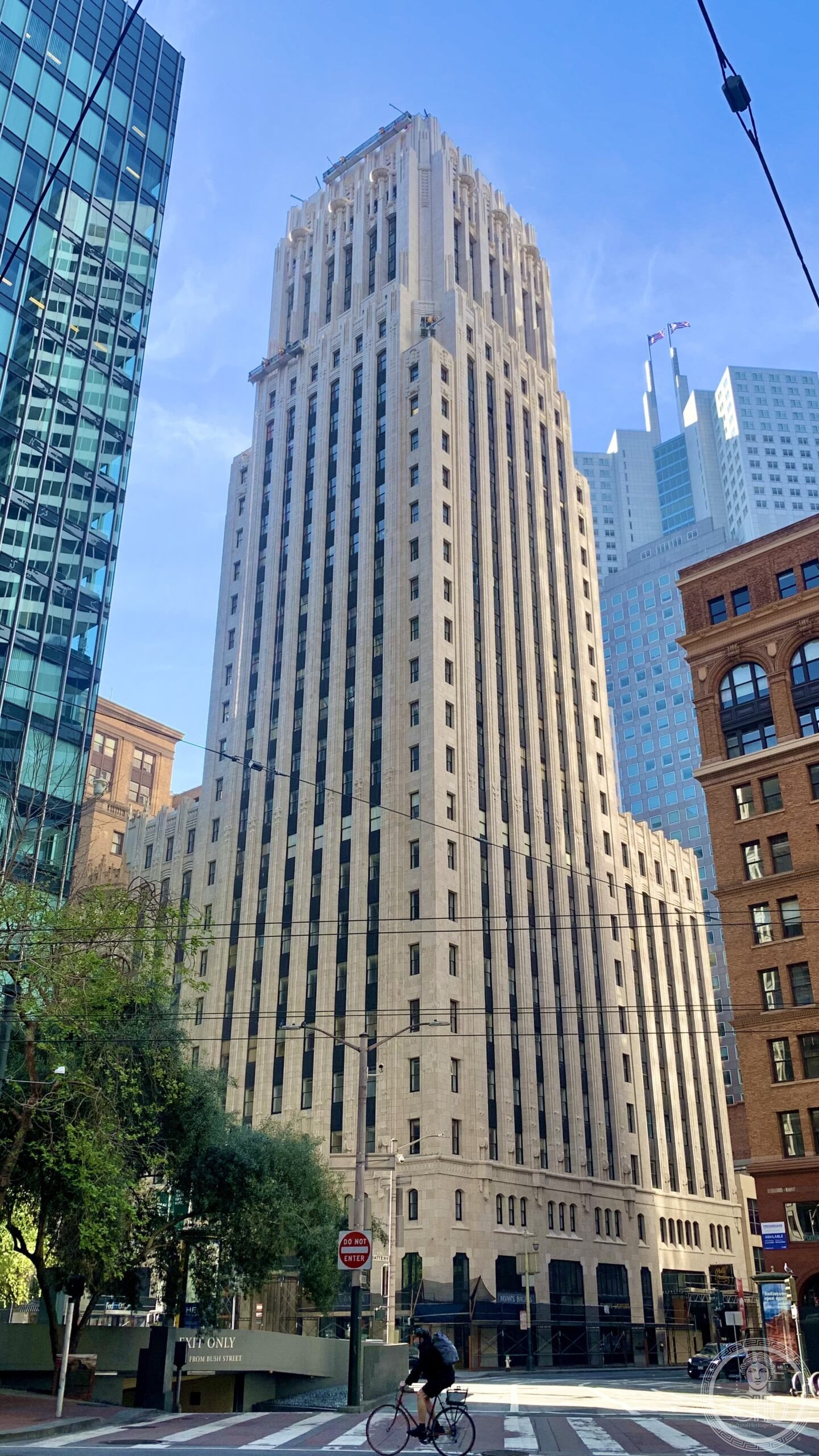

Completed in 1929 at the corner of Bush and Sansome streets at the edge of San Francisco’s Financial District, the Shell Building is one of the finest examples of the stepped Art Deco commercial tower in California — a 29-story shaft of buff terracotta and brick designed by architect George Kelham, whose carefully calibrated setbacks create one of the most distinctive silhouettes on the downtown skyline.
At a glance
Standing at 100 Bush Street, the Shell Building was designed by George Kelham and completed in 1929 for the Shell Oil Company of California. At 29 stories and 388 feet, it was among the tallest buildings in San Francisco at its completion. The building’s Art Deco ornamental programme in polychrome terracotta — with stylised shell motifs (echoing the client’s corporate identity), geometric friezes at the setback zones, and elaborately carved entrance surrounds — is among the most coherent in the city’s Art Deco inventory. The building is listed on the National Register of Historic Places and designated a San Francisco Landmark; it continues in use as a prime commercial office building in the Financial District.
Key facts
- Completed: 1929
- Architect: George Kelham
- Style: Art Deco
- Address: 100 Bush St, San Francisco, CA 94104
- Height: 29 stories
- NRHP: Listed; San Francisco Landmark
- Notable: Shell motif terracotta ornament; stepped setback silhouette; polychrome facade panels; active office building
History
George Kelham was one of the most productive architects in the Bay Area in the early 20th century, responsible for major civic and commercial buildings including the San Francisco Public Library’s main branch (1917), the Russ Building (1927), and numerous hotels and office towers. The Shell Building commission, received in the late 1920s from the Shell Oil Company of California, gave Kelham the opportunity to work in the new Art Deco idiom at a scale and ambition that matched the era’s commercial confidence.
The brief — a prestigious oil company headquarters at a prominent Financial District corner — called for a building that would announce Shell’s California operations and serve as a symbol of the company’s modernity and prosperity. Kelham’s response was a stepped tower in terracotta and brick whose ornamental programme incorporated the scallop shell motif of the Shell corporate identity into the Art Deco geometric vocabulary of the facade: the result is a building whose client identity and architectural identity reinforce rather than contradict each other, a rare achievement in commercial architecture of the period.
The building was completed in 1929, just months before the stock market crash of October that year. Shell Oil occupied the building as planned, and it remained a corporate landmark through the mid-century decades. A series of subsequent tenants maintained the building’s status as a prestigious Financial District address; the landmark designation, which recognised the integrity of both the exterior terracotta and the lobby interior, has protected it from the kind of strip-and-reclad treatments that altered many of its contemporaries in the postwar decades.
What you see
The Shell Building’s setback profile is its most distinctive feature at a distance: the stepped silhouette, with major setbacks at approximately the 14th and 22nd floors, creates a pyramidal rhythm that reads from the Bay and from the Marin headlands as a characteristic element of San Francisco’s pre-war skyline. At street level, the Bush and Sansome facades present a composition of polychrome terracotta ornament in tan, buff, and terracotta tones, with the density of ornament concentrated at the entrance level and at the setback zones. The scallop shell motif appears in the spandrel friezes, the entrance surrounds, and the carved panels at the base of the tower — a coherent programme that rewards sustained looking.
The entrance on Bush Street is the building’s most elaborate exterior space: flanked by carved terracotta panels with abstracted figures and shell motifs, the recessed portal frames bronze doors with geometric Art Deco ironwork. The lobby beyond is a sequence of marble wall panels, original bronze elevator surrounds, and vaulted plasterwork that has been carefully preserved through successive tenant changes. The corner of Bush and Sansome, where the building turns from one street to the other, is one of the most photogenic corners in the Financial District: the stepped tower above, the polychrome facade at eye level, and the canyon of the financial district behind.
Practical information
- Lobby access: Open weekdays during business hours; free entry
- Best view: Corner of Bush and Sansome; or looking east from Montgomery St toward the bay
- Time needed: 20–30 minutes lobby + exterior
- GPS: 37.7914° N, 122.4009° W
- Nearest transit: BART Montgomery St station (4 minutes walk); Muni buses on Bush Street
Getting there
The Shell Building stands at 100 Bush Street at the corner of Battery, in the heart of the San Francisco Financial District. BART serves Montgomery St station (Market and Montgomery) 4 minutes west on foot; the Embarcadero BART and Muni Metro station is 5 minutes east. San Francisco International Airport (SFO) is approximately 14 miles (23 km) south; BART from SFO to Montgomery St takes approximately 35 minutes.
Nearby
- Transamerica Pyramid (1972) — William Pereira’s iconic white pyramid tower at 600 Montgomery, 3 minutes north; defining element of the SF skyline
- Embarcadero Center — John Portman’s connected office-retail complex along the waterfront; 5 minutes east
- Ferry Building Marketplace — 1898 beaux-arts terminal with Farmer’s Market and food hall; Embarcadero and Market; 6 minutes east
Sources
- National Register of Historic Places, Shell Building nomination — nps.gov
- San Francisco Planning Department, Landmark designation records — sf.gov
- California Office of Historic Preservation, George Kelham bibliography — ohp.parks.ca.gov
- Gebhard, David. Architecture in San Francisco and Northern California. Peregrine Smith, 1985.
- Wikidata, Shell Building San Francisco — wikidata.org
Find it on the map
See this place and what’s around it →📷 Become a Cultural Heritage Online photographer
Share your photos of places: they stay published under your name as the author. The more they're seen, the more you get noticed — and soon a contest will reward the most appreciated photos.
Log in or sign up free to add a photoIs this page about you?
This page is read by travellers and heritage enthusiasts who find it on Google. Tell us how you are connected to this place and we will take it from there.