
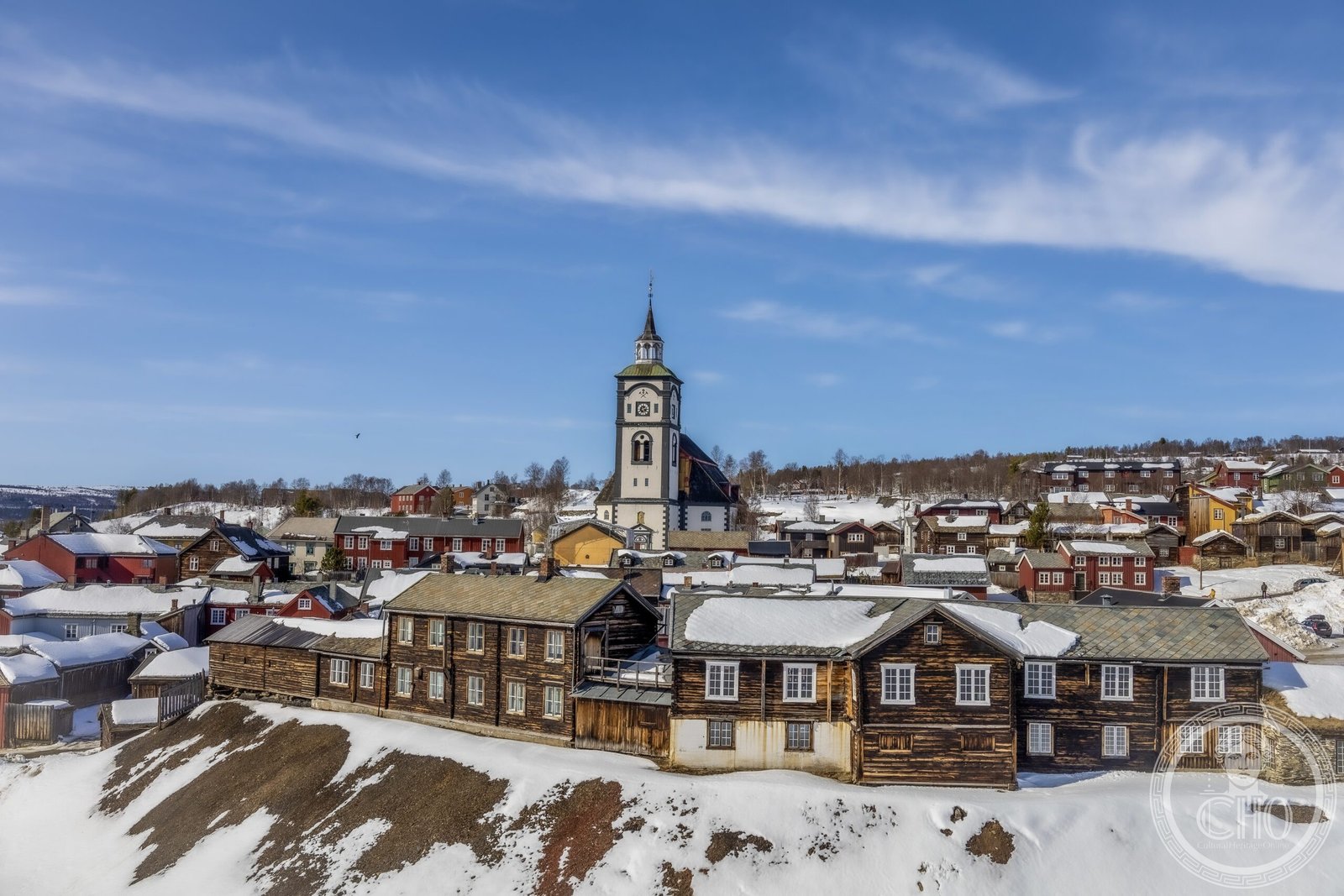
Nestled in the high fells of central Norway, Røros is one of the world’s best-preserved industrial heritage towns — a 17th-century copper mining settlement where smelting works, timber houses, and the great mining church have survived virtually unchanged for more than 300 years. Inscribed by UNESCO in 1980, it stands as a remarkable testament to the human capacity to build and sustain a community in an extreme subarctic environment.
Significance and overview
Røros is an exceptionally intact example of a European mining town, retaining its original street pattern, building scale, and material culture from the 17th to 19th centuries. Its wooden architecture, dominated by low log houses with turf roofs, and the iconic silhouette of the Bergstadens Ziir (the miners’ church) create a townscape of extraordinary coherence and authenticity. UNESCO extended the inscription in 2010 to include the surrounding Circumference — the vast landscape of mines, smelting sites, transport routes, and farmsteads that formed the productive hinterland of the copper industry.
The property was recognised under UNESCO criteria (iii), (iv), and (v), reflecting its outstanding cultural landscape, its architectural ensemble, and its living testimony to an industrial way of life that persisted for 333 years.
Historical background
Copper ore was discovered near Røros in 1644, and the Røros Copper Works (Røros Kobberverk) was founded the same year, receiving its royal charter from King Christian IV of Denmark-Norway. The town was built from scratch in the subarctic highlands at an altitude of 628 metres, enduring temperatures that regularly drop below −40°C in winter. Workers, miners, and their families created a self-contained world of smelting, farming, and trade that operated continuously for over three centuries.
The company town was finally closed in 1977 after the copper deposits were exhausted, but the town itself survived almost intact because economic stagnation had paradoxically prevented the demolition and redevelopment that destroyed comparable industrial towns elsewhere in Europe. This “arrested development” preserved Røros as a living museum of early modern industrial culture.
Key features
The Bergstadens Ziir church (1784) is the symbolic heart of Røros — a large Baroque stone building that served as the religious and social centre for a community of miners, smelters, and farmers. The surrounding streets preserve 80 protected wooden buildings, including the distinctive “slave houses” (the workers’ dwellings), merchant houses, and the smelthouses. The Smelthytta (smelting museum) occupies the ruins of the last smelting works and provides a vivid account of the industrial process.
The Circumference landscape includes the vast Storwartz mining area with its open-pit mines and slag heaps, the Femundsmarka wilderness, and a network of historically important transport routes across the fells used to bring ore and charcoal to the smelting works.
Cultural and ecological importance
Røros represents the intersection of Norwegian industrial history, Sami cultural heritage (the Circumference landscape was shared with the Sami reindeer herding culture), and the social history of a company town under royal patronage. The town’s identity was forged in hardship — extreme cold, dangerous mining conditions, and the social hierarchy of the copper works — and this heritage is maintained through a strong local culture of historical memory, including the Røros Market (Rørosmartnan), a centuries-old winter fair held every February.
The surrounding landscape is also ecologically significant, with the Femundsmarka National Park adjacent to the Circumference protecting one of Norway’s largest wilderness areas.
UNESCO criteria
Røros was inscribed in 1980 under criteria (iii), (iv), and (v). Criterion (iii) recognises it as an outstanding testimony to a living cultural tradition of copper mining that shaped Norwegian society for over three centuries. Criterion (iv) singles out the architectural ensemble as an outstanding example of a type of building and landscape illustrative of a significant stage in human history. Criterion (v) acknowledges the Circumference as an outstanding example of a traditional human settlement and land-use that represents a culture and the interaction between human communities and their environment.
Visitor experience
Røros is a living town of approximately 5,600 people, and visitors experience it as a working community rather than a museum frozen in time. The Røros Museum (Rørosmuseet) manages several historic sites, including the Smelthytta and the Olavsgruva mine (where underground tours are available year-round). The town’s main street, Bergmannsgata, is lined with wooden houses that double as shops, cafes, and galleries. In winter, Røros is magical: snow-covered streets, candlelit windows, and the February market transform it into a scene from a Norwegian fairy tale.
The surrounding landscape is ideal for cross-country skiing in winter and hiking, fishing, and reindeer herding tours in summer.
Getting there
Røros is served by Røros Airport (connections from Oslo via Widerøe). By train from Oslo, take the Rørosbanen line (approx. 5 hours) — one of Norway’s most scenic rail journeys, crossing the high fells. By road, Røros is 3 hours from Trondheim via the E6 and RV30. GPS: 62.574° N, 11.386° E.
Nearby context
The Femundsmarka National Park, immediately east of the Circumference, protects 573 km² of high-altitude wilderness with lakes, rivers, and pristine fell landscape. Trondheim, Norway’s third city and a UNESCO-listed destination in its own right (Nidaros Cathedral), is 160 km to the north-west. The Dovre mountain plateau and Dovrefjell National Park — home to wild musk oxen — lie to the west. The border region with Sweden (Dalarna province, home to Swedish folk culture) is within 100 km to the east.
Find it on the map
See this place and what’s around it →📷 Become a Cultural Heritage Online photographer
Share your photos of places: they stay published under your name as the author. The more they're seen, the more you get noticed — and soon a contest will reward the most appreciated photos.
Log in or sign up free to add a photo