
Where Money Was Invented
Sardis (Sardes in Greek, Sfard in Persian) was the capital of the ancient Lydian Empire — the kingdom that, in the 7th century BC, produced the world’s first coins. Under King Croesus, whose name became synonymous with wealth, Sardis was one of the greatest cities of the ancient world: a metropolis controlling the trade routes between the Aegean and the Iranian plateau, with gold-bearing river sands at its door.
The Temple of Artemis
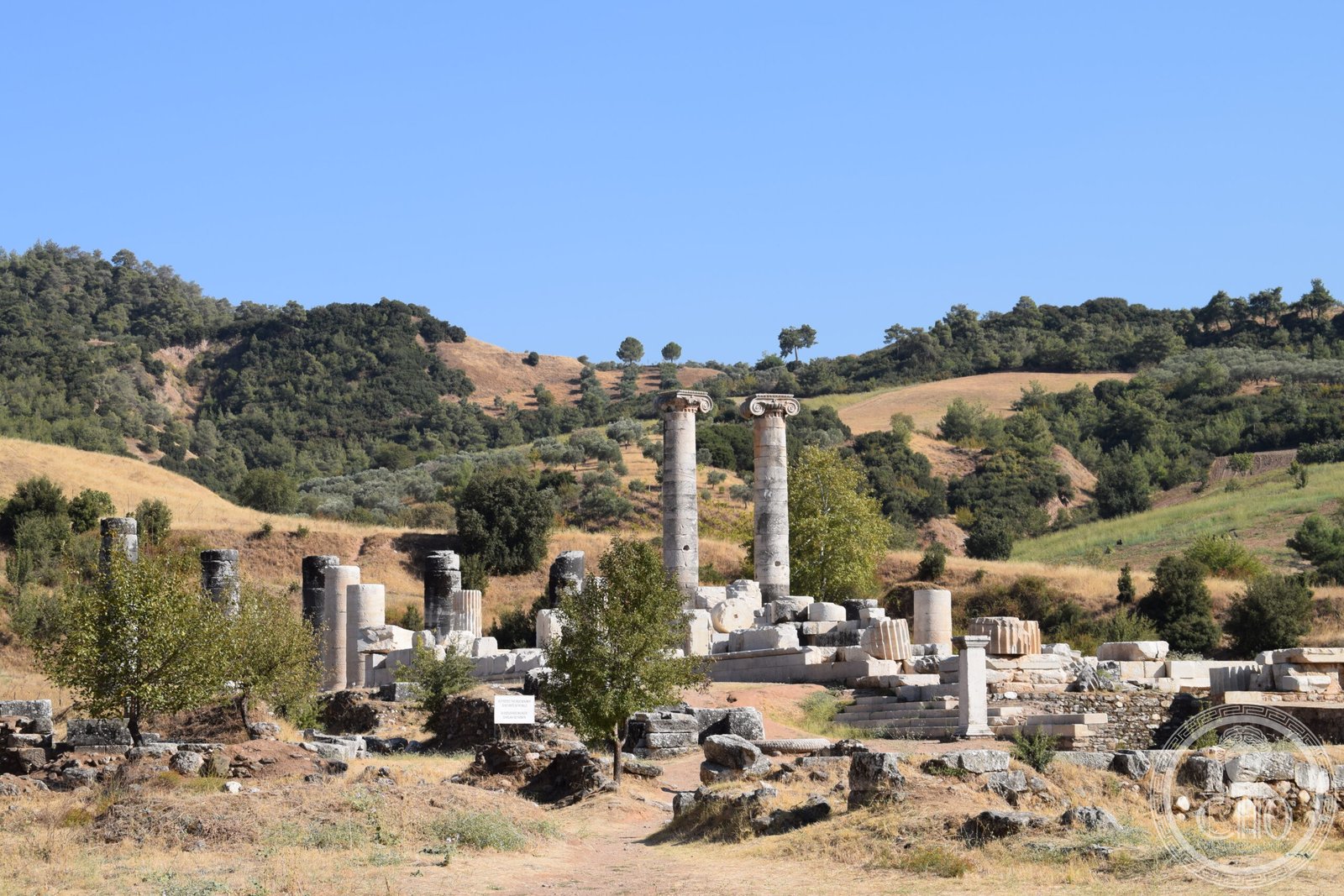
The Temple of Artemis at Sardis is one of the largest Greek temples ever built — larger than the Parthenon, intended to rival the great temples of Ephesus and Didyma. Though never completed, its surviving columns (including two still standing in the Roman phase) convey the scale of Lydian royal ambition. The temple was dedicated to Artemis but served a syncretic cult under Persian, Greek, and later Roman rule.
The Gymnasium and Byzantine City
The Roman-era gymnasium and bath complex at Sardis, excavated by Harvard and Cornell universities since 1958, is one of the best-preserved gymnasium complexes in the Eastern Mediterranean. Adjacent synagogue remains — the largest ancient diaspora synagogue known — testify to a substantial Jewish community in Roman Sardis. Byzantine churches and medieval fortifications layer additional centuries of inhabitation onto the site.
Bin Tepe — The Lydian Royal Necropolis
Ten kilometres north of the city lies Bin Tepe (“Thousand Hills”) — the royal burial ground of the Lydian kings, where over a hundred burial mounds (tümülüs) are arrayed across the landscape. The largest, identified with King Gyges (founder of the Mermnad dynasty, r. 680–644 BC), rivals the pyramids of Giza in base diameter. The mounds were constructed from carefully engineered earthworks, their chambers of hewn stone accessed through a long dromos.
UNESCO Recognition
Inscribed in 2024 under criteria ii, iii, and iv, Sardis and the Lydian Tumuli of Bin Tepe were recognised for their outstanding testimony to the Lydian civilisation and its decisive contribution to Mediterranean commercial culture through the invention of coinage, and for the exceptional preservation of both the urban site and the royal necropolis.
Visiting the Site
Sardis is well preserved and open to visitors. The Temple of Artemis is freely accessible; the gymnasium complex and synagogue require a site ticket. The Bin Tepe mounds are visible across the Hermus plain from the main highway and accessible by local road. The site museum in the village of Sart holds finds from the Harvard-Cornell excavations.
Getting There
Sardis is 90 km east of Izmir, accessed via the E96 highway through the Hermus (Gediz) valley. From Izmir airport, the drive takes approximately 1.5 hours. The site is also reachable by train from Izmir to Salihlı station (2 hrs), with the ruins a short taxi ride away.
Wider Context
The Lydian legacy is omnipresent in Western culture without being widely recognised: the electrum stater of Sardis is the ancestor of every coin in the world. The Lydian musical scale (the Lydian mode) gave its name to one of the fundamental tonalities of Western music. Sardis joins Ephesus, Pergamon, and Troy among Turkey’s great Aegean archaeological sites.
Find it on the map
See this place and what’s around it →📷 Become a Cultural Heritage Online photographer
Share your photos of places: they stay published under your name as the author. The more they're seen, the more you get noticed — and soon a contest will reward the most appreciated photos.
Log in or sign up free to add a photo