The Pacific Islands is home to 38 UNESCO World Heritage Sites across 14 countries, stretching from the ancient rock art of Australia’s Murujuga to the stone city of Nan Madol in Micronesia and the ceremonial marae of French Polynesia. Coral reefs, volcanic calderas, prehistoric agricultural systems, and colonial port towns together form one of the most geographically dispersed World Heritage regions on earth. From Cultural Heritage Online.
The shape of the Pacific Islands’s World Heritage list
Of the 38 inscribed sites, 19 are classified as natural, 12 as cultural, and 7 as mixed — a balance that reflects both the region’s extraordinary biodiversity and its deep record of human settlement. The Pacific accounts for some of the largest protected areas on the World Heritage List by surface area, including the Phoenix Islands Protected Area in Kiribati and the vast marine expanse of Papahānaumokuākea in Hawaiʻi.
The first Pacific inscriptions came in 1981, when Australia placed three sites on the list simultaneously: the Great Barrier Reef, Kakadu National Park, and the Willandra Lakes Region. The most recent addition is Murujuga Cultural Landscape in Western Australia, inscribed in 2025, which preserves more than 50,000 years of continuous custodianship through one of the world’s most extensive rock art concentrations.
Countries with the most inscriptions
Australia holds 20 of the region’s 38 sites, making it by far the dominant state on the Pacific World Heritage map. Its list spans continent-scale natural systems — the Great Barrier Reef, Gondwana Rainforests, Wet Tropics of Queensland — alongside cultural landmarks such as the Sydney Opera House, the Australian Convict Sites, and Budj Bim Cultural Landscape, whose eel-farming channels predate the Egyptian pyramids.
New Zealand follows with three inscriptions: Te Wahipounamu in the South Island, the Tongariro National Park (a dual cultural and natural site anchored in Māori spiritual tradition), and the New Zealand Sub-Antarctic Islands. France and the United States each hold two sites in the region — French Polynesia’s lagoon marae at Taputapuātea and the Marquesas Islands on one side, Papahānaumokuākea and Hawaiʻi Volcanoes National Park on the other.
Cross-border and serial sites
Several Pacific World Heritage properties draw their value from scale and seriality rather than a single location. The Australian Convict Sites, inscribed in 2010, is a serial property linking eleven penal-era buildings and landscapes across six Australian states and territories, read together as testimony to the forced migration system that shaped modern Australia. The Gondwana Rainforests of Australia similarly spans protected areas in Queensland and New South Wales, recognised for their Gondwanan floral lineages.
Beyond Australia, Papahānaumokuākea — a joint US nomination — extends across the Northwestern Hawaiian Islands and represents the largest marine protected area inscribed under the World Heritage Convention at the time of its 2010 designation. Chief Roi Mata’s Domain in Vanuatu is a compact serial site linking the dwelling, battlefield, and burial ground of the paramount chief Roi Mata, offering a rare example of oral tradition, sacred geography, and archaeological record aligned across a single landscape.
Natural and mixed-criteria sites
The Pacific’s natural sites concentrate extraordinary ecological value in a small number of very large properties. East Rennell in the Solomon Islands — a raised coral atoll — is the world’s largest raised coral island and holds the southernmost Pacific rainforest. The Phoenix Islands Protected Area covers 408,000 square kilometres of ocean and atolls in Kiribati, one of the remotest marine environments on earth and a reference ecosystem for climate resilience research.
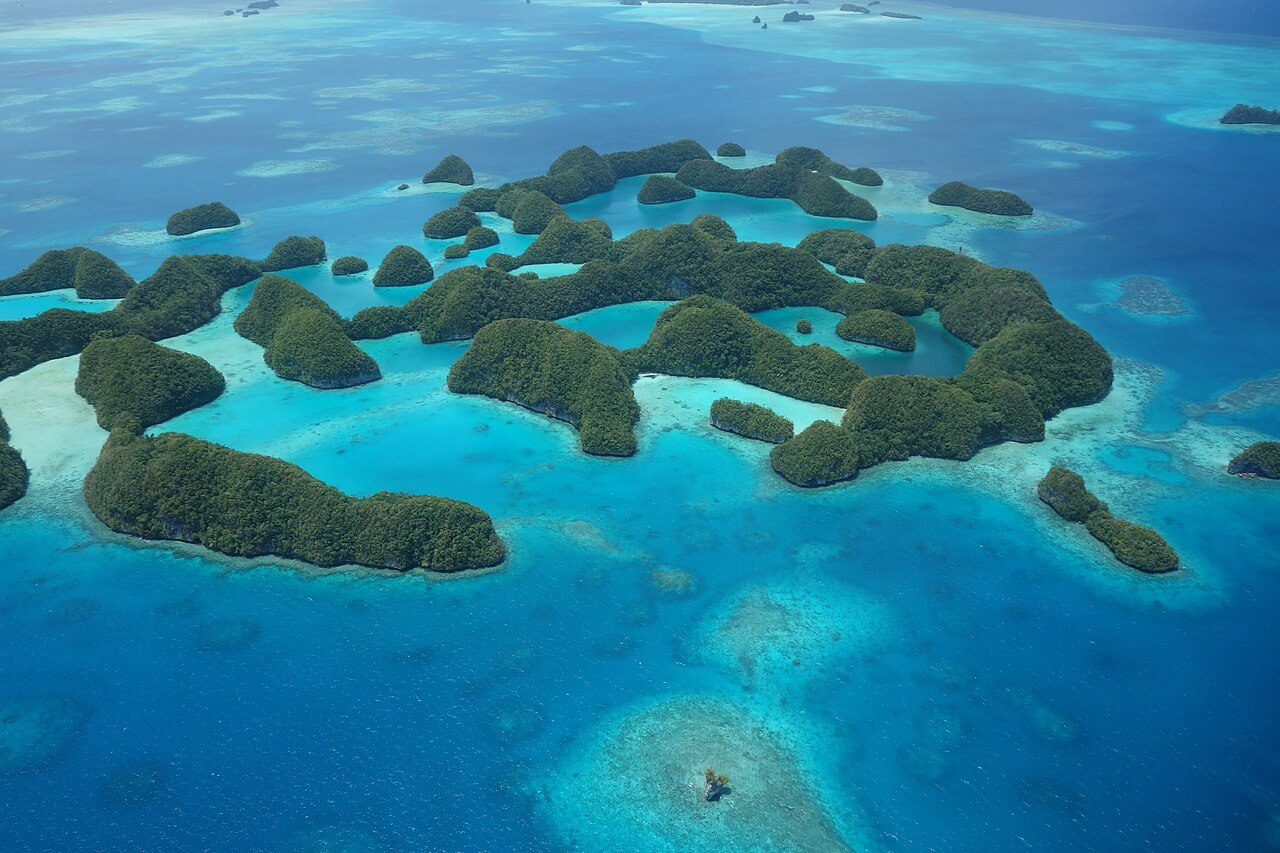
Mixed sites in the region tend to be places where Indigenous cultural landscapes and outstanding natural values are inseparable. Kakadu National Park in Australia, Uluṟu-Kata Tjuṯa National Park, the Rock Islands Southern Lagoon in Palau, and Tongariro National Park in New Zealand all carry mixed designations. The Rock Islands of Palau — a dense archipelago of limestone mushroom islands and turquoise lagoons — meets both natural criteria for its marine biodiversity and cultural criteria for its long association with Palauan tradition.
Explore the Pacific Islands’s UNESCO heritage
Each country in the region contributes a distinct heritage character to the broader Pacific list. The guides below cover every country with at least one inscription, with site-by-site detail and travel context.
- Australia (20 sites)
- New Zealand (3 sites)
- Papua New Guinea (1 site)
- Fiji (1 site)
- Vanuatu (1 site)
- Micronesia (1 site)
- Palau (1 site)
Every site in this list is pinpointed on CHO’s interactive heritage map, with GPS coordinates and sourced editorial history. See our guide to UNESCO World Heritage criteria, and our piece on cultural travel beyond mass tourism.
Frequently Asked Questions
How many UNESCO World Heritage Sites does the Pacific Islands have?
The Pacific Islands region, broadly corresponding to Oceania, has 38 UNESCO World Heritage Sites across 14 countries and territories. The total grew with the 2025 inscription of Murujuga Cultural Landscape in Western Australia, the most recent addition to the regional list.
Which country in the Pacific Islands has the most UNESCO World Heritage Sites?
Australia holds 20 of the region’s 38 sites, more than all other Pacific countries combined. Its inscriptions range from the Great Barrier Reef — the world’s largest coral system — to the Sydney Opera House and the Budj Bim Cultural Landscape, which records Indigenous aquaculture traditions stretching back at least 6,600 years.
What is the oldest UNESCO World Heritage Site in the Pacific Islands?
Three sites share the distinction of being the Pacific’s earliest inscriptions, all added in 1981: the Great Barrier Reef, Kakadu National Park, and the Willandra Lakes Region, all in Australia. They were among the first batch of World Heritage properties designated anywhere in the world, three years after the convention came into force.
Are any Pacific Island nations on the UNESCO List of World Heritage in Danger?
Several Pacific sites have faced danger-listing due to environmental and climate pressures. East Rennell in the Solomon Islands was placed on the List of World Heritage in Danger in 2013, primarily because of logging activity threatening its forest ecosystems. The Great Barrier Reef has been the subject of repeated UNESCO reviews given the scale of coral bleaching driven by rising ocean temperatures.
Sources used in this article
- UNESCO — List of World Heritage Sites in the Pacific Islands.
- CHO magazine — What is a World Heritage Site?
- CHO — Interactive map of heritage sites.