
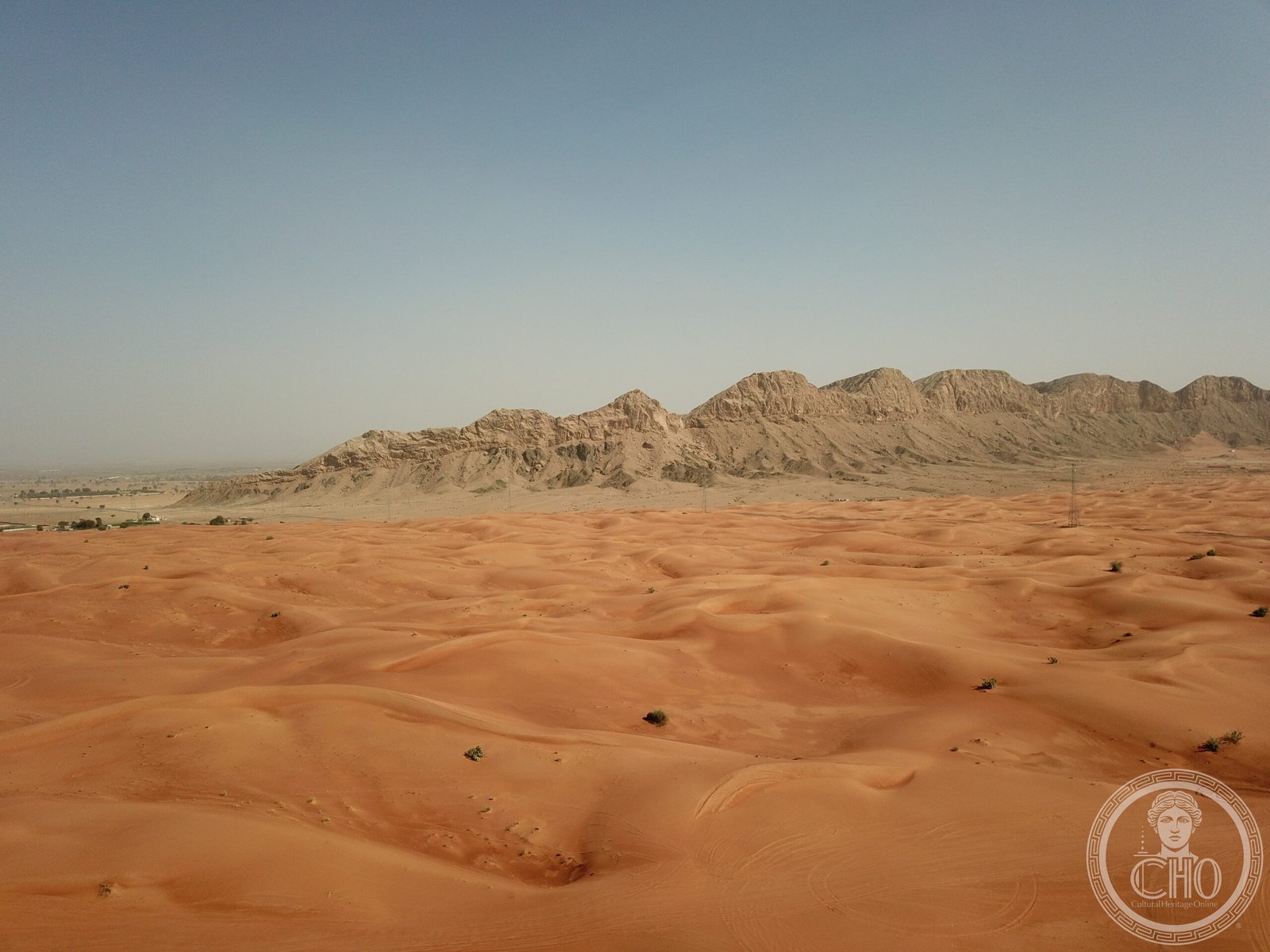
In the middle of the sand desert that covers the interior of the Emirate of Sharjah, where nothing grows today and no predator survives but the heat, an outcrop of reddish sandstone emerges from the dunes like a geological mirage: Jabal Al Fayah. 125,000 years ago — when glaciation had lowered sea level and turned the Arabian desert into a savannah crossed by rivers and lakes — this same spur of rock was a natural shelter for the first Homo sapiens who had left Africa. Found here: stone tools of the African lithic industry (Mode 3, typical of the Middle Stone Age), dated by optically stimulated luminescence to 125,000 years ago. This discovery rewrote the history of human dispersal. A UNESCO World Heritage site since 2023.
At a glance
Jabal Al Fayah (also spelled Jebel Faya) is a sandstone rock formation in the Emirate of Sharjah, inland UAE, inscribed by UNESCO in 2023 (ref. 1735). It is the most important Paleolithic archaeological site in the Arabian Peninsula: excavations (2003–present) by the Sharjah Directorate of Antiquities and the University of Tübingen have uncovered stone tool assemblages dated to 125,000 BP — the oldest evidence of Homo sapiens anywhere in Arabia. The tools are typologically African (Mode 3 / Middle Stone Age), confirming that the first human dispersal from Africa through Arabia occurred during an interglacial humid phase, 125,000 years ago — about 60,000 years earlier than previously believed from genetic evidence alone.
Key facts
- UNESCO: World Heritage since 2023 (Jabal Al Fayah, ref. 1735)
- Age: stone tools dated to 125,000 BP (optically stimulated luminescence); the oldest human presence in Arabia
- Significance: proves an early “Out of Africa” dispersal route through the Arabian Peninsula during humid interglacial periods (MIS 5e)
- Tools: Mode 3 (Levallois-related) and Mode 1 lithic technology; typologically African; no Neanderthal-type tools found
- Humidity cycles: Arabia became habitable (savanna, rivers, lakes) during interglacial humid phases; stone tools reflect at least 3 such phases at the site
- Museum: the Sharjah Museum of Archaeology and Ancient History houses the finds and has a dedicated Faya gallery
History
The discovery that changed our understanding of human prehistory came in 2011, when Hans-Peter Uerpmann (University of Tübingen) and the Sharjah Directorate of Antiquities published in Science their analysis of stone tools from three assemblages (FAY-NE1A, FAY-NE1B, FAY-NE1C) at Jabal Al Fayah, dated by OSL to 125,000, 95,000 and 40,000 years ago. The oldest assemblage contains hand axes and flakes of African type — not of Levantine (Neanderthal) type — confirming that the makers were anatomically modern humans, not Neanderthals.
The site overturns the “Late Dispersal” model (which placed the Out of Africa event at 60,000–70,000 BP via the Bab el-Mandeb strait) and supports instead the “Northern Route” model: during the interglacial MIS 5e (129,000–116,000 BP), sea levels were lower, the Red Sea was narrow, and the Sahara and Arabian deserts were replaced by savanna — allowing populations to move from Ethiopia through Yemen and Arabia toward South Asia. The Sharjah Emirate has invested heavily in the site’s presentation and the UNESCO nomination was formally completed in 2023.
What you see
Jabal Al Fayah rises about 15–20 m above the flat desert plain: a narrow sandstone ridge 1 km long, with rock shelters and overhangs that provided shade from the Pleistocene sun. The excavation trenches are visible from the visitor path; interpretation panels explain the stratigraphy and the OSL dating process. The rock shelters where the tools were found are enclosed but visible through protective fencing.
The surrounding landscape is flat desert (stone and sand), featureless but with a stark beauty. The Hajar mountains are visible on the eastern horizon.
Practical information
- Location: 40 km east of Sharjah city (inland from the coast); accessible by car on the Al Dhaid road (SH88)
- Sharjah Museum of Archaeology and Ancient History: contains the best displays of the finds; essential before or after the site visit; in Sharjah city
- Site visit: outdoor archaeological site; bring water, sun protection; guided tours available from Sharjah Tourism
- Best time: November–March (cooler; desert temperatures bearable)
Getting there
From Sharjah city: drive east on Al Dhaid Road (SH88) for approximately 40 km toward Al Dhaid town; the site is signposted. From Dubai: 70 km (1 hr on E611 + SH88). GPS: 25.11° N, 55.84° E.
Nearby
- Sharjah Museum of Archaeology and Ancient History — the essential companion to the site; 40 km west in Sharjah city
- Al Dhaid — an inland oasis town 15 km east of Faya; date palm groves; traditional falconry area
- Mleiha Archaeological Centre — another Sharjah prehistoric site, 30 km south; Bronze Age tombs and a visit centre
Sources
- UNESCO World Heritage Centre — “Jabal Al Fayah” (ref. 1735)
- Uerpmann et al. — “The Stone Age Sequence of the Jebel Faya Rock Shelter”, Science (2011)
- Sharjah Directorate of Antiquities — Jebel Faya reports
Find it on the map
See this place and what’s around it →📷 Become a Cultural Heritage Online photographer
Share your photos of places: they stay published under your name as the author. The more they're seen, the more you get noticed — and soon a contest will reward the most appreciated photos.
Log in or sign up free to add a photo