Guatemala has four UNESCO World Heritage Sites — a compact list that still spans rain-soaked Maya lowlands, Spanish Baroque streetscapes, and a newly recognised pre-classic ceremonial centre that reshapes how we understand the ancient Americas. Each property distils a different chapter of a country whose cultural and biological depth far outpaces its modest footprint on heritage maps. From Cultural Heritage Online.
Why Guatemala’s list looks the way it does
Four inscribed properties is a small number for a nation that harbours thousands of Maya archaeological sites, one of the best-preserved colonial capitals in the western hemisphere, and montane cloud forests classified among the most biodiverse on the planet. The disparity reflects both the selectivity of the UNESCO process and Guatemala’s limited institutional capacity to prepare the extensive documentation nominations require. Properties must demonstrate Outstanding Universal Value against ten criteria, supported by management plans and buffer zones — a process that can take a decade or more from first candidacy.
Guatemala’s tentative list, updated in recent years, signals where future nominations may emerge: the Cuchumatanes highlands, the Mirador-Río Azul archaeological region, and several cave systems with intact Maya painted records are among the candidates being developed. The 2023 inscription of Tak’alik Ab’aj, more than four decades after the first two sites were added, demonstrates that the list remains open — and that the country’s relationship with the World Heritage Convention is evolving rather than static.
The first inscriptions
Guatemala was among the earliest signatories to act on the 1972 World Heritage Convention. In 1979 — just seven years after the convention was adopted — two properties entered the list in the same session:
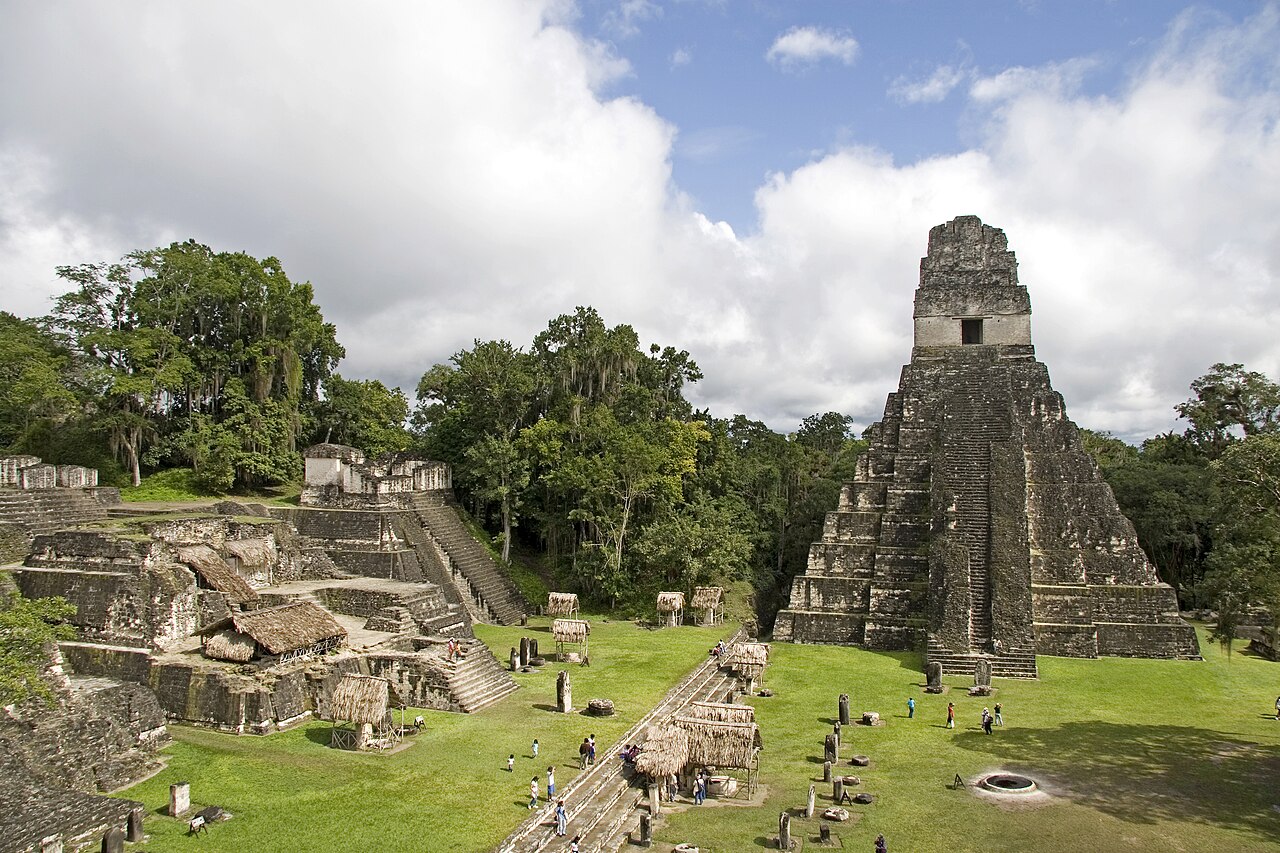
- Tikal National Park (1979, mixed) — the largest excavated Maya city in Guatemala, rising above the Petén rainforest canopy on a plateau that shelters jaguars, tapirs, and some 330 bird species alongside its temples.
- Antigua Guatemala (1979, cultural) — the former colonial capital, rebuilt repeatedly after earthquakes and preserved almost intact since the seat of government moved to the present capital in 1776.
Two years later a third site followed:
- Archaeological Park and Ruins of Quiriguá (1981, cultural) — a compact but exceptional Maya site on the Caribbean coastal plain, noted for the tallest carved stone monuments — stelae and zoomorphic altars — produced in the ancient Maya world.
The most visited — and the alternatives
Tikal draws the majority of Guatemala’s heritage tourism: its Temple I (the Temple of the Great Jaguar) appears on the national flag, and the site receives hundreds of thousands of visitors annually. Antigua is similarly prominent on the Central American travel circuit, its cobblestone grid and ochre-washed ruins of Baroque convents making it one of the most photographed colonial cities on the continent. Both properties justify their prominence, but neither exhausts what the list offers.
Quiriguá, located near the banana-plantation town of Los Amates, receives far fewer visitors despite containing Stela E — at around ten metres, the tallest free-standing Maya stela known to survive. The site is compact enough to cover in two hours, and its position at the confluence of Maya and lowland Caribbean cultural zones gives it a distinct character. Tak’alik Ab’aj, inscribed in 2023 on the Pacific piedmont near Retalhuleu, is the newest and least-visited property; it is notable as one of the few sites where Olmec and early Maya styles coexist in monumental sculpture, pointing to a transitional moment in Mesoamerican civilisation around 900–200 BCE.
Natural and shared sites
Guatemala has no purely natural World Heritage Sites. Tikal, however, carries a mixed designation — a status that recognises both its archaeological significance and the ecological integrity of the surrounding Petén forest. The park sits within the broader Maya Biosphere Reserve, the largest protected tropical forest north of the Amazon in Central America. Its natural values include critical habitat for threatened species including the harpy eagle and the scarlet macaw, as well as a continuous forest corridor connecting to neighbouring Belize and Mexico.
None of Guatemala’s inscribed properties form part of a transnational or serial World Heritage nomination, though the Mirador Basin — if successfully nominated — could eventually link with related Maya forest sites across Belize and Mexico. The country’s tentative list includes several properties with potential cross-border dimensions, reflecting a broader regional conversation about managing the Maya lowland landscape as an interconnected system rather than a set of isolated archaeological parks.
How to find them
The four inscribed sites span very different corners of the country. Antigua lies forty kilometres west of Guatemala City and is accessible by shuttle in under an hour. Tikal requires a flight or a full-day overland journey to the Petén department in the north. Quiriguá is reached from the Atlantic Highway in the southeast, typically as a half-day detour between Guatemala City and the Caribbean coast. Tak’alik Ab’aj sits on the Pacific coastal plain in Retalhuleu department, about two and a half hours southwest of the capital — a region rarely featured in standard itineraries despite its archaeological density.
Guatemala’s World Heritage sites sit alongside thousands of other places on CHO’s interactive map, with GPS and sourced editorial history for each. See also our guides to Italy’s and France’s UNESCO sites, and our piece on cultural travel beyond mass tourism.
Frequently Asked Questions
How many UNESCO World Heritage Sites does Guatemala have?
As of 2023, Guatemala has four inscribed UNESCO World Heritage Sites: Tikal National Park, Antigua Guatemala, the Archaeological Park and Ruins of Quiriguá, and the National Archaeological Park Tak’alik Ab’aj. Three are classified as cultural sites and one — Tikal — holds a mixed designation for both cultural and natural values.
What was Guatemala’s first UNESCO World Heritage Site?
Guatemala received its first two World Heritage inscriptions simultaneously in 1979: Tikal National Park and Antigua Guatemala. Both were among the earliest properties inscribed globally, just seven years after the World Heritage Convention was adopted in 1972.
What is the most recently inscribed World Heritage Site in Guatemala?
The National Archaeological Park Tak’alik Ab’aj was inscribed in 2023, making it Guatemala’s newest World Heritage Site. Located on the Pacific piedmont, it is significant for its coexistence of Olmec and early Maya monumental sculpture, dating to roughly 900–200 BCE.
Does Guatemala have any natural UNESCO World Heritage Sites?
Guatemala has no purely natural World Heritage Sites. Tikal National Park holds a mixed designation, recognised for both its exceptional Maya archaeological remains and the ecological integrity of the surrounding Petén rainforest, which forms part of the largest protected tropical forest in northern Central America.
Sources used in this article
- UNESCO — State Party Guatemala — World Heritage list.
- UNESCO — Guatemala: World Heritage Sites.
- CHO magazine — What is a World Heritage Site?
- CHO — Interactive map of heritage sites.