Mongolia has 6 UNESCO World Heritage Sites, a compact list that spans nomadic capitals on the steppe, Bronze Age ritual landscapes, ancient rock art, and vast transboundary lake basins shared with Russia. The country’s inscriptions reflect a civilisation built on movement — the Mongol Empire left almost no walled cities, yet it shaped the politics and trade routes of half the known world. Six sites encode that legacy with unusual clarity. From Cultural Heritage Online.
Why Mongolia’s list looks the way it does
Mongolia submitted its first World Heritage nomination only in 2003, a relative latecomer compared with European states that began registering sites in the 1970s. The delay partly reflects the country’s post-Soviet transition and the institutional effort required to prepare nomination dossiers. When submissions did arrive, they addressed landscapes at a scale that matches Mongolia’s geography: the Uvs Nuur Basin, the country’s inaugural inscription, covers roughly 1.07 million hectares straddling the Russian border.
The list divides into four cultural sites and two natural ones, with no mixed designations as of 2023. Several inscriptions are serial, bundling dispersed monuments under a single nomination rather than protecting a single bounded place. That approach suits a territory where cultural significance is spread across hundreds of kilometres of open steppe rather than concentrated in a single city or monument complex.
The first inscriptions
Mongolia’s World Heritage story began in 2003 with two simultaneous inscriptions that set the tone for everything that followed — one natural, one soon after cultural.
- Uvs Nuur Basin (2003) — a transboundary natural site shared with Russia, covering a closed drainage basin that functions as a reference ecosystem for Central Asian steppe, desert, and tundra biomes.
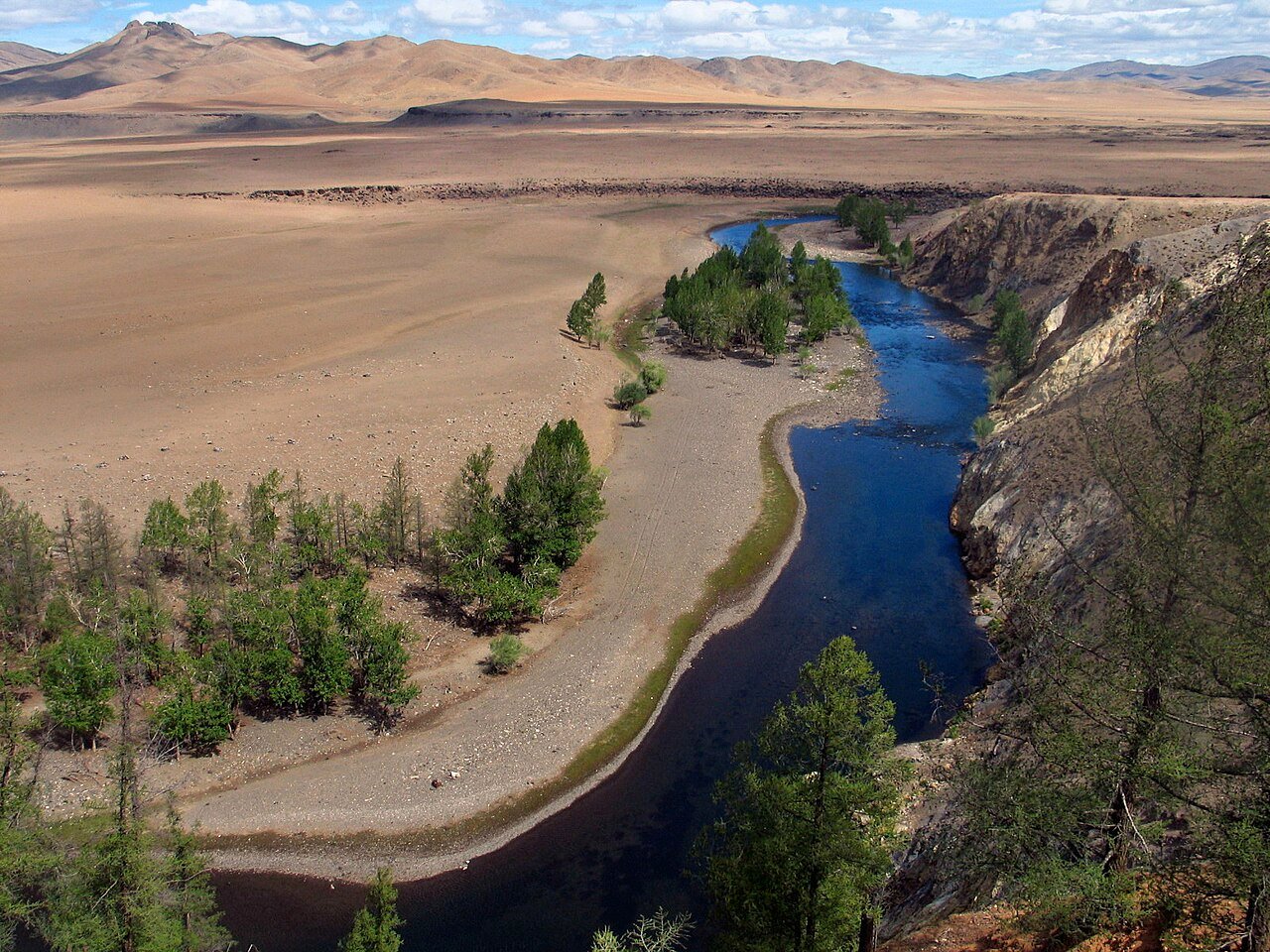
- Orkhon Valley Cultural Landscape (2004) — inscribed the following year, it encompasses pastureland along the Orkhon River that served as the political heartland of successive nomadic empires, including the Göktürks in the 8th century and the Mongol Empire under Chinggis Khan.
The Orkhon Valley quickly became Mongolia’s most recognised World Heritage Site, in part because it includes the ruins of Karakorum, the 13th-century Mongol capital, and the adjacent Erdene Zuu monastery, the earliest surviving Buddhist monastery in Mongolia.
The most visited — and the alternatives
The Orkhon Valley draws the largest share of heritage-focused visitors, and its combination of ruined capital, active monastery, and steppe scenery makes the concentration of significance there easy to understand. Travellers willing to look elsewhere, however, find inscriptions that receive far less international attention.
- Petroglyphic Complexes of the Mongolian Altai (2011) — rock carvings in the Altai mountains that depict animals including mammoths, rhinoceros, and ostriches, species that inhabited the region when the climate was significantly colder and drier than today, making the site an indirect record of prehistoric environmental change.
- Great Burkhan Khaldun Mountain and its surrounding sacred landscape (2015) — revered as the birthplace and probable burial place of Chinggis Khan, the mountain is a site of continuous pilgrimage and is protected under Mongolian law as a Strictly Protected Area.
- Deer Stone Monuments and Related Bronze Age Sites (2023) — Mongolia’s most recent inscription, comprising four clusters of engraved megaliths used for ceremonial and funerary practices during the late Bronze Age and early Iron Age, with characteristic carved deer figures that give the monuments their name.
Natural and shared sites
Both of Mongolia’s natural World Heritage Sites are transboundary designations shared with Russia. The Uvs Nuur Basin, inscribed in 2003, protects a closed salt lake and its surrounding ecosystems across the Tuva Republic and northern Mongolia. Because the basin has no outflow to the ocean, it serves as an especially sensitive indicator of regional climate patterns — a quality UNESCO recognised explicitly in the inscription.
The Landscapes of Dauria (2017) extends across the Eastern Steppe, a rolling grassland system that supports one of the world’s largest remaining populations of Mongolian gazelle. The site is managed jointly with the adjacent Russian Daurian Steppe Biosphere Reserve and reflects the ecological reality that migratory species do not observe national borders. Together, the two natural inscriptions cover ecosystems at a continental scale that few other World Heritage designations approach.
How to find them
Mongolia’s six World Heritage Sites are spread across an area roughly three times the size of France, and most require planning beyond a single city base. Ulaanbaatar serves as the practical starting point for visits to the Orkhon Valley and the Deer Stone clusters; the Altai petroglyphs and Burkhan Khaldun are more remote and typically reached by organised expedition or chartered transport. The Uvs Nuur Basin and Dauria landscapes are primarily of interest to researchers and dedicated nature travellers, with limited tourism infrastructure on-site.
Mongolia’s World Heritage sites sit alongside thousands of other places on CHO’s interactive map, with GPS and sourced editorial history for each. See also our guides to Italy’s and France’s UNESCO sites, and our piece on cultural travel beyond mass tourism.
Frequently Asked Questions
How many UNESCO World Heritage Sites does Mongolia have?
Mongolia has 6 UNESCO World Heritage Sites as of 2023. The list comprises four cultural sites and two natural sites, with both natural designations shared transnationally with Russia.
What was Mongolia’s first UNESCO World Heritage Site?
Mongolia’s first inscription was the Uvs Nuur Basin in 2003, a transboundary natural site shared with Russia covering a closed salt lake and surrounding steppe, desert, and tundra ecosystems. The Orkhon Valley Cultural Landscape followed in 2004 and became the country’s most widely visited heritage site.
Which of Mongolia’s UNESCO sites is the most recently inscribed?
The Deer Stone Monuments and Related Bronze Age Sites received World Heritage status in 2023, making it Mongolia’s most recent inscription. The site comprises four clusters of carved megaliths dating to the late Bronze Age and early Iron Age, known for engraved deer figures used in ceremonial and funerary contexts.
Does Mongolia share any UNESCO World Heritage Sites with other countries?
Yes, both of Mongolia’s natural World Heritage Sites are transboundary designations shared with Russia. The Uvs Nuur Basin (2003) and the Landscapes of Dauria (2017) each extend across the Russian border and are managed under bilateral agreements between the two countries.
Sources used in this article
- UNESCO — State Party Mongolia — World Heritage list.
- UNESCO — Mongolia: World Heritage Sites.
- CHO magazine — What is a World Heritage Site?
- CHO — Interactive map of heritage sites.