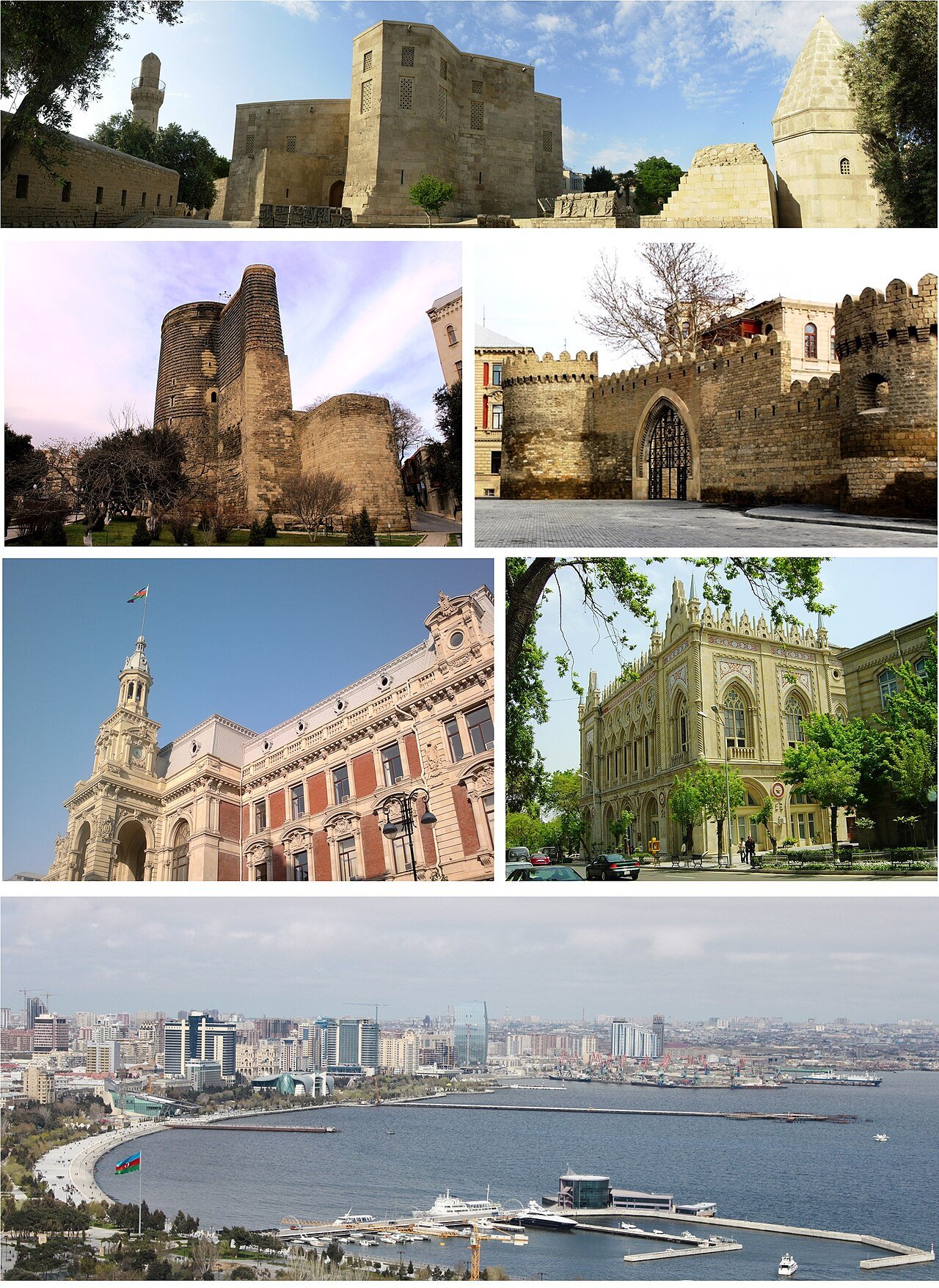
Azerbaijan has five UNESCO World Heritage Sites, ranging from a medieval Caspian walled city to ancient rock carvings, a silk-trade palace town, a high-altitude transhumance landscape, and a rare tract of primeval forest shared with Iran. Positioned where the Caucasus meets the Caspian shore, the country’s inscriptions reflect trade routes, pastoral traditions, and an extraordinary geological record that stretches back millennia. From Cultural Heritage Online.
Why Azerbaijan’s list looks the way it does
Azerbaijan joined the World Heritage Convention relatively recently in terms of its inscription record, placing its first site in 2000. The five sites inscribed by 2023 span three categories: three cultural, one natural, and one mixed cultural landscape. That spread is not accidental — the country occupies a corridor between ancient civilisations, and each inscription captures a different layer of that position, from Zoroastrian-influenced petroglyph traditions to Silk Road merchant architecture to seminomadic herding routes still practiced today.
The 2023 additions brought Azerbaijan’s tally to five and marked a particular shift: both new inscriptions draw attention to living or once-living cultural and ecological systems rather than single monumental structures. The Hyrcanian Forests, shared with Iran, represent a type of temperate forest that once covered much of the northern hemisphere and has survived here largely intact. The transhumance route of the Khinalig people documents a way of life practiced at altitudes above 2,300 metres.
The first inscriptions
Azerbaijan’s entry onto the World Heritage list happened in a single step in 2000, with one inscription that anchored the entire programme:
- Walled City of Baku with the Shirvanshah’s Palace and Maiden Tower (2000) — the medieval core of the capital, enclosing two of the South Caucasus’s most significant pre-modern structures within a fortified urban fabric
The inscription covers the historic inner city known as Icheri Sheher, a walled enclosure that predates the Baku oil boom by centuries. The Shirvanshah’s Palace complex served as the seat of a dynasty that ruled much of present-day Azerbaijan between the 9th and 16th centuries. The Maiden Tower, a cylindrical structure of uncertain original function, remains one of the most studied and debated monuments in the region, with proposed interpretations ranging from a defensive watchtower to a Zoroastrian fire temple.
The most visited — and the alternatives
The Walled City of Baku draws the majority of international visitors to Azerbaijan’s heritage sites, sitting at the heart of a capital that has seen significant urban investment over the past two decades. Gobustan Rock Art Cultural Landscape, inscribed in 2007, is the second-best known site — a plateau southwest of Baku holding more than 6,000 rock carvings depicting human figures, animals, plants, and hunting and fishing scenes across a span of millennia. It also contains ancient mud volcanoes and remnants of camp sites.
Less visited, but worth attention, are the following:
- Historic Centre of Sheki with the Khan’s Palace (2019) — a merchant city whose wealth derived from 18th- and 19th-century silkworm breeding; the Khan’s Palace is notable for its stained-glass window panels, known as shebeke, assembled without adhesive or nails
- Cultural Landscape of Khinalig People and ‘Köç Yolu’ Transhumance Route (2023) — a mixed site documenting the seasonal migration of the Khinalig people between high summer pastures above 2,300 metres and lower winter grazing lands, a practice that has shaped both the landscape and the community’s distinct language and identity
Natural and shared sites
Azerbaijan holds one natural World Heritage inscription: the Hyrcanian Forests, added in 2023 as a transnational extension of Iran’s 2019 inscription of the same forest belt. The Hyrcanian zone is a temperate broadleaf deciduous forest biome stretching along the southern slopes of the Caucasus and the northern slopes of the Alborz range. Scientists consider it a Tertiary relict — a surviving fragment of the forests that once covered much of the mid-latitude northern hemisphere before the Pleistocene glaciations reshaped the climate. Species diversity in the Hyrcanian belt is unusually high relative to comparable forest systems elsewhere in the region.
The transnational character of the inscription matters practically: conservation of this forest type cannot be achieved by either country alone, since the corridor of habitat crosses the international boundary. Azerbaijan’s portion adds a northern buffer to the forest system already recognised in Iran, and the combined inscription places pressure on both governments to coordinate land management and resist encroachment from agriculture and infrastructure development.
How to find them
All five sites are accessible by road, though journey times from Baku vary considerably. The Walled City is walkable from the city centre. Gobustan lies roughly an hour’s drive southwest. Sheki requires a half-day journey northwest by road or rail. The Khinalig transhumance landscape is situated in the high mountains of the Quba district and involves mountain roads that may be seasonal. The Hyrcanian Forests are located in the Lerik and Astara districts along the Iranian border, in the country’s far southeast.
Azerbaijan’s World Heritage sites sit alongside thousands of other places on CHO’s interactive map, with GPS and sourced editorial history for each. See also our guides to Italy’s and France’s UNESCO sites, and our piece on cultural travel beyond mass tourism.
Frequently Asked Questions
How many UNESCO World Heritage Sites does Azerbaijan have?
Azerbaijan has five UNESCO World Heritage Sites as of 2023. Three are classified as cultural, one as natural, and one as a mixed cultural landscape. The most recent additions — the Hyrcanian Forests and the Cultural Landscape of Khinalig People — were both inscribed in 2023.
What was Azerbaijan’s first UNESCO World Heritage Site?
The Walled City of Baku with the Shirvanshah’s Palace and Maiden Tower was Azerbaijan’s first UNESCO inscription, added to the World Heritage List in 2000. It encompasses the medieval fortified inner city of the capital, known locally as Icheri Sheher, along with two of its most significant historic monuments.
Does Azerbaijan have any natural UNESCO World Heritage Sites?
Yes. The Hyrcanian Forests, inscribed in 2023, are Azerbaijan’s only natural World Heritage Site. They form part of a transnational designation shared with Iran and protect a Tertiary relict forest belt along the southern Caucasus and the Caspian littoral — one of the most biodiverse temperate forest systems in the region.
What makes the Gobustan Rock Art site significant?
Gobustan Rock Art Cultural Landscape, inscribed in 2007, contains more than 6,000 rock carvings made over thousands of years, depicting humans, animals, and scenes of hunting and fishing. The site also features mud volcanoes and ancient camp remains, giving it value as both an archaeological record and a geological phenomenon.
Sources used in this article
- UNESCO — State Party Azerbaijan — World Heritage list.
- UNESCO — Azerbaijan: World Heritage Sites.
- CHO magazine — What is a World Heritage Site?
- CHO — Interactive map of heritage sites.
Sources
- S1 — Swietochowski, Tadeusz. Russia and Azerbaijan: A Borderland in Transition. Columbia University Press, 1995. ISBN 978-0-231-07068-3.
- S2 — Altstadt, Audrey L. The Azerbaijani Turks: Power and Identity Under Russian Rule. Hoover Institution Press, 1992. ISBN 978-0-8179-9182-1.
Spotted an error? Write to editorial@culturalheritageonline.com and we correct it the same day.