Sri Lanka has 8 UNESCO World Heritage Sites — six cultural and two natural — spanning ancient hydraulic capitals, a Portuguese-Dutch fortified harbour, cloud-forest highland ecosystems, and a 5th-century rock citadel that still stops visitors in their tracks. From Buddhist kingdoms that predated Rome’s fall to colonial-era walls flush with seawater, the island’s list compresses several thousand years of continuous civilisation into a remarkably coherent portrait. From Cultural Heritage Online.
Why Sri Lanka’s list looks the way it does
Sri Lanka’s eight inscriptions reflect two distinct layers of significance. The northern and north-central Cultural Triangle — roughly a triangle linking Anuradhapura, Polonnaruwa, and Kandy — preserves the uninterrupted arc of Sinhalese Buddhist statecraft from the 3rd century BCE through the 18th century CE. These capitals were not simply royal seats; they were elaborate ritual landscapes where kingship, water management, and religious architecture formed a single, interdependent system.
The southern and upland sites add a second dimension: the long encounter between that indigenous civilisation and European maritime power, and the extraordinary biodiversity the island’s geography has protected. Together, the eight sites represent a country that was historically both a crossroads of Indian Ocean trade and a cultural producer in its own right — not merely a waypoint.
The first inscriptions
Sri Lanka entered the World Heritage List in 1982 with three simultaneous inscriptions, a cluster that signalled UNESCO’s recognition of the Cultural Triangle as an ensemble rather than isolated monuments. All three remain among the most visited heritage sites on the island.
- Sacred City of Anuradhapura (1982) — Sri Lanka’s first capital, continuously inhabited from the 4th century BCE and home to some of the oldest surviving brick structures in the world.
- Ancient City of Polonnaruwa (1982) — The medieval capital that succeeded Anuradhapura, celebrated for its 12th-century hydraulic engineering and the serene Gal Vihara rock-cut Buddha sculptures.
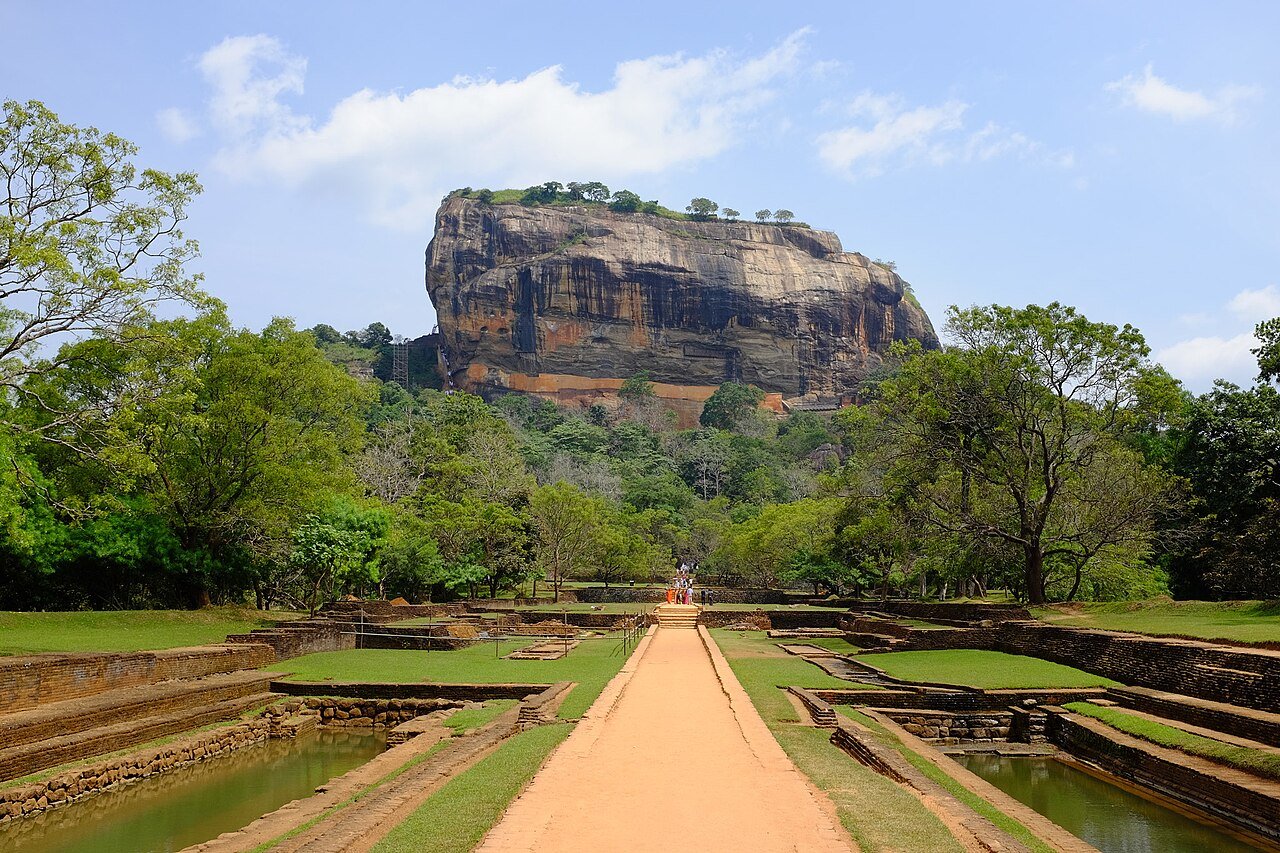
- Ancient City of Sigiriya (1982) — A 5th-century royal palace and fortress built atop a volcanic plug 200 metres above the surrounding plain, with surviving fresco galleries and a sophisticated system of water gardens at its base.
The most visited — and the alternatives
Sigiriya draws the largest crowds by a considerable margin, and with good reason: the ascent past lion’s-paw gateway ruins to a summit terrace with 360-degree views of the surrounding forest is among the most dramatic heritage experiences in South Asia. Polonnaruwa, with its compact archaeological park navigable by bicycle, runs a close second in visitor numbers. Kandy, the last royal capital before British annexation in 1815, anchors the island’s living Buddhist tradition — its Temple of the Tooth Relic remains an active place of worship, not a museum.
Visitors who look beyond those three find considerable reward. The Rangiri Dambulla Cave Temple (1991), the largest and best-preserved Buddhist cave complex in Sri Lanka, contains five separate shrines carved into natural caverns, their ceilings and walls covered in painting across successive centuries. The Old Town of Galle (1988), on the island’s southwestern tip, is the most intact example of a European-built fortified city in South and Southeast Asia — its Dutch-era ramparts include an innovative seawater-flushed sewer system still functioning today. The Sacred City of Kandy itself, sometimes overlooked as a “gateway” destination, rewards slower attention: the Dalada Maligawa complex and the royal botanical gardens at Peradeniya together constitute a landscape of remarkable deliberate design.
Natural and shared sites
Sri Lanka’s two natural sites protect ecosystems that are globally significant rather than merely scenic. The Sinharaja Forest Reserve (1988) is the island’s last substantial tract of primary tropical rainforest, sheltering an exceptional proportion of endemic species — roughly 60 percent of the island’s endemic trees are found here, along with rare birds, reptiles, and mammals found nowhere else on earth. Access is deliberately limited and best arranged through the Forest Department.
The Central Highlands of Sri Lanka (2010), the most recently inscribed site, encompasses three protected areas — Horton Plains National Park, Knuckles Conservation Forest, and Peak Wilderness Protected Area — forming together the least-disturbed remaining expanse of submontane and montane rain forest on the island. The highlands feed eight of Sri Lanka’s major rivers and constitute a functioning watershed for a large portion of the island’s population. Neither natural site involves transnational or serial arrangements; both are wholly within Sri Lanka’s borders, as are all eight inscriptions.
How to find them
The six cultural sites are clustered enough that a two-week itinerary can reach all of them, with internal rail and road connections well established between the main nodes. Dambulla and Sigiriya sit close enough to each other to share a base. Galle and the Central Highlands each require a separate southward or upward detour from the Kandy axis. Sinharaja is best reached independently via the town of Deniyaya on the island’s southwestern flank.
Sri Lanka’s World Heritage sites sit alongside thousands of other places on CHO’s interactive map, with GPS and sourced editorial history for each. See also our guides to Italy’s and France’s UNESCO sites, and our piece on cultural travel beyond mass tourism.
Frequently Asked Questions
How many UNESCO World Heritage Sites does Sri Lanka have?
As of 2022, Sri Lanka has 8 UNESCO World Heritage Sites. Six are classified as cultural and two as natural, with no mixed-category inscriptions on the list.
What was Sri Lanka’s first UNESCO World Heritage Site?
Sri Lanka received its first World Heritage inscriptions in 1982, when three sites were listed simultaneously: the Sacred City of Anuradhapura, the Ancient City of Polonnaruwa, and the Ancient City of Sigiriya. All three remain among the island’s most significant heritage destinations.
What is Sri Lanka’s most recently inscribed World Heritage Site?
The Central Highlands of Sri Lanka, inscribed in 2010, is the country’s most recent addition to the World Heritage List. It covers three protected highland areas — Horton Plains, the Knuckles Conservation Forest, and Peak Wilderness — and is recognised primarily for its submontane and montane rain forest ecosystems.
Does Sri Lanka have any natural UNESCO World Heritage Sites?
Sri Lanka has two natural World Heritage Sites: the Sinharaja Forest Reserve, inscribed in 1988 for its primary tropical rainforest and exceptional endemism, and the Central Highlands, inscribed in 2010 for its highland rain forest and role as a watershed for the island’s major rivers.
Sources used in this article
- UNESCO — State Party Sri Lanka — World Heritage list.
- UNESCO — Sri Lanka: World Heritage Sites.
- CHO magazine — What is a World Heritage Site?
- CHO — Interactive map of heritage sites.