Bulgaria has 10 UNESCO World Heritage Sites, a compact list that spans Thracian rock tombs, medieval monastery complexes, Byzantine fresco cycles, and mountain old-growth forest. The range is striking for a country of its size: from a lone equestrian relief carved into a cliff face to one of the best-preserved beech forest networks in Europe, Bulgaria’s inscribed places reward travellers willing to go beyond the obvious. From Cultural Heritage Online.
Why Bulgaria’s list looks the way it does
Bulgaria joined UNESCO’s World Heritage Convention early, and the results show: four of its ten sites were inscribed in 1979, the very first year the country participated. That initial wave drew heavily on Thracian and medieval heritage — periods when the territory that is now Bulgaria sat at the crossroads of Eurasian and Byzantine cultural exchange. The list has grown steadily since, with the most recent addition coming in 2017.
Of the ten sites, seven are classified as cultural and three as natural. The natural inscriptions reflect the country’s position at the edge of the Balkans, where sub-Mediterranean and continental ecosystems converge. The cultural sites span roughly two millennia, from pre-Christian Thracian funerary art through medieval Orthodox Christianity to the syncretic Renaissance architecture of the Bulgarian National Revival period.
The first inscriptions
In 1979, Bulgaria placed four sites on the World Heritage List in a single year — a confident opening statement about the depth of its heritage. Those inaugural inscriptions were:
- Boyana Church — a two-nave medieval church on the outskirts of Sofia, with 13th-century frescoes of exceptional quality.
- Madara Rider — a large rock relief carved into a cliff face at 23 metres’ height, depicting a horseman triumphing over a lion, dated to around the early 8th century.
- Rock-Hewn Churches of Ivanovo — a complex of cave churches near Ruse decorated with 14th-century frescoes in the Palaeologan style.
- Thracian Tomb of Kazanlak — a beehive-shaped burial chamber in the Valley of the Roses, with vivid painted scenes of Thracian life.
Together, these four sites established a pattern that would continue: Bulgaria’s nominations tend to be tightly focused on a single monument or small complex, rather than broad cultural landscapes. That specificity makes each site legible on its own terms.
The most visited — and the alternatives
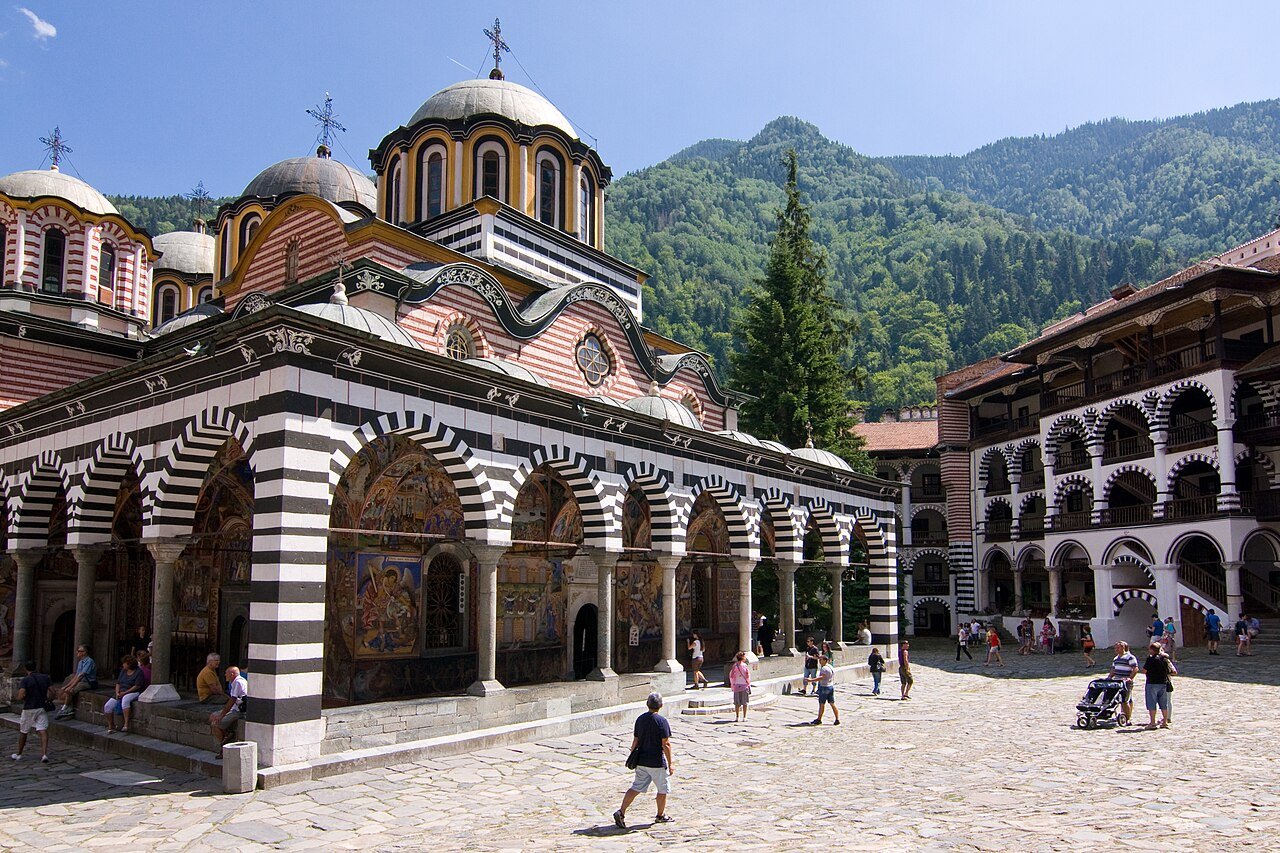
Rila Monastery draws the largest crowds, and justifiably so. Founded in the 10th century and rebuilt in its present form in the 19th, it occupies a forested mountain valley in the Rila range and represents the fullest expression of Bulgarian National Revival architecture at monastic scale. Pirin National Park, also in southwestern Bulgaria, pulls hikers and skiers to its glacial lakes and high limestone peaks. These two destinations anchor most heritage itineraries in the country.
Beyond the familiar names, the list offers quieter alternatives worth seeking out. The Thracian Tomb of Sveshtari, inscribed in 1985, contains a burial chamber whose half-female, half-plant caryatid figures are unlike anything else surviving from the Thracian world. Srebarna Nature Reserve, a small wetland on the Danube floodplain, holds one of the last intact colonies of Dalmatian pelicans in Europe. The Rock-Hewn Churches of Ivanovo sit above the Rusenski Lom river and remain relatively uncrowded despite frescoes that art historians rank among the finest of the late Byzantine period.
Natural and shared sites
Bulgaria’s three natural inscriptions cover very different ecosystems. Srebarna Nature Reserve (1983) protects a shallow lake and reed-bed complex on the Danube that serves as a staging ground for migratory birds. Pirin National Park (1983, extended 2010) covers high-altitude terrain with glacial cirques, karst springs, and Bosnian pine stands that can live for over a thousand years. Both are entirely within Bulgarian territory.
The third natural site is transnational. In 2017, nine forest massifs within Bulgaria’s Central Balkan National Park were incorporated into the expanding serial nomination known as the Ancient and Primeval Beech Forests of the Carpathians and Other Regions of Europe — a property now shared with 18 countries across the continent. This inscription places Bulgaria’s old-growth beech stands within a Europe-wide conservation framework, recognising their significance not just nationally but as part of the continent’s largest remaining temperate forest ecosystem.
How to find them
Bulgaria’s World Heritage Sites are distributed across the country, from the Danube floodplain in the northeast to the Rila and Pirin ranges in the southwest. Several cluster conveniently: Boyana Church is on the edge of Sofia, making it an easy half-day excursion. Kazanlak and the Valley of the Roses are accessible from Plovdiv. The Ivanovo churches and Sveshtari tomb both lie in the northeast, within a few hours of each other.
Bulgaria’s World Heritage sites sit alongside thousands of other places on CHO’s interactive map, with GPS and sourced editorial history for each. See also our guides to Italy’s and France’s UNESCO sites, and our piece on cultural travel beyond mass tourism.
Frequently Asked Questions
How many UNESCO World Heritage Sites does Bulgaria have?
Bulgaria has 10 UNESCO World Heritage Sites as of 2022, comprising 7 cultural sites and 3 natural sites. The list spans prehistoric Thracian tombs, medieval Orthodox monuments, and mountain and wetland ecosystems in the Balkans.
What was Bulgaria’s first UNESCO World Heritage Site?
Bulgaria inscribed four sites simultaneously in 1979 — its first year of participation in the World Heritage Convention. Those inaugural sites were Boyana Church, the Madara Rider, the Rock-Hewn Churches of Ivanovo, and the Thracian Tomb of Kazanlak.
Does Bulgaria have any transnational UNESCO sites?
Yes. In 2017, nine forest massifs within Bulgaria’s Central Balkan National Park were added to the Ancient and Primeval Beech Forests of the Carpathians and Other Regions of Europe, a serial transnational site now shared with 18 other European countries. It is Bulgaria’s most recently inscribed World Heritage property.
What are Bulgaria’s natural UNESCO World Heritage Sites?
Bulgaria has three natural inscriptions: Srebarna Nature Reserve, a Danube wetland hosting one of Europe’s last Dalmatian pelican colonies; Pirin National Park, a high-altitude mountain area with glacial lakes and ancient Bosnian pines; and the Bulgarian component of the Ancient and Primeval Beech Forests transnational serial site.
Sources used in this article
- UNESCO — State Party Bulgaria — World Heritage list.
- UNESCO — Bulgaria: World Heritage Sites.
- CHO magazine — What is a World Heritage Site?
- CHO — Interactive map of heritage sites.