Hungary has eight UNESCO World Heritage Sites, spanning Roman burial chambers and monastic hilltops, an inland sea shared with Austria, a vast steppe protected as a national park, and a wine region whose terraced hillsides have been shaped by human hands for centuries. From Cultural Heritage Online.
Why Hungary’s list looks the way it does
Hungary sits at a crossroads where Central European, Roman, and Pannonian traditions converge. Its UNESCO list reflects that layering: Baroque and Gothic architecture rises over Roman foundations; folk traditions survive in a single Palóc village; and the Great Plain carries traces of pastoral life stretching back millennia. Seven of the country’s eight sites carry the cultural designation, a ratio that underscores how deeply Hungary’s significance is tied to human activity across the landscape rather than untouched wilderness.
The single natural inscription does significant work on its own. The karst cave system Hungary shares with Slovakia represents one of the most complete temperate-zone cave networks anywhere in the world, encompassing more than 700 individual caves and illustrating geological processes that span millions of years. It is, by any measure, the outlier on a list otherwise defined by centuries of architecture and land use.
The first inscriptions
Hungary joined the World Heritage Convention early, receiving its first two inscriptions at the 1987 session of the World Heritage Committee. Both sites have since become defining reference points for Hungarian heritage:
- Budapest, including the Banks of the Danube, the Buda Castle Quarter and Andrássy Avenue — the capital’s sweeping riverside panorama and its layered built fabric from Roman Aquincum to the neo-Gothic Parliament.
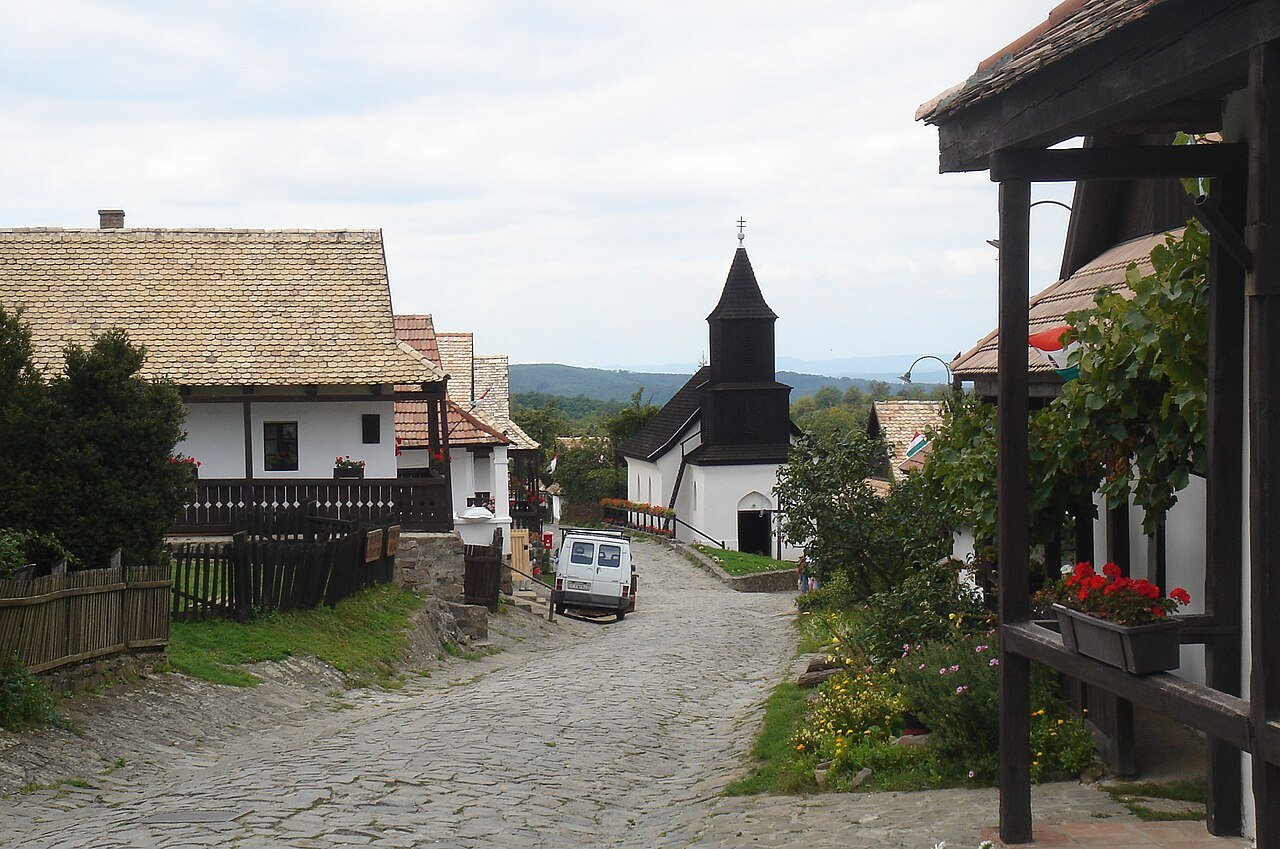
- Old Village of Hollókő and its Surroundings — a living Palóc farming settlement in the Cserhát hills, recognised as an outstanding example of rural vernacular architecture that evolved organically before industrialisation reshaped Central European villages.
The pairing is telling: a major capital and a small village inscribed in the same year, signalling that Hungary’s case to UNESCO rested on the full range of its heritage rather than on monuments alone.
The most visited — and the alternatives
Budapest and, to a lesser degree, the Tokaj Wine Region Historic Cultural Landscape attract the bulk of international attention. The capital’s Castle Hill, Chain Bridge, and Parliament building are among the most photographed subjects in Central Europe. Tokaj, inscribed in 2002 as the most recent addition to Hungary’s list, draws visitors familiar with the historic sweet wines produced on its volcanic soils — and offers some of the country’s most photogenic vineyard terracing.
Three other inscriptions reward the effort to look beyond the main circuits:
- Pannonhalma Archabbey (1996) — founded in 996 and still an active Benedictine community, the monastery’s hillside silhouette incorporates Gothic, Baroque, and Romantic construction phases across a millennium of continuous use.
- Early Christian Necropolis of Pécs (2000) — fourth-century Roman provincial burial chambers decorated with Christian-themed murals, among the most important early Christian funerary monuments in Central Europe.
- Hortobágy National Park (1999) — the Great Plain at its most elemental, where the Nine-arched Bridge and the csikós horsemanship tradition persist alongside one of the largest continuous grassland ecosystems in Europe.
Natural and shared sites
The Caves of Aggtelek Karst and Slovak Karst, jointly inscribed with Slovakia, represent Hungary’s sole natural World Heritage property. The system’s more than 700 caves — including Baradla, one of the largest stalactite caves in Europe — document karst formation processes in a temperate climate zone rarely represented at this scale on the World Heritage List. Access from the Hungarian side centres on the village of Aggtelek in the north of the country, close to the Slovak border.
Hungary’s second transnational inscription is the Fertő/Neusiedlersee Cultural Landscape, shared with Austria. The Fertő lake basin has supported human settlement for some 5,000 years, and its combination of shallow steppe lake, reed marshes, and surrounding Baroque estate architecture creates a landscape unlike anywhere else in Central Europe. The site straddles the border and is best understood as a single ecological and cultural unit that political geography has divided into two national zones.
How to find them
Hungary’s World Heritage sites sit alongside thousands of other places on CHO’s interactive map, with GPS and sourced editorial history for each. See also our guides to Italy’s and France’s UNESCO sites, and our piece on cultural travel beyond mass tourism.
Frequently Asked Questions
How many UNESCO World Heritage Sites does Hungary have?
Hungary has eight UNESCO World Heritage Sites as of the most recent available data. Seven are classified as cultural sites and one — the Caves of Aggtelek Karst and Slovak Karst — is a natural inscription shared with Slovakia.
What was Hungary’s first UNESCO World Heritage Site?
Hungary received its first two inscriptions simultaneously in 1987: Budapest (including the Banks of the Danube, the Buda Castle Quarter, and Andrássy Avenue) and the Old Village of Hollókő and its Surroundings. Both were recognised at the 11th session of the World Heritage Committee in Paris.
Does Hungary have any transnational UNESCO World Heritage Sites?
Yes, Hungary holds two transnational inscriptions. The Caves of Aggtelek Karst and Slovak Karst is shared with Slovakia, while the Fertő/Neusiedlersee Cultural Landscape is shared with Austria. Both sites are best understood as single cross-border units that span two national territories.
What is the most recently inscribed UNESCO site in Hungary?
The Tokaj Wine Region Historic Cultural Landscape, inscribed in 2002, is Hungary’s most recent World Heritage inscription. The site recognises a wine-producing area whose volcanic hillside terracing and centuries of viticulture tradition have shaped the landscape into a distinctive cultural property.
Sources used in this article
- UNESCO — State Party Hungary — World Heritage list.
- UNESCO — Hungary: World Heritage Sites.
- CHO magazine — What is a World Heritage Site?
- CHO — Interactive map of heritage sites.
Sources
- S1 — Molnár, Miklós. A Concise History of Hungary. Cambridge University Press, 2001. ISBN 978-0-521-66736-4.
- S2 — Kontler, László. A History of Hungary: Millennium in Central Europe. Palgrave Macmillan, 2002. ISBN 978-1-4039-0316-7.
Spotted an error? Write to editorial@culturalheritageonline.com and we correct it the same day.