
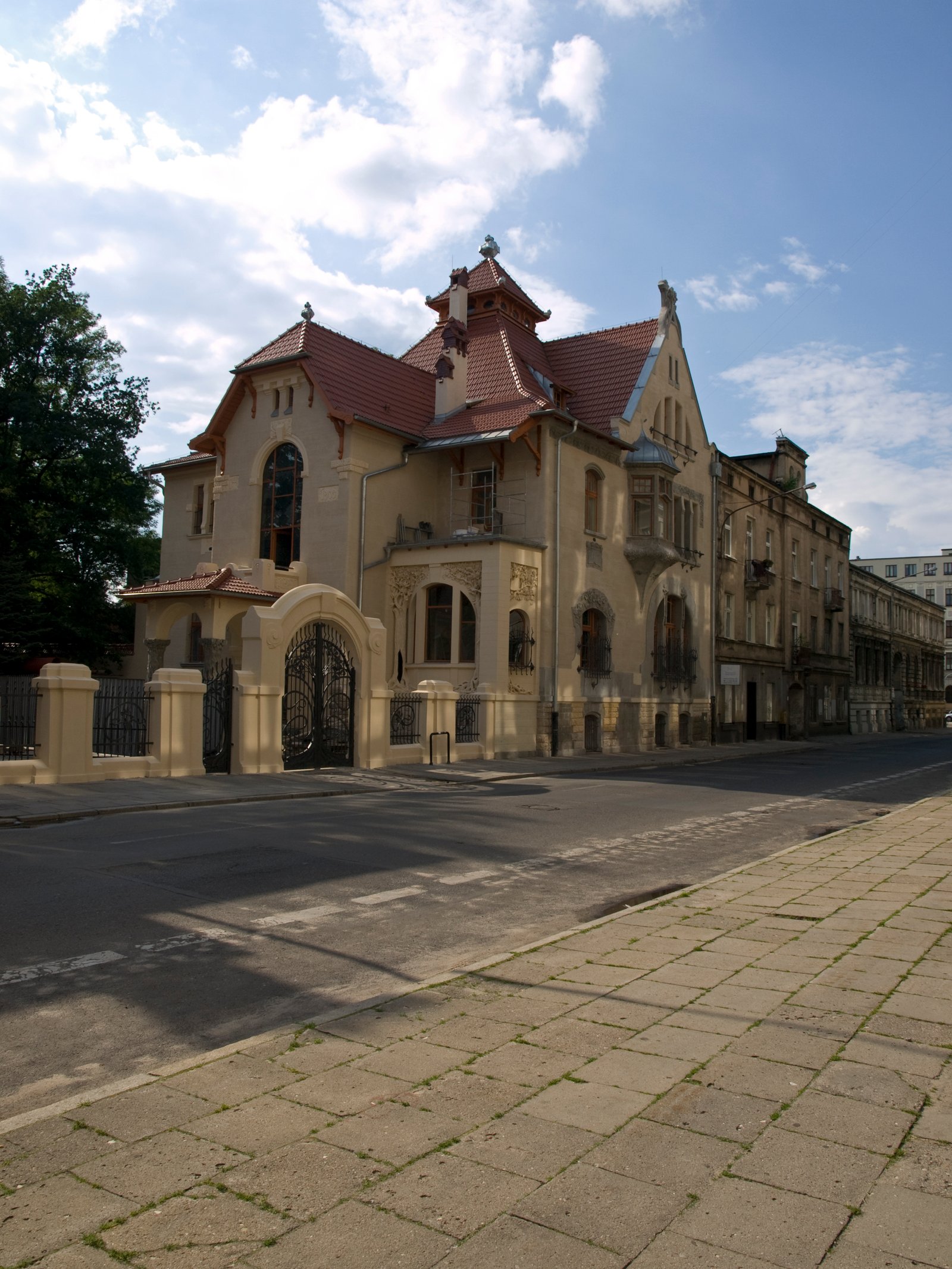
Łódź’s Art Nouveau jewel — a villa under carved apple boughs, built for a textile heir and now a gallery, its stained glass and curling stucco intact.
At a glance
The Leopold Kindermann Villa on Wólczańska Street is the finest piece of Art Nouveau in Łódź and one of the best in Poland. Gustaw Landau-Gutenteger designed it around 1901 for the textile manufacturer Leopold Kindermann and his wife Laura, building it in 1902–03 on a plot that came as part of Laura’s dowry. Asymmetrical and restless, covered inside and out in carved leaves and apple boughs — Łódź nicknamed it “the villa under the apple trees” — it kept a wooden grand staircase, a great allegorical stained-glass window and, unusually for the time, central heating. Since the 1970s it has been a public art gallery.
Key facts
- Location: Wólczańska 31, Łódź, Poland
- Built: 1902–1903; designed by Gustaw Landau-Gutenteger (c. 1901)
- For: the textile industrialist Leopold Kindermann (1869–1917) and his wife Laura
- Style: Art Nouveau (Secession), asymmetrical, with nature-inspired carving
- Nickname: “the villa under the apple trees” (willa pod jabłoniami)
- Now: the Villa Gallery and Chimera Gallery, branches of the Municipal Gallery of Art
History
By 1900 Łódź’s industrialists had built their palaces in every revived historical style; the next generation reached instead for Art Nouveau, the style of the moment across Europe. Leopold Kindermann, heir to a cotton-and-wool manufacturing family, was among them. On a plot at Wólczańska 31 that came with his wife Laura’s dowry, he had the architect Gustaw Landau-Gutenteger design a villa in the new manner.
Built in 1902–03, the house is pure Art Nouveau. Its form is asymmetrical and dynamic; its decoration, inside and out, runs to leaves, flowers and apple boughs — the source of its Łódź nickname, “the villa under the apple trees”. The hall holds a wooden staircase rising to a galleried landing and a large stained-glass window with an allegorical female figure among geometric and floral motifs. The villa even had central heating, its fireplaces kept for show. Political unrest delayed the family’s move until 1908.
The Kindermann fortune, like the city’s others, was undone by war and nationalisation. From the 1970s the villa passed to the city as an exhibition space, and a careful restoration in 2010–13 returned its stucco, woodwork and glass. It now houses the Villa Gallery and the Chimera Gallery, branches of the Municipal Gallery of Art in Łódź.
What you see
The exterior is the first surprise: a villa that refuses straight lines, its gables, balconies and window frames flowing into carved foliage, with apple branches worked into the plaster. It is small beside the cotton barons’ palaces, but far more inventive.
Inside, the Art Nouveau survives where it matters. The wooden staircase climbs to its gallery; the stained-glass window throws coloured light across the hall; the moulded ceilings keep their leaves and flowers. As a working gallery, the house now shows contemporary art against its own ornament — the building itself the best exhibit.
Practical information
- The villa is the Villa Gallery (Municipal Gallery of Art); check the gallery for opening times and current exhibitions
- A short walk from Piotrkowska Street in central Łódź
- Allow 30–45 minutes
- The interior is best appreciated alongside whatever exhibition is on
Getting there
The villa is at Wólczańska 31, a block west of Piotrkowska Street in central Łódź. The centre is easily walked or reached by tram; Łódź lies about 130 km south-west of Warsaw, with frequent trains.
Nearby
- Piotrkowska Street
- The Izrael Poznański Palace and Manufaktura
- The other Art Nouveau and eclectic villas of central Łódź
Sources
- Zabytek.pl — National Heritage Board of Poland (NID)
- Municipal Gallery of Art in Łódź (Miejska Galeria Sztuki)
- Łódź city tourism (lodz.travel)
- Art Nouveau European Route / architectural registers
Find it on the map
See this place and what’s around it →📷 Become a Cultural Heritage Online photographer
Share your photos of places: they stay published under your name as the author. The more they're seen, the more you get noticed — and soon a contest will reward the most appreciated photos.
Log in or sign up free to add a photoIs this page about you?
This page is read by travellers and heritage enthusiasts who find it on Google. Tell us how you are connected to this place and we will take it from there.