
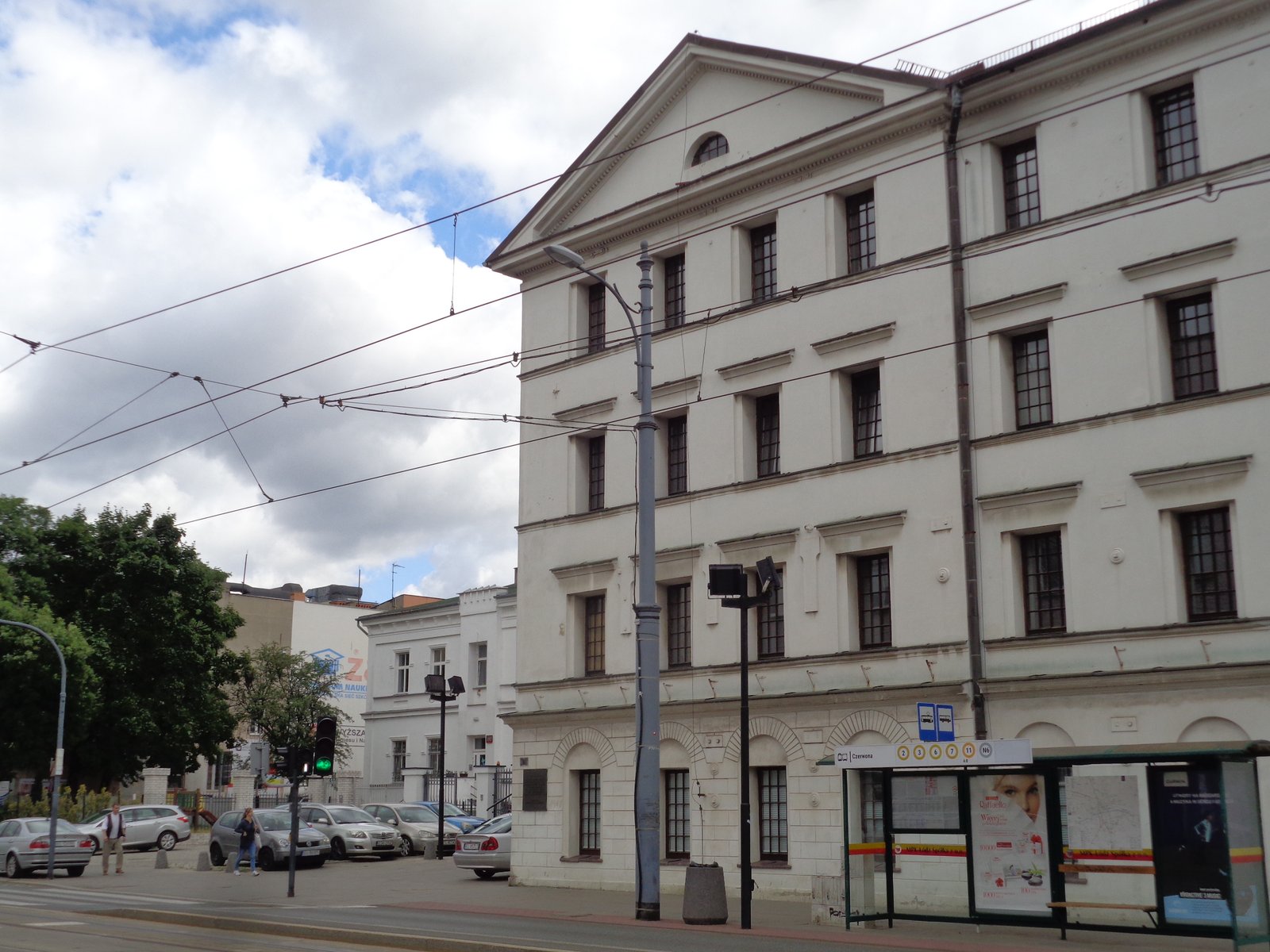
The white-plastered mill that started it all — Łódź’s first steam-powered cotton factory, classicist where its successors were red brick, now the world’s first textile museum.
At a glance
The White Factory stands at the southern end of Piotrkowska Street in Łódź, the oldest of the city’s great textile mills. Ludwik Geyer built it between 1835 and 1839 as a classicist block, its plastered front pale where the later Łódź mills would be raw red brick — hence the name. In 1838 it took the first steam engine in the city’s textile industry and became the first fully mechanized factory in Łódź, running the whole cycle from spinning to finishing. It was the beginning of the boom that made Łódź the “Polish Manchester”. The building now holds the Central Museum of Textiles.
Key facts
- Location: Piotrkowska 282/284, Łódź, Poland
- Built: 1835–1839, for the manufacturer Ludwik Geyer (1805–1869)
- Style: classicist; a pale, plastered block — the “White Factory”
- First: Łódź’s first fully mechanized mill and first textile steam engine (1838)
- Now: the Central Museum of Textiles (Centralne Muzeum Włókiennictwa)
- The museum: the first textile museum in the world, with Europe’s largest textile collection
History
In 1820 the small town of Łódź was designated a “factory town”, opening it to weavers and manufacturers. Among those who came was Ludwik Geyer, from a Saxon textile family, who arrived in 1828 and within a decade had built the most advanced mill in the region. Between 1835 and 1839 he raised the White Factory — a long classicist building, plastered and pale, in the restrained architecture of the age before red brick took over.
What made it matter was inside. In 1838 Geyer installed the first steam engine in the Łódź textile industry, a sixty-horsepower machine, and brought the whole process under one roof: spinning, weaving, finishing, all mechanized. It was the first fully mechanized factory in Łódź and one of the first in the Kingdom of Poland, and it set the pattern that Scheibler and Poznański would later build to an enormous scale. Łódź’s nickname, the “Polish Manchester”, begins here.
The Geyer works passed through the upheavals of the next century, but the White Factory survived. Since 1960 it has housed the Central Museum of Textiles — the first museum of its kind in the world, holding the largest textile collection in Europe — and in 2023 it joined the European Route of Industrial Heritage.
What you see
The White Factory is plainer than the palaces and red-brick mills that followed it, and that is the point. A long classicist façade, pale and regular, fronts Piotrkowska Street and the park behind; it is architecture from the first, restrained phase of Łódź’s industry, before display took over.
Inside, the Central Museum of Textiles fills it with the story the building began: looms and machines, fabrics and design across centuries, and the history of the city that cloth built. An open-air museum of wooden Łódź houses stands in the park alongside.
Practical information
- The factory is the Central Museum of Textiles; check the museum for opening times and tickets
- At the southern end of Piotrkowska Street, with a park and open-air museum alongside
- Allow 1.5 to 2 hours for the museum
- A good first stop for understanding how Łódź became a textile city
Getting there
The White Factory is at Piotrkowska 282/284, at the southern end of Łódź’s long main street. Trams run the length of Piotrkowska and nearby streets; from the centre it is a short ride. Łódź lies about 130 km south-west of Warsaw by train.
Nearby
- Piotrkowska Street
- Księży Młyn and the Scheibler mills
- The Źródliska Park and palm house
Sources
- Central Museum of Textiles, Łódź (Centralne Muzeum Włókiennictwa)
- European Route of Industrial Heritage (ERIH)
- Zabytek.pl — National Heritage Board of Poland (NID)
- Łódź city tourism
Find it on the map
See this place and what’s around it →📷 Become a Cultural Heritage Online photographer
Share your photos of places: they stay published under your name as the author. The more they're seen, the more you get noticed — and soon a contest will reward the most appreciated photos.
Log in or sign up free to add a photoIs this page about you?
This page is read by travellers and heritage enthusiasts who find it on Google. Tell us how you are connected to this place and we will take it from there.