Morocco has nine UNESCO World Heritage Sites, all of them cultural, stretching from Phoenician harbours and Roman cities on the Atlantic plain to medieval medinas threaded by centuries of Islamic scholarship, Berber craft, and Andalusian exile. Together they trace the long conversation between North Africa, the Mediterranean world, and sub-Saharan trade routes that shaped one of the world’s most layered built civilisations. From Cultural Heritage Online.
Why Morocco’s list looks the way it does
Morocco’s nine inscriptions are all cultural — not one natural site has crossed the threshold yet, despite a tentative list that includes Talassemtane National Park and the Atlantic lagoons of Dakhla. The bias toward built heritage reflects the density and continuity of urban civilisation along the Atlantic and Mediterranean littoral: medinas that have been lived in without interruption for a thousand years, Roman ruins that predate Islam, and port cities remodelled by successive colonial powers.
What binds the list is the idea of layering. Fez, Marrakesh, Meknes, and Tétouan are not preserved ruins but functioning cities whose historic cores contain mosques, madrasas, tanneries, and souks still operating as they have for centuries. The UNESCO criteria applied to them consistently stress authenticity of urban fabric and continuity of living tradition — criteria that favour Morocco’s medinas over isolated monuments.
The first inscriptions
Morocco entered the World Heritage List in 1981, at the fifth session of the World Heritage Committee held in Paris. The original inscription covered one site:
- Medina of Fez (1981) — the largest surviving medieval medina in the world, founded in the ninth century and home to the University of al-Qarawiyyin, widely regarded as one of the oldest continuously operating universities on earth.
Over the following decade and a half the list expanded steadily as Morocco submitted additional medinas and archaeological sites. By 1996 four cities were inscribed, establishing the pattern — historic urban cores rather than single monuments — that continues to define the country’s approach to the Convention.
The most visited — and the alternatives
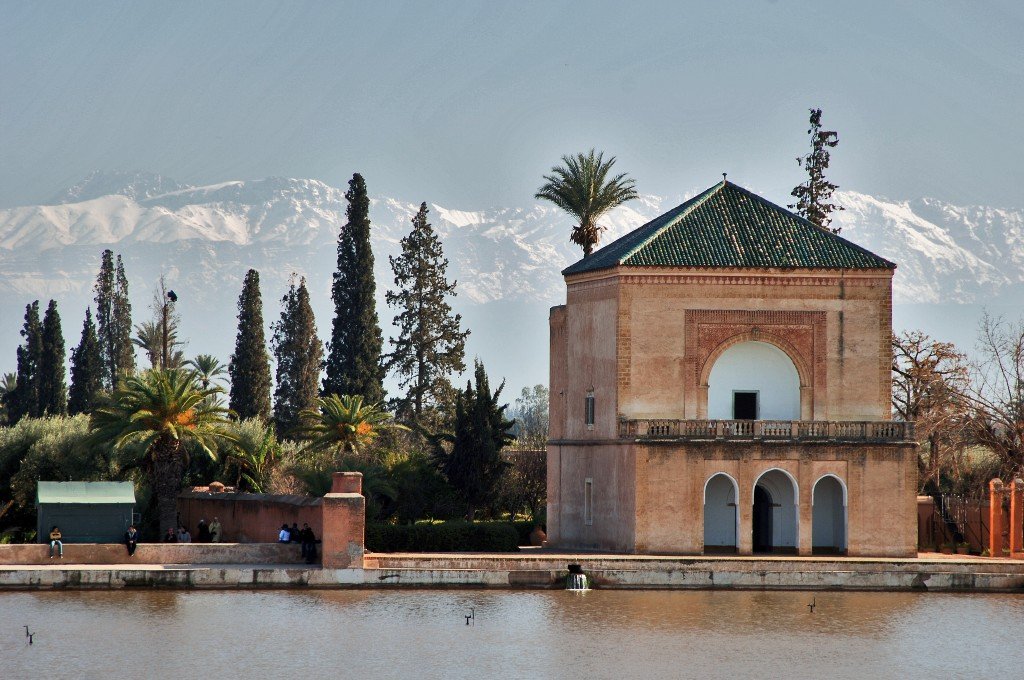
The Medina of Marrakesh draws by far the largest crowds: Djemaa el-Fna square, the Koutoubia minaret, and the maze of souks behind it are among the most photographed streetscapes in Africa. Rabat, inscribed in 2012 as “a Shared Heritage” for its layered Almohad, colonial, and modernist urban identity, attracts visitors to the Hassan Tower and the Kasbah of the Udayas. These are the names most itineraries default to.
The less-visited inscribed sites reward the detour:
- Volubilis — a Roman city on the Saïs plain whose mosaics and triumphal arch document centuries of Mediterranean cultural exchange long before the Arab conquest.
- Essaouira (Mogador) — an eighteenth-century Atlantic port designed by a French military engineer for the Alaouite sultan, whose grid of white-washed streets and ramparts influenced trade between Europe and sub-Saharan Africa.
- El Jadida (Mazagan) — a Portuguese star-fort city whose Renaissance bastions and extraordinary vaulted cistern survive almost intact, a reminder of Iberian maritime ambition on the Moroccan coast.
- Medina of Tétouan — a relatively compact medina that received waves of Andalusian refugees after 1492, giving its architecture an Ibero-Moorish distinctiveness unusual even within Morocco.
Natural and shared sites
Morocco currently holds no natural World Heritage Sites, though its tentative list signals ambition in that direction: Talassemtane National Park in the Rif Mountains, the argan woodland biosphere of the Souss-Massa, and the Atlantic lagoon system around Dakhla are among the candidates proposed for future nomination. The absence of a natural inscription is notable for a country whose geography spans the Atlas ranges, the Sahara edge, and two coastlines.
Morocco does not share any transnational or serial World Heritage inscriptions with other states as of 2026 — all nine of its properties are national nominations. This places Morocco in contrast with neighbours such as Spain and France, whose lists include jointly inscribed routes and landscapes. Several of the tentative nominations, particularly those related to trans-Saharan caravan routes, could eventually change that picture if brought to inscription in collaboration with Mauritania, Mali, or Algeria.
How to find them
Morocco’s World Heritage sites sit alongside thousands of other places on CHO’s interactive map, with GPS and sourced editorial history for each. See also our guides to Italy’s and France’s UNESCO sites, and our piece on cultural travel beyond mass tourism.
Frequently Asked Questions
How many UNESCO World Heritage Sites does Morocco have?
Morocco has nine UNESCO World Heritage Sites, all inscribed for cultural significance. The list spans Roman archaeological remains, medieval medinas, and Atlantic port cities built under Portuguese and French influence, with no natural sites inscribed as of 2026.
What was Morocco’s first UNESCO World Heritage Site?
The Medina of Fez was Morocco’s first inscription, added to the World Heritage List in 1981 at the fifth session of the World Heritage Committee in Paris. It remains the largest surviving medieval medina in the world and contains the historic University of al-Qarawiyyin.
Does Morocco have any natural UNESCO World Heritage Sites?
No — all nine of Morocco’s current inscriptions are cultural properties. Several natural sites, including Talassemtane National Park and the Dakhla lagoon system, appear on the country’s tentative list and may be formally nominated in future sessions.
What is Morocco’s most recently inscribed UNESCO site?
Rabat, designated as “Rabat, Modern Capital and Historic City: a Shared Heritage,” was inscribed in 2012, making it the most recent addition to Morocco’s World Heritage list. The inscription recognises the city’s layered identity, encompassing Almohad medieval structures alongside early twentieth-century French colonial urban planning.
Sources used in this article
- UNESCO — State Party Morocco — World Heritage list.
- UNESCO — Morocco: World Heritage Sites.
- CHO magazine — What is a World Heritage Site?
- CHO — Interactive map of heritage sites.