The United States has 26 UNESCO World Heritage Sites, a list that runs from Pleistocene ice fields in Alaska and ancient earthwork cities on the Mississippi to a Moravian settlement in Pennsylvania and a Hawaiian archipelago where culture and ocean are inseparable. From Cultural Heritage Online.
Why the United States’ list looks the way it does
With 12 natural sites and one mixed designation, the United States leans toward geology and wilderness more heavily than most large nations. This reflects both the country’s extraordinary physical geography and the early 20th-century political priority placed on the national park idea. Yellowstone, the Everglades, the Grand Canyon — these were protected decades before the World Heritage Convention existed, and their inscriptions in the late 1970s and 1980s followed almost automatically from their status as icons of conservation.
The 13 cultural sites, by contrast, span pre-Columbian civilisations, Spanish colonial missions, Quaker and Moravian settlements, and one of the great examples of 20th-century architecture. The range is wide but the list is not long: the United States has inscribed selectively, and several significant cultural landscapes remain outside it. The country ratified the Convention in 1973 and has been a State Party since the beginning.
The first inscriptions
At the second session of the World Heritage Committee in 1978, two American sites received simultaneous inscription — a pairing that set the tone for the list’s dual character:
- Mesa Verde National Park (Colorado) — the cliff dwellings built by Ancestral Puebloans between roughly the 6th and 13th centuries.
- Yellowstone National Park (Wyoming / Montana / Idaho) — the world’s first national park, established in 1872, and the largest concentration of geothermal features on Earth.
One cultural, one natural: the pattern held. In 1979 the Grand Canyon, Everglades, and Independence Hall in Philadelphia were added, establishing that the committee regarded the United States as a country with heritage worth recognising across both categories from the outset.
The most visited — and the alternatives
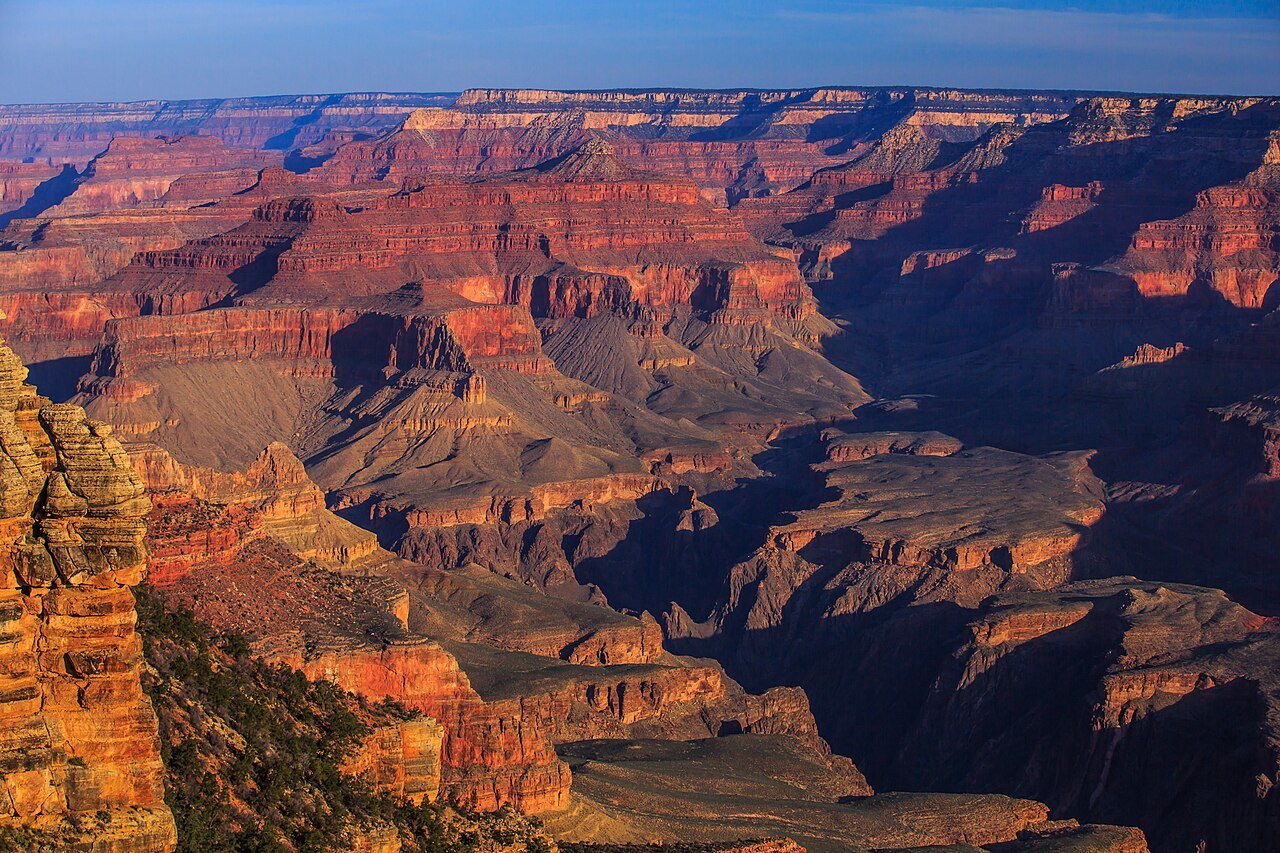
The Grand Canyon receives around five million visitors a year. Yellowstone, the Everglades, and the Great Smoky Mountains — all World Heritage natural sites — draw crowds that require advance booking and early arrivals. On the cultural side, Independence Hall and Monticello (inscribed 1987, alongside the University of Virginia) are well-worn stops on the east-coast itinerary. Mammoth Cave National Park in Kentucky, the world’s longest known cave system, also carries UNESCO status but is genuinely quieter than its superlatives suggest.
Three inscriptions reward specific curiosity. Cahokia Mounds (Illinois, 1982) contains Monks Mound, the largest prehistoric earthen structure in the Americas — a platform larger at its base than the Great Pyramid at Giza, built by a sophisticated urban society around 1100 CE. Poverty Point (Louisiana, 2014) was constructed between roughly 1700 and 1100 BCE by a hunter-gatherer and fishing society, challenging older assumptions about which societies could undertake monumental construction. Taos Pueblo (New Mexico, 1992) is a multi-storey adobe settlement continuously inhabited since the 13th or 14th century, still home to members of the Taos pueblo community.
Natural and shared sites
The natural sites cover an extraordinary ecological range: the active volcanoes of Hawaii, the temperate rainforest and coastline of Olympic National Park, the ancient redwood forests of California, the karst caverns of Carlsbad Caverns in New Mexico, and the coral-ringed Hawaiian archipelago of Papahānaumokuākea — a mixed site encompassing both natural and indigenous Hawaiian cultural heritage, inscribed in 2010 and extended in 2016. The sheer geographic spread means no single journey touches more than a fraction of them.
Two natural inscriptions are shared with Canada and span the border directly. The Kluane / Wrangell–St. Elias / Glacier Bay / Tatshenshini-Alsek complex, inscribed in stages between 1979 and 1994, is one of the largest protected wilderness areas on Earth. Waterton-Glacier International Peace Park, inscribed in 1995, straddles Alberta and Montana and was the world’s first international peace park. On the cultural side, Moravian Church Settlements (2024) links the Historic Moravian Bethlehem District in Pennsylvania with sites in Denmark, Germany, and the United Kingdom — the most recent inscription on the American list.
How to find them
The United States’ World Heritage sites sit alongside thousands of other places on CHO’s interactive map, with GPS and sourced editorial history for each. See also our guides to Italy’s and France’s UNESCO sites, and our piece on cultural travel beyond mass tourism.
Frequently Asked Questions
How many UNESCO World Heritage Sites does the United States have?
The United States has 26 UNESCO World Heritage Sites. The list includes 13 cultural sites, 12 natural sites, and one mixed site (Papahānaumokuākea), making it one of the more nature-weighted lists among large nations that have ratified the Convention.
What was the United States’ first UNESCO World Heritage Site?
Two sites were inscribed simultaneously in 1978 at the second session of the World Heritage Committee: Mesa Verde National Park in Colorado and Yellowstone National Park spanning Wyoming, Montana, and Idaho. No single site holds the distinction of being first; both were inscribed on the same day.
What is the most recently inscribed World Heritage Site in the United States?
The Historic Moravian Bethlehem District in Pennsylvania was inscribed in 2024 as part of the transnational serial nomination “Moravian Church Settlements,” shared with Denmark, Germany, and the United Kingdom. It is the only American site on that transnational inscription.
Does the United States share any World Heritage Sites with other countries?
Yes — three inscriptions are transnational. The Kluane / Wrangell–St. Elias / Glacier Bay / Tatshenshini-Alsek wilderness complex and the Waterton-Glacier International Peace Park are both shared with Canada. The Moravian Church Settlements nomination (2024) links Pennsylvania with sites in Denmark, Germany, and the United Kingdom.
Sources used in this article
- UNESCO — State Party the United States — World Heritage list.
- UNESCO — the United States: World Heritage Sites.
- CHO magazine — What is a World Heritage Site?
- CHO — Interactive map of heritage sites.