Japan has 26 UNESCO World Heritage Sites, ranging from ancient Buddhist temple complexes and medieval castles to primeval beech forests and the remote volcanic islands of the far Pacific — a list that mirrors how deeply nature and sacred architecture have shaped Japanese civilisation over millennia. From Cultural Heritage Online.
Why Japan’s list looks the way it does
Japan’s UNESCO portfolio is predominantly cultural: 21 of its 26 sites carry a cultural designation, reflecting a heritage tradition in which human construction — temple, garden, castle, mine — is inseparable from the landscape it inhabits. The remaining five sites are natural, protecting island ecosystems and ancient forest environments that survived largely because they remained outside the reach of industrialisation.
The list also reveals how seriously Japan approaches serial nominations. Several inscriptions bundle dozens of discrete components — shrines, villages, archaeological sites — under a single thematic framework. This approach lets a complex, geographically dispersed tradition be recognised as a coherent whole rather than as a collection of isolated monuments.
The first inscriptions
Japan’s World Heritage journey opened in 1993, when four sites were inscribed simultaneously — an unusually confident debut that placed both cultural monuments and pristine nature on the list from day one:
- Buddhist Monuments in the Hōryū-ji Area — a cluster of 7th-century wooden structures in Nara Prefecture, among the oldest surviving wooden buildings on earth.
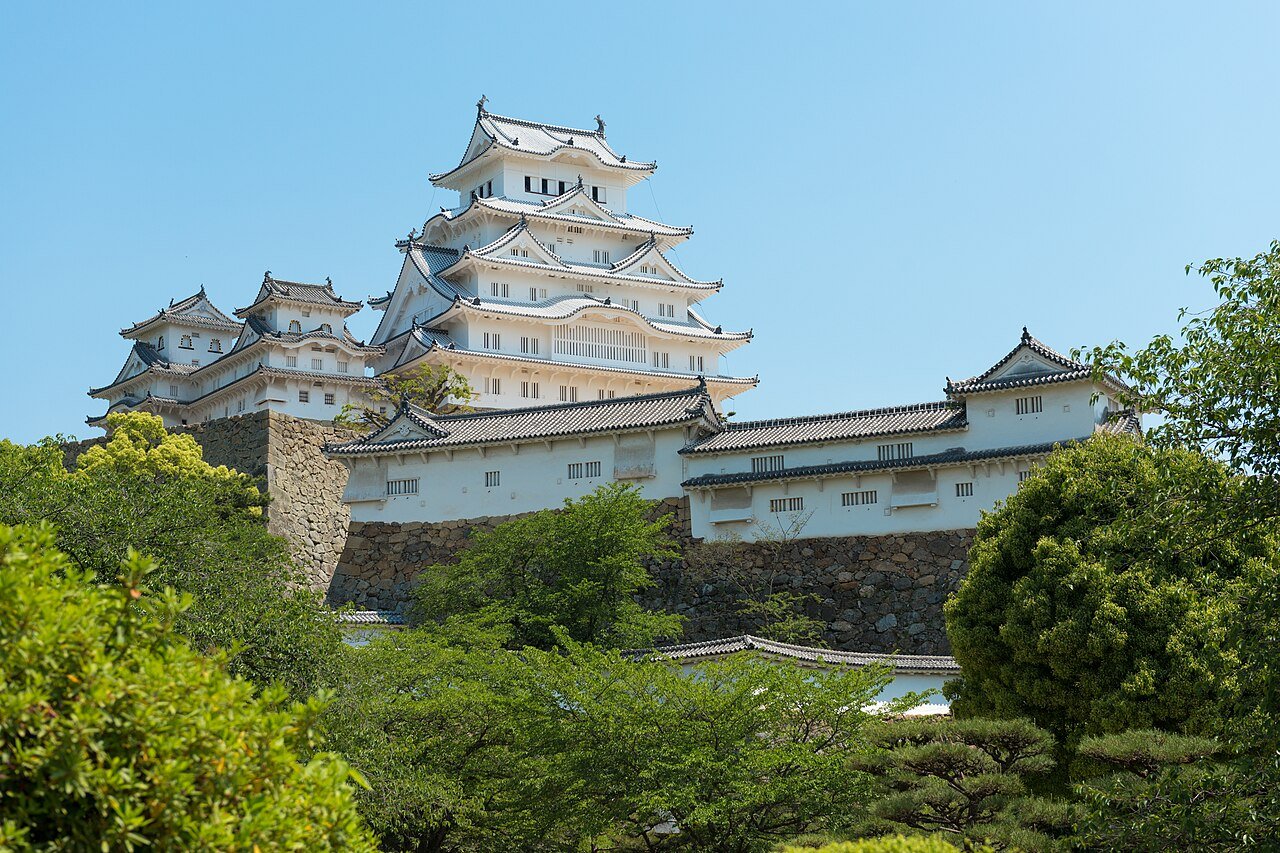
- Himeji Castle — the great white fortress in Hyōgo Prefecture, often called Shirasagijō (“White Heron Castle”) for its elegant silhouette.
- Yakushima — a subtropical island in Kagoshima Prefecture, home to ancient cedar forests including trees estimated at several thousand years old.
- Shirakami-Sanchi — a primeval beech forest straddling Aomori and Akita Prefectures, one of the last virgin beech stands in East Asia.
The breadth of that first year set the tone: Japan was not going to present only its most photogenic castles, but the full spectrum of what its territory had produced and preserved.
The most visited — and the alternatives
The sites that draw the largest international crowds are well established. The Historic Monuments of Ancient Kyoto (which encompasses 17 individual components across three cities) and the Historic Monuments of Ancient Nara anchor most heritage itineraries. Hiroshima Peace Memorial, inscribed in 1996, carries a different weight entirely: it is one of the rare UNESCO sites defined not by beauty but by the necessity of remembrance.
Beyond those icons, Japan’s list holds several sites that reward slower, more deliberate travel:
- Iwami Ginzan Silver Mine (Shimane Prefecture, 2007) — a complex of tunnels, smelting quarters, and castle towns that operated from the 16th to the 20th century using traditional, labour-intensive techniques that left the surrounding landscape largely intact.
- Hiraizumi (Iwate Prefecture, 2011) — 11th- and 12th-century temples and gardens built to embody Buddhist Pure Land ideals, far from the main Kyoto–Nara axis.
- Hidden Christian Sites in the Nagasaki Region (2018) — twelve components across Nagasaki and Kumamoto Prefectures that trace three centuries of clandestine faith practice during the ban on Christianity from the 17th to the 19th century.
- Jōmon Prehistoric Sites in Northern Japan (2021) — seventeen archaeological sites spanning roughly 13,000 to 400 BCE, documenting one of the world’s longest-running sedentary hunter-gatherer cultures.
Natural and shared sites
Japan’s five natural World Heritage Sites protect some of the most biologically rich and geologically distinct environments in East Asia. Shiretoko Peninsula (2005) in Hokkaido was inscribed for the interaction between its marine and terrestrial ecosystems; the Ogasawara Islands (2011), an isolated Pacific archipelago some 1,000 kilometres south of Tokyo, were recognised for their extraordinary endemic biodiversity. Most recently, the 2021 inscription of Amami-Ōshima, Tokunoshima, northern Okinawa, and Iriomote Island protected subtropical rainforest habitats home to species found nowhere else on earth. The most recent inscription overall is the Sado Island Gold Mines, added to the list in 2024 for its historical mining landscape and cultural significance.
Japan also participates in one transnational serial inscription: the Architectural Work of Le Corbusier (2016), shared with Argentina, Belgium, France, Germany, India, and Switzerland. Japan’s contribution is the National Museum of Western Art in Tokyo, designed by Le Corbusier and completed in 1959 — the only building by the Swiss-French architect on Asian soil.
How to find them
Japan’s World Heritage sites sit alongside thousands of other places on CHO’s interactive map, with GPS and sourced editorial history for each. See also our guides to Italy’s and France’s UNESCO sites, and our piece on cultural travel beyond mass tourism.
Frequently Asked Questions
How many UNESCO World Heritage Sites does Japan have?
Japan has 26 UNESCO World Heritage Sites as of 2024, comprising 21 cultural sites and 5 natural sites. The most recent addition is the Sado Island Gold Mines, inscribed in 2024.
What was Japan’s first UNESCO World Heritage Site?
Japan’s first inscriptions came in 1993, when four sites were added simultaneously: Buddhist Monuments in the Hōryū-ji Area, Himeji Castle, Yakushima, and Shirakami-Sanchi. No single site holds priority — all four were inscribed at the same session.
Does Japan have any natural UNESCO World Heritage Sites?
Yes, Japan has five natural World Heritage Sites: Yakushima, Shirakami-Sanchi, Shiretoko, the Ogasawara Islands, and the 2021 inscription covering Amami-Ōshima, Tokunoshima, northern Okinawa, and Iriomote Island. Together they protect ancient forests, island ecosystems, and unique endemic biodiversity.
Is Japan part of any transnational UNESCO inscription?
Japan participates in one transnational serial inscription: the Architectural Work of Le Corbusier (2016), shared with six other countries. Japan’s contribution is the National Museum of Western Art in Tokyo, the only Le Corbusier-designed building in Asia.
Sources used in this article
- UNESCO — State Party Japan — World Heritage list.
- UNESCO — Japan: World Heritage Sites.
- CHO magazine — What is a World Heritage Site?
- CHO — Interactive map of heritage sites.
Sources
- S1 — Coaldrake, William H. Architecture and Authority in Japan. Routledge, 1996. ISBN 978-0-415-10601-6.
- S2 — Totman, Conrad. A History of Japan. Blackwell Publishing, 2005. ISBN 978-1-4051-2359-4.
Spotted an error? Write to editorial@culturalheritageonline.com and we correct it the same day.