
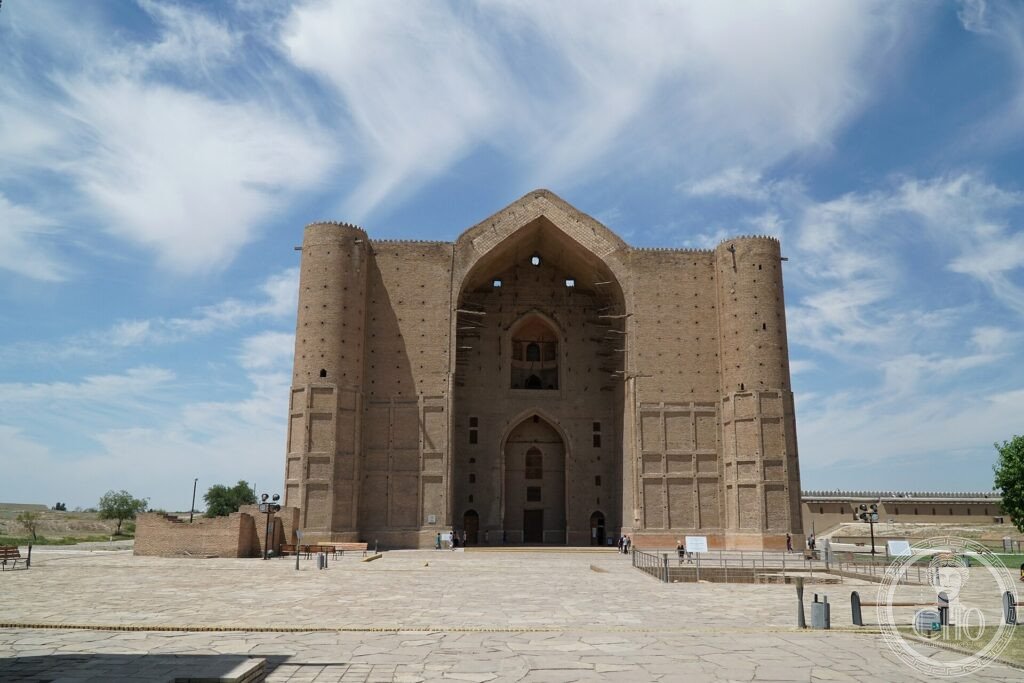
Mausoleo di Khoja Ahmed Yasawi (1389–1405): il prototipo incompiuto dell’arte timuride
Timur lo volle grandioso, sopra la tomba di un amato maestro sufi, e lo lasciò incompiuto alla sua morte: il portale enorme mostra ancora le impalcature di mattoni. Proprio per questo il mausoleo di Yasawi è un libro aperto sull’architettura timuride, modello delle cupole e dei portali di Samarcanda.
At a glance
The Mausoleum of Khoja Ahmed Yasawi, in the town of Turkestan in southern Kazakhstan, was built between 1389 and 1405 by the conqueror Timur (Tamerlane) over the grave of a revered 12th-century Sufi master and poet. Timur intended it as a colossal shrine and a model for his imperial architecture, but it was left unfinished at his death, its great portal still showing the wooden scaffolding in the brickwork. This makes it an exceptional record of Timurid construction, a prototype for the monuments of Samarkand. It was inscribed by UNESCO in 2003.
Key facts
- UNESCO: World Heritage since 2003
- Built: 1389–1405, by order of Timur (Tamerlane)
- For: Khoja Ahmed Yasawi, a 12th-century Sufi master and poet
- Unfinished: the main portal was never completed at Timur’s death
- Prototype: a model for later Timurid architecture in Samarkand
- Great dome: the largest brick dome in Central Asia
History
Khoja Ahmed Yasawi was a 12th-century Sufi mystic and poet whose tomb at Yasi (now Turkestan) became a major place of pilgrimage. Two centuries later Timur, building an empire from his capital at Samarkand, ordered a vast new mausoleum over the grave, both an act of piety and a statement of power on the steppe frontier.
Master builders raised a huge structure of fired brick, crowned by the largest dome in Central Asia and faced with glazed tile. But when Timur died in 1405 the work stopped, and the immense entrance portal was left unfinished, its surface still bearing the holes and timbers of the scaffolding — a unique window onto how such monuments were built.
What you see
The mausoleum rises from the plain as a great cube of brick, its turquoise and blue domes gleaming above, its rear façades sheathed in patterned glazed tile. The main portal, vast and bare, reveals the unfinished brickwork and the rows of beam-holes left by the builders. Within, halls lead to the tomb chamber and a giant bronze cauldron cast for the shrine.
Around it, the restored old town of Turkestan sets the monument in its historic context.
Practical information
- Mausoleum: a place of pilgrimage and a museum; modest dress
- Time needed: 1–2 hours
- Note: Turkestan is a growing tourist centre on the old Silk Road
- Setting: in southern Kazakhstan, near the Uzbek border
Getting there
The mausoleum is in the city of Turkestan in southern Kazakhstan, on the railway and road between Shymkent and the Aral region. Turkestan has an airport and train links. GPS: 43.2972° N, 68.2711° E.
Nearby
- Otrar — the ruined Silk Road city where Timur died, nearby
- Shymkent — the regional city to the south
- Sauran — a ruined medieval walled town near Turkestan
Sources
- UNESCO World Heritage Centre — “Mausoleum of Khoja Ahmed Yasawi” (ref. 1103)
- Azret-Sultan State Historical and Cultural Reserve-Museum — official body
- Encyclopaedia Britannica — Timur; Timurid architecture
Find it on the map
See this place and what’s around it →📷 Diventa un fotografo di Cultural Heritage Online
Condividi le tue foto dei luoghi: restano pubblicate con la tua firma come autore. Più vengono viste, più ti fai conoscere — e presto un concorso premierà le foto più apprezzate.
Accedi o registrati gratis per aggiungere una fotoDo you manage this place?
This page is read by travellers and heritage enthusiasts who find it on Google. Keep it accurate — and make it work for you. Free for non-profit heritage institutions.