
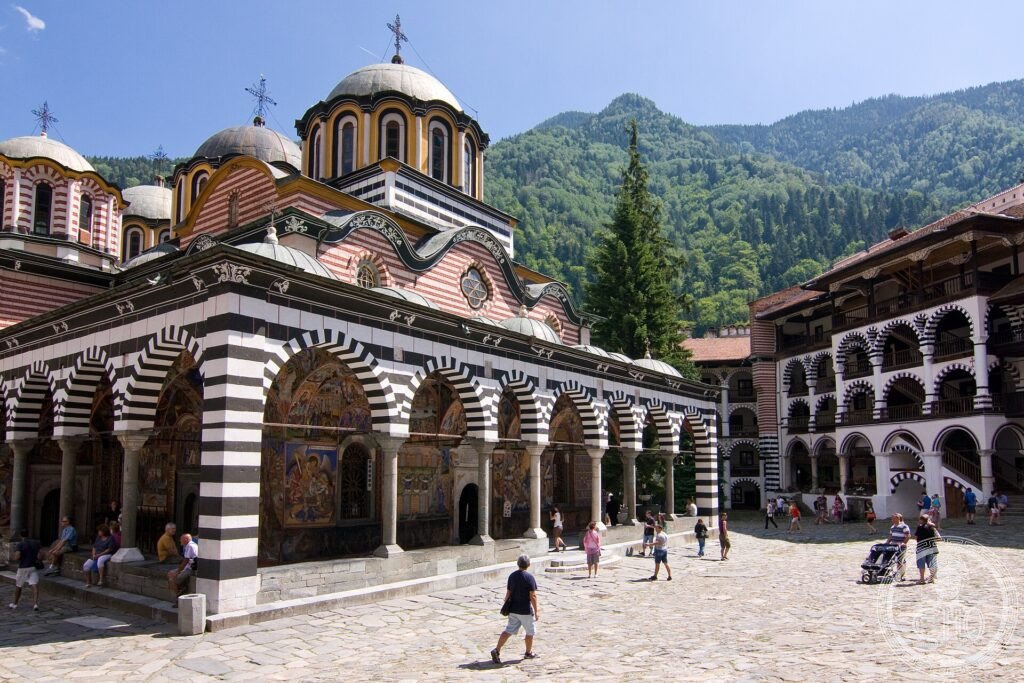
Among the forests of the Rila Mountains, the largest Orthodox monastery in Bulgaria has guarded the national identity for a thousand years. Founded around the hermitage of Saint Ivan of Rila, it survived invasions and foreign rule; rebuilt in the nineteenth century, its banded black-and-white arcades and its frescoes are the symbol of the Bulgarian Revival.
At a glance
Rila Monastery, set deep in the forested Rila Mountains, is the largest and most revered Orthodox monastery in Bulgaria and a symbol of the nation’s identity. Founded in the 10th century around the hermitage of St Ivan of Rila, it preserved Bulgarian language and culture through centuries of foreign rule. Largely rebuilt in the 19th century after a fire, in the spirit of the Bulgarian National Revival, its arcaded courtyard, striped facades and vivid frescoes make it a masterpiece. It was inscribed by UNESCO in 1983.
Key facts
- UNESCO: World Heritage since 1983 (Rila Monastery)
- Founded: 10th century, around the hermitage of St Ivan of Rila
- Largest in Bulgaria: the chief Orthodox monastery of the country
- Hrelyu’s Tower (1335): the oldest surviving building of the complex
- National Revival: rebuilt in the 19th century in the Revival style
- Frescoes: the church is covered inside and out with vivid paintings
History
St Ivan of Rila, a 10th-century hermit, withdrew to these mountains, and after his death a monastery grew around his cult, becoming a centre of Bulgarian spiritual and cultural life. Through the medieval kingdoms and then the long centuries of Ottoman rule, Rila helped keep alive the Bulgarian language, faith and letters, its scriptorium copying manuscripts when statehood was lost.
The medieval monastery was repeatedly damaged; the stone Hrelyu’s Tower of 1335 survives from that age. After a fire in 1833 the monastery was rebuilt by master craftsmen of the National Revival, who gave it its present arcaded courtyard, striped stonework and the brilliantly frescoed church — a statement of reborn national pride.
What you see
The fortress-like outer walls open into a courtyard ringed by tiers of black-and-white striped arcades, balconies of carved wood above. At its centre the church glows with frescoes inside and out, its domes and gilded iconostasis among the finest of the Revival. The grim stone Hrelyu’s Tower stands apart, a survivor of the medieval monastery.
A museum holds treasures including the carved wooden Rila Cross, and the surrounding mountains add to the sense of retreat.
Practical information
- Monastery: active and freely open; the museum and tower charge entry
- Time needed: half a day, longer with the mountain setting
- Note: modest dress required to enter the church
- Setting: in a national park, a popular day trip from Sofia
Getting there
Rila Monastery is in the Rila Mountains of south-western Bulgaria, about 120 km south of Sofia. It is reached by road; buses and tours run from Sofia and Blagoevgrad. GPS: 42.1333° N, 23.3403° E.
Nearby
- Rila National Park — the mountains and the Seven Rila Lakes
- Sofia — the Bulgarian capital, about 120 km north
- Hermitage of St Ivan — the saint’s cave and chapel above the monastery
Sources
- UNESCO World Heritage Centre — “Rila Monastery” (ref. 216)
- Rila Monastery — official monastery site
- Encyclopaedia Britannica — Rila Monastery
Find it on the map
See this place and what’s around it →📷 Become a Cultural Heritage Online photographer
Share your photos of places: they stay published under your name as the author. The more they're seen, the more you get noticed — and soon a contest will reward the most appreciated photos.
Log in or sign up free to add a photoIs this page about you?
This page is read by travellers and heritage enthusiasts who find it on Google. Tell us how you are connected to this place and we will take it from there.