
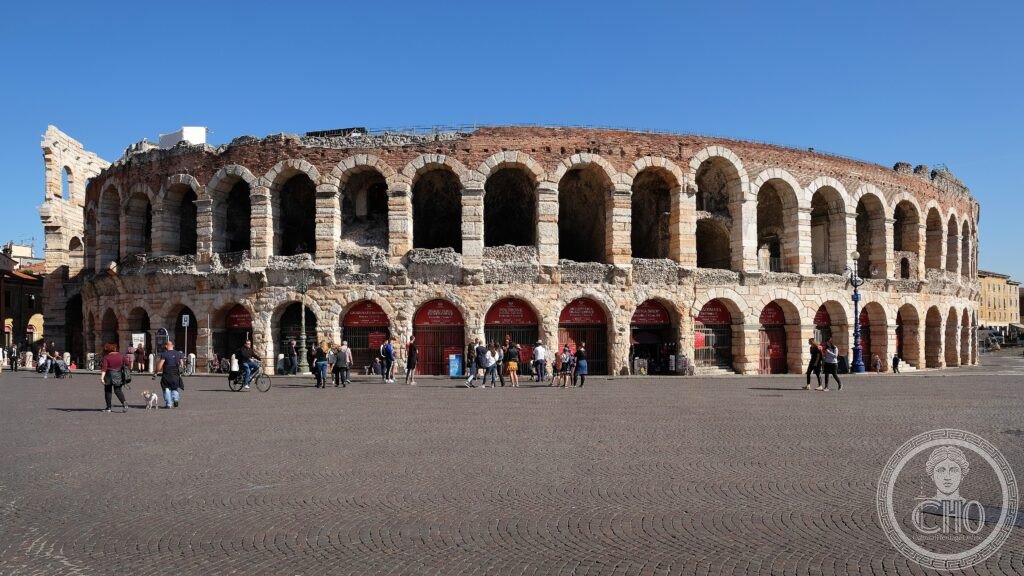
Verona lays a Roman amphitheatre, a fortified dynasty’s tombs, a Venetian loggia and the setting of Shakespeare’s most famous romance across one compact centre. Few Italian cities show so many distinct historical layers still standing on the same streets, still in daily use.
At a glance
Verona was a Roman municipium from 89 BCE and a colony from 49 BCE, and its Roman fabric survives in the Arena amphitheatre, the Teatro Romano, the Porta Borsari gate and the Arco dei Gavi, an honorific arch dismantled by Napoleon’s troops in 1805 and reconstructed in the courtyard of the Castelvecchio in 1932.
Between 1262 and 1387 the city was ruled by the Scaligeri (della Scala) family, whose fortified tombs, the Arche Scaligere, stand beside the church of Santa Maria Antica. Cangrande I, the family’s most powerful ruler, was Dante’s patron. Venetian rule followed from 1405 to 1797, leaving the Loggia del Consiglio, designed by Giovanni Giocondo, as its principal civic monument. Verona is also the setting Shakespeare chose for Romeo and Juliet, a story that in fact derives from earlier Italian novellas by Luigi Da Porto and Matteo Bandello; the so-called Juliet’s balcony was added to a genuinely medieval house only in 1936, to satisfy visitor expectations rather than historical fact.
Key facts
- Arena di Verona: Roman amphitheatre built in the Augustan to Flavian period, elliptical in plan, roughly 139 by 110 metres, the third-largest surviving Roman amphitheatre in Italy after the Colosseum and the Amphitheatre of Capua.
- Original capacity: around 30,000 spectators; the modern Opera Festival seating plan holds a much smaller, though still very large, audience.
- Arche Scaligere: fortified Gothic tombs of the Scaligeri rulers, including Cangrande I, Mastino II and Cansignorio, the last topped by a two-level canopy with five equestrian statues.
- Loggia del Consiglio: Venetian Renaissance civic building of 1476–1493, designed by Giovanni Giocondo, who later worked on St Peter’s Basilica in Rome.
- UNESCO status: the historic centre of Verona was inscribed as a World Heritage Site in 2000, reference 797.
History
Verona’s name, with its non-Latin -ona ending, suggests a pre-Roman, probably Celtic, settlement before it became a Roman municipium in 89 BCE. Its position controlling the Adige river crossing and the Via Postumia, the main road linking Genua and Aquileia, made it strategically central to Roman northern Italy. The Arena was built using pink Verona limestone quarried at Sant’Ambrogio di Valpolicella; its construction technique, alternating brick and stone, places it in the same building tradition as the Colosseum and the Amphitheatre of Capua. The amphitheatre’s original outer wall was largely demolished in the medieval period, when houses were built directly against its structure; only four arches, known as the ala, survive because they stood isolated at the north end.
Under the Scaligeri, who ruled from 1262 to 1387, Verona gained the Castelvecchio fortress, built between 1354 and 1376 with crenellated walls, a drawbridge over the Adige and the Torre del Mastio. The building now houses the Castelvecchio Museum, renovated by Carlo Scarpa between 1957 and 1964, a work regarded as one of the most significant museum designs of postwar Italy. Venetian rule from 1405 to 1797 added the Loggia del Consiglio and the Lion of St Mark that still looks over the Piazza delle Erbe. The historic centre was inscribed on the UNESCO World Heritage list in 2000.
What you see
The Arena dominates the Piazza Bra, its pink limestone arches worn by two thousand years of use; the interior seating is the original Roman stone, its steps smoothed by centuries of spectators. Today it hosts the Arena di Verona Opera Festival, held every summer since 1913, when it opened to mark the centenary of Giuseppe Verdi’s birth. The 14,000-seat venue has no permanent stage or roof, performances continue in the rain, and the audience’s tradition of lighting small candles at the opening of each show has become one of opera’s best-known rituals. Aida remains the most frequently staged work, its fourth-act temple scene sometimes involving hundreds of extras, horses and even elephants.
The Piazza delle Erbe occupies the site of the Roman forum, its central column marking the exact spot of the old rostra. Market stalls still fill the square daily. Nearby, the Arco della Costa links the piazza to the Piazza dei Signori, with a whale rib hung from its keystone according to a seventeenth-century local legend. The Arche Scaligere stand close by, their carved canopies and equestrian figures among the most elaborate funerary monuments of fourteenth-century Italy.
Practical information
- Opening times: the Arena and other monuments have seasonal and event-related schedules; check the official Arena di Verona and city tourism channels before visiting.
- Admission: tickets are required for the Arena interior and major museums; current prices are published by the relevant institutions.
- Opera season: performances run through the summer months; booking in advance is advisable given the scale of the festival.
- Getting around: the historic centre is compact and best explored on foot.
Getting there
Verona’s historic centre is walkable from the city’s rail and coach connections, with the Arena and Piazza Bra forming a natural starting point for exploring the Roman, Scaligeri and Venetian layers of the city.
Nearby
- Castelvecchio — Scaligeri fortress and museum a short walk from the Arena, with a renowned Carlo Scarpa renovation.
- Piazza delle Erbe — the former Roman forum, now the city’s market square, close to the Arche Scaligere.
- Casa di Giulietta — the medieval house on Via Cappello associated with the Romeo and Juliet legend.
- Teatro Romano — the Roman theatre on the north bank of the Adige.
Sources
- UNESCO
Find it on the map
See this place and what’s around it →📷 Become a Cultural Heritage Online photographer
Share your photos of places: they stay published under your name as the author. The more they're seen, the more you get noticed — and soon a contest will reward the most appreciated photos.
Log in or sign up free to add a photo