
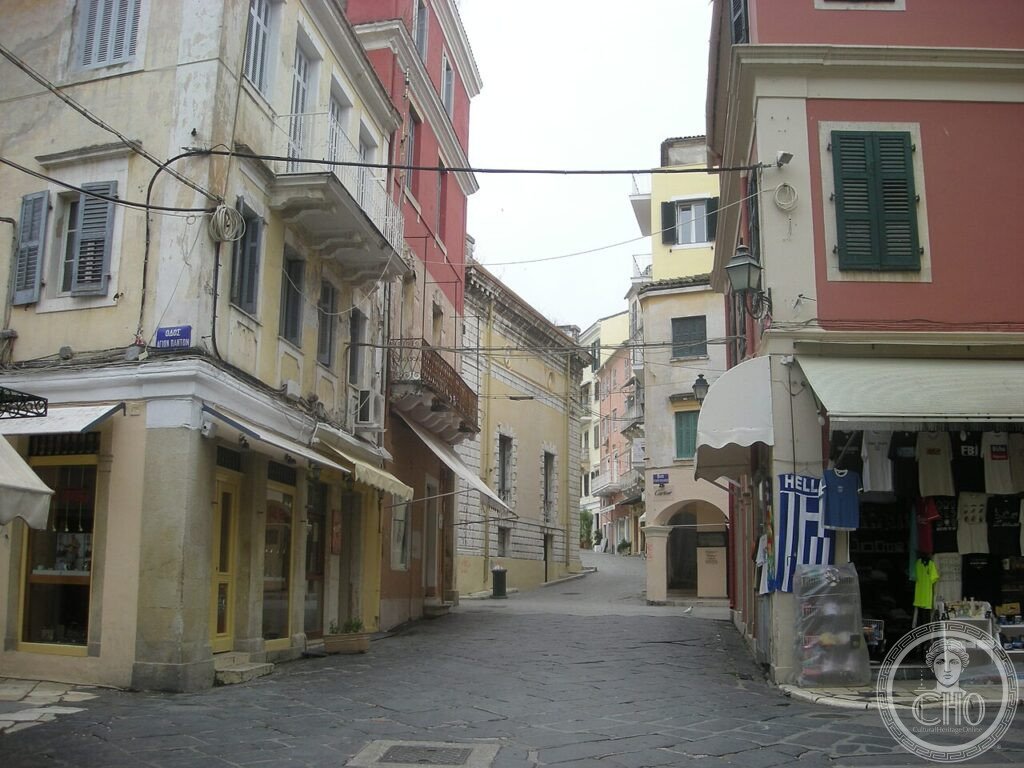
Corfu Old Town is the only Greek city that was never absorbed into the Ottoman Empire. Four centuries of Venetian rule, followed by French and British administrations, left a townscape of tall shuttered tenements, a Parisian-style arcade and a cricket pitch beneath two fortresses, a layering found nowhere else in Greece.
At a glance
The Old Town occupies a peninsula guarded by two Venetian fortresses, one on the headland and one on a western promontory. It was the capital of Venetian Corfu for 411 years, the longest Venetian colonial tenure of any Greek island, before passing briefly to France and then to Britain ahead of union with the Kingdom of Greece in 1864. The Old Town was inscribed as a UNESCO World Heritage Site in 2007.
Key facts
- Location: Corfu Town, Ionian Islands, Greece, at 39.6240° N, 19.9220° E
- Venetian rule: 1386–1797, the longest Venetian colonial period of any Greek island
- Ottoman sieges withstood: 1571 and 1716, the latter known as the Great Siege of Corfu
- Later rule: French from 1807, then a British Protectorate from 1815 to 1864
- UNESCO status: inscribed as a World Heritage Site in 2007
History
Corfu passed through Byzantine, Norman and Angevin hands before the Corfiots themselves requested Venetian protection in 1386, beginning a period of Venetian rule that lasted 411 years and made the town the capital of the Venetian Ionian Islands. The Old Fortress was built and expanded through the sixteenth century, and the town withstood an Ottoman assault in 1571, the same year as the Battle of Lepanto, and a far larger Ottoman siege in 1716. In that Great Siege the defenders, led by the Saxon mercenary commander Johann Matthias von der Schulenburg, held the walls until a storm broke up the Ottoman fleet, an event the Venetians credited to the town’s patron saint, Spyridon. A statue of Schulenburg was later raised in the Old Fortress, said to be the only statue of a living person erected during the Venetian Republic.
Venetian rule ended in 1797 when Napoleon’s Treaty of Campo Formio abolished the Republic. Corfu passed briefly to France, then to Russia and the Ottomans jointly, then back to France, which built the Liston arcade in 1807 on the model of the Rue de Rivoli in Paris. From 1815 to 1864 Corfu was part of the British Protectorate known as the United States of the Ionian Islands, a period that left the Spianada esplanade its cricket pitch and a neoclassical Anglican church within the Old Fortress. The Ionian Islands were united with the Kingdom of Greece in 1864, and the Old Town was recognised as a UNESCO World Heritage Site in 2007.
What you see
The Campiello quarter preserves the medieval Venetian street pattern, its narrow lanes known locally as kandounia lined with tall five- and six-storey tenements, taller than typical Greek town houses, with external stone staircases, overhanging upper floors and green-shuttered facades. Fourteen small irregular squares, or campiellos, survive within the quarter, each once serving as a gathering point for the surrounding block. The Church of Agios Spyridon holds the silver reliquary of the town’s patron saint, whose remains are carried in procession four times a year.
The Old Fortress stands on a natural islet linked to the town by a bridge and contains the Anglican Church of Saint George, a Doric neoclassical building raised during the British period. The New Fortress, built from 1572 following the 1571 siege, forms a terraced work of Venetian military engineering on the hill behind the town and can be visited on foot. The Liston arcade, built by the French in 1807 to a design recalling the Rue de Rivoli, runs along one side of the Spianada, said to be the largest square in Greece, at whose centre lies the only cricket pitch in the country, still used for matches that continue a practice introduced by the British garrison. The Palace of Saint Michael and Saint George, built as the British Residency in 1819, now houses the Museum of Asian Art.
Practical information
- Access: the Old Town is a walkable pedestrian area; the New Fortress and Old Fortress can both be visited on foot
- Opening times and admission: for the fortresses and the Museum of Asian Art, check the official Greek Ministry of Culture or local tourism channels before visiting, as arrangements vary
- Saint Spyridon processions: held on Easter Saturday, Palm Sunday, 11 August and the first Sunday of November
Getting there
Corfu is served by Ioannis Kapodistrias Airport (IATA code CFU), which receives scheduled and charter flights from major European cities.
Nearby
- Old Fortress — on the headland at the edge of the Old Town, reached by a bridge from the centre
- New Fortress — on the hill behind the Old Town, a walk from the Campiello quarter
- Spianada and Liston — the open esplanade and arcade forming the edge of the historic centre
Sources
- UNESCO
Find it on the map
See this place and what’s around it →📷 Become a Cultural Heritage Online photographer
Share your photos of places: they stay published under your name as the author. The more they're seen, the more you get noticed — and soon a contest will reward the most appreciated photos.
Log in or sign up free to add a photo