
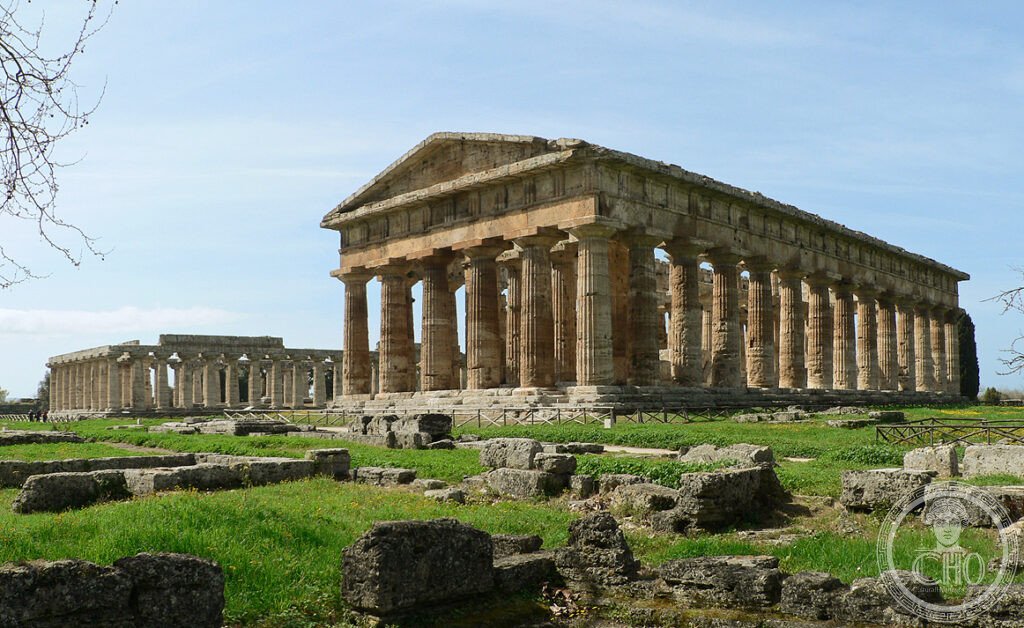
On a flat coastal plain south of Naples, three Doric temples still stand where Greek builders raised them between the sixth and fifth centuries BCE. Encircled by their original city walls and visible from every direction, they form the most complete Greek temple group surviving outside Greece itself.
At a glance
Paestum, ancient Poseidonia, lies on the coastal plain of Salerno province, roughly 90 kilometres south of Naples. Founded around 600 BCE by Greek colonists from Sybaris, the city passed to the Lucanians around 400 BCE, then to Rome in 273 BCE, before falling into malarial decline and eventual abandonment by the ninth century CE. Rediscovered in 1746, it has been a reference point for the study of Greek Doric architecture ever since, and was inscribed as a UNESCO World Heritage Site in 1998.
Key facts
- Ancient name: Poseidonia, later Paiston under the Lucanians, then Paestum under Rome.
- Founded: around 600 BCE, a Greek colony sent out by Sybaris.
- Temples: Temple of Hera I (‘the Basilica’, c. 550 BCE), Temple of Athena (c. 500 BCE) and Temple of Hera II, also called the Temple of Neptune or Poseidon (c. 460-450 BCE).
- City walls: an intact circuit around five kilometres long, with four surviving gates.
- Status: UNESCO World Heritage Site since 1998.
History
Poseidonia was founded around 600 BCE as a colony of Sybaris, itself a Greek city in Calabria, making Paestum a second-generation Greek settlement built on the wealth of its agricultural coastal plain. Its three temples were raised across more than a century: the Basilica around 550 BCE, the Temple of Athena around 500 BCE, and the largest and best preserved, the Temple of Hera II, around 460-450 BCE, at the height of the city’s prosperity.
Around 400 BCE the city was taken by the Lucanians, an Italic, Oscan-speaking people from the Apennines, who renamed it Paiston. Under Lucanian rule the city’s wealthier inhabitants adopted the Greek custom of painting tomb interiors, producing figurative scenes unique in southern Italy. Rome conquered the city in 273 BCE, renaming it Paestum and overlaying a Roman forum and grid on the earlier Greek town. As Rome’s own power grew, Paestum declined, and the low-lying coastline became increasingly malarial. Vandal raids in the fifth century, a brief Byzantine period, and Saracen raids in the ninth century hastened the city’s abandonment; by then the site was disappearing under swamp and vegetation, and it remained largely forgotten for centuries.
In 1746 road builders working on the route between Salerno and Naples came across the ruins. Ferdinand IV, King of Naples, visited in 1750 and ordered excavation. The French architects Soufflot and Legeay produced the first drawings of the temples in 1752, and Paestum quickly became essential viewing for European travellers and architects during the Grand Tour, at a time when Ottoman-occupied Athens was difficult and dangerous to visit. Robert Adam came in 1755, Piranesi included the temples in his engravings in 1778, and the art historian Winckelmann cited Paestum in his writing on Greek architecture. The site was inscribed as a UNESCO World Heritage Site in 1998.
What you see
The Basilica, or Temple of Hera I, is the oldest of the three, dating to around 550 BCE, its front row of nine columns an unusual odd number that places a column on the central axis, a convention of early Doric design. The Temple of Athena, from around 500 BCE, has six columns across its front and retains some marble decorative elements alongside its limestone construction, along with Ionic columns inside, an early mixing of orders. The Temple of Hera II, often called the Temple of Neptune or Poseidon, is the largest and best preserved of the three, dating to around 460-450 BCE, with six columns across the front and fourteen along each side. Its interior still holds a rare double colonnade dividing the space into three aisles, visible from the doorway, and its travertine limestone columns take on a warm, honey-coloured tone in the evening light.
The temples stand within a near-complete circuit of Greek city walls stretching some five kilometres, with four gates still visible, later partly built into the ninth-century defences. To the south, the Roman forum, laid out in the second century BCE, sits on a grid superimposed over the earlier Greek street plan, alongside the partially excavated remains of a first-century BCE Roman amphitheatre. The Paestum National Museum, just outside the archaeological area, holds one of the principal collections of Magna Graecia material, including Greek ceramics and the painted stone slabs from the Lucanian tombs. Among them is the Tomb of the Diver, from around 480 BCE and predating the Lucanian period, whose painted image of a man diving into water is the only surviving ancient Greek painting of its kind and is widely read as a metaphor for the passage from life to death.
Practical information
- Tickets and hours: the archaeological area and the Paestum National Museum are separate visits; current opening times and admission arrangements are published through the site’s official channels.
- What is covered: a visit typically takes in the three temples, the city walls, the Roman forum and amphitheatre, and the museum’s collection of ceramics and Lucanian tomb paintings.
- On site: the museum sits just outside the entrance to the archaeological area.
Getting there
Paestum lies on the coastal plain of Salerno province, roughly 90 kilometres south of Naples. Travellers should check current road and rail options from Naples or Salerno before setting out, as the practicalities of reaching the site are best confirmed through official transport information rather than fixed here.
Nearby
- Salerno — the provincial capital, historically linked to Paestum by the road on which the ruins were rediscovered in 1746.
- Naples — around 90 kilometres to the north, the usual gateway city for visitors travelling to Paestum.
Sources
- Paestum National Museum
- UNESCO
Find it on the map
See this place and what’s around it →📷 Become a Cultural Heritage Online photographer
Share your photos of places: they stay published under your name as the author. The more they're seen, the more you get noticed — and soon a contest will reward the most appreciated photos.
Log in or sign up free to add a photo