
Rome in the Balkans: What the Italians Built in Albania (1937–1941)
Gherardo Bosio had four years and a borrowed country. What he left behind is the most coherent ensemble of Italian colonial Rationalism outside North Africa.
Between 1937 and 1941 the Italian government rebuilt central Tirana according to a plan conceived by Gherardo Bosio, a Florentine architect who died of cancer at thirty-eight, having never seen his most ambitious project completed. Alongside Bosio, Florestano Di Fausto — who had already transformed the Greek island of Rhodes and the Libyan coast — built the only significant Rationalist villa on the Albanian Adriatic. Together, these two architects produced what may be the best-preserved ensemble of Italian colonial Rationalism anywhere in the Balkans.
The Albanian chapter of Italian colonial architecture is short and uncomfortable and largely invisible in Western architectural history. It runs from approximately 1925 to 1943, covers two political phases (Italian “technical collaboration” with the Albanian monarchy, then direct military occupation from April 1939), and involves a handful of architects whose work elsewhere — in Libya, in Rhodes, in Italian colonial East Africa — is better documented and more frequently discussed. The Albanian chapter is harder to find, partly because Albanian archives were closed for decades under communism, partly because the buildings themselves were renamed and repurposed immediately after 1944, and partly because Italian architectural history has not always been eager to examine what its best practitioners were doing in the years when the country was running a formal empire.
The architects
The two key figures are Florestano Di Fausto and Gherardo Bosio, and they are not figures in the same sense. Di Fausto was fifty in 1937, well into an established international career. He had redesigned the urban centres of Rhodes and Kos for the Dodecanese islands after their transfer to Italy in 1912, and had worked across Libya — Tripoli, Bengazi, the smaller coastal towns — producing a recognisable personal style that balanced Rationalist discipline with references to Mediterranean vernacular: arched loggias, whitewashed surfaces, courtyard organisation, and a consistent attention to how buildings read from the sea or from a distance across water. He was, as his Wikipedia entry puts it, “the architect of the Mediterranean,” a description that is promotional but not inaccurate.
Bosio was thirty-five when he went to Albania in 1939, a decade into a promising academic and professional career in Florence. He had been a student and collaborator of Giovanni Michelucci, the architect who would design Florence’s Santa Maria Novella railway station in 1934 — one of the defining monuments of Italian Rationalism — and he brought to Albania the same rigorous, stripped-classical vocabulary that Michelucci’s generation had developed as the architectural language of the Italian state. He produced the masterplan for Tirana’s institutional quarter, designed four major buildings within it, and died of cancer in Florence in April 1941 at thirty-eight, before most of his Albanian projects were completed.
What they built
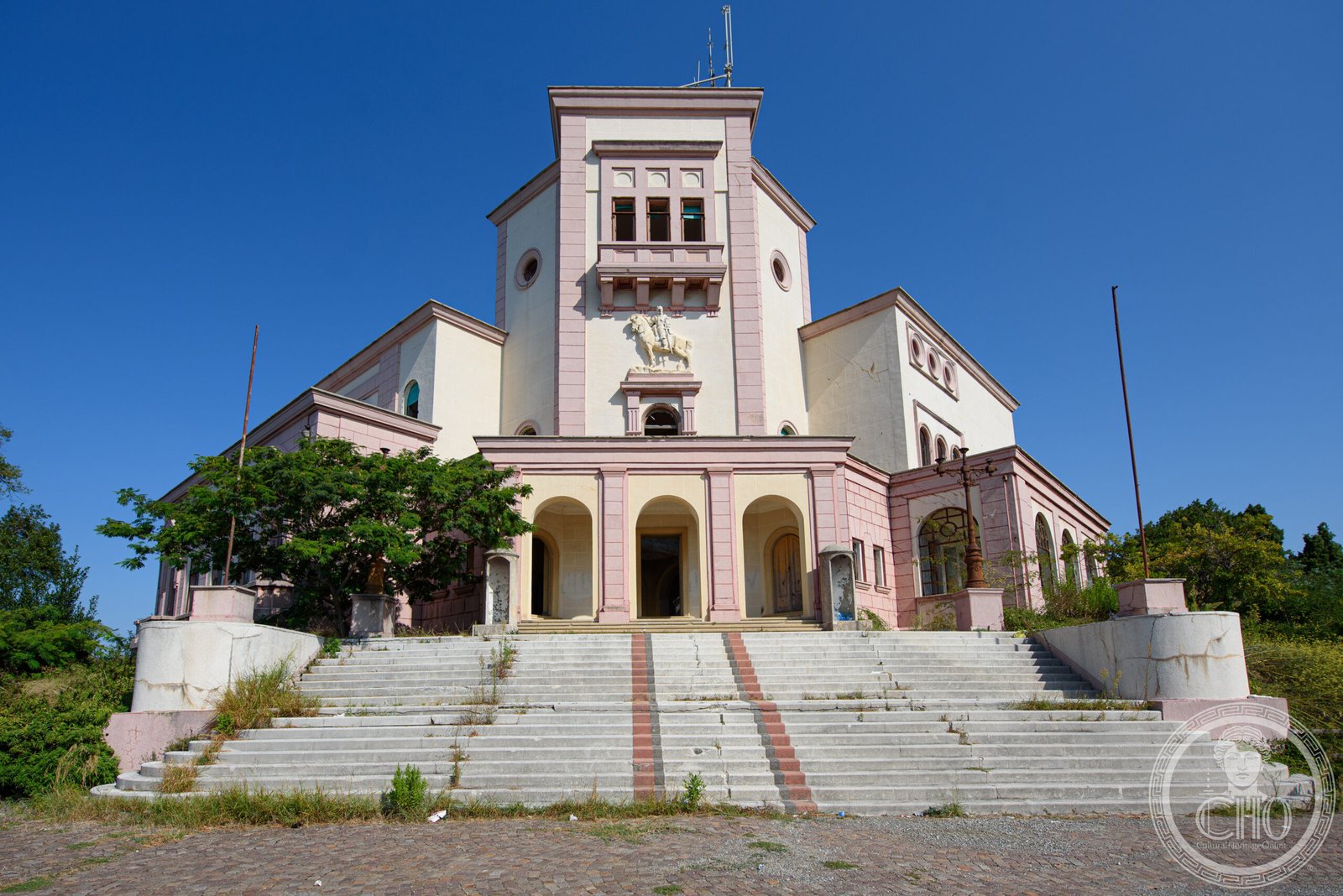
Di Fausto’s main Albanian commission was the Royal Villa in Durrës, completed in 1937 for King Zog I. The brief was straightforward — a summer residence with commanding views of the Adriatic — and Di Fausto treated it as he had treated his most successful Mediterranean buildings: by letting the site do most of the work. The villa sits on Kodër Vilë, a hill ninety-eight metres above the bay, and the building’s terraces step down the slope in a sequence that functions as a series of outdoor rooms between the residence and the coast. The vocabulary is recognisably Di Fausto — flat roof, horizontal string courses, recessed loggia — but lighter and less formally programmatic than his Libyan government buildings. It is, by reputation, among the most pleasurable of his works; the 1997 looting that stripped its marble and decorative interiors makes it difficult to assess from the outside, but the massing and the site remain exceptional.
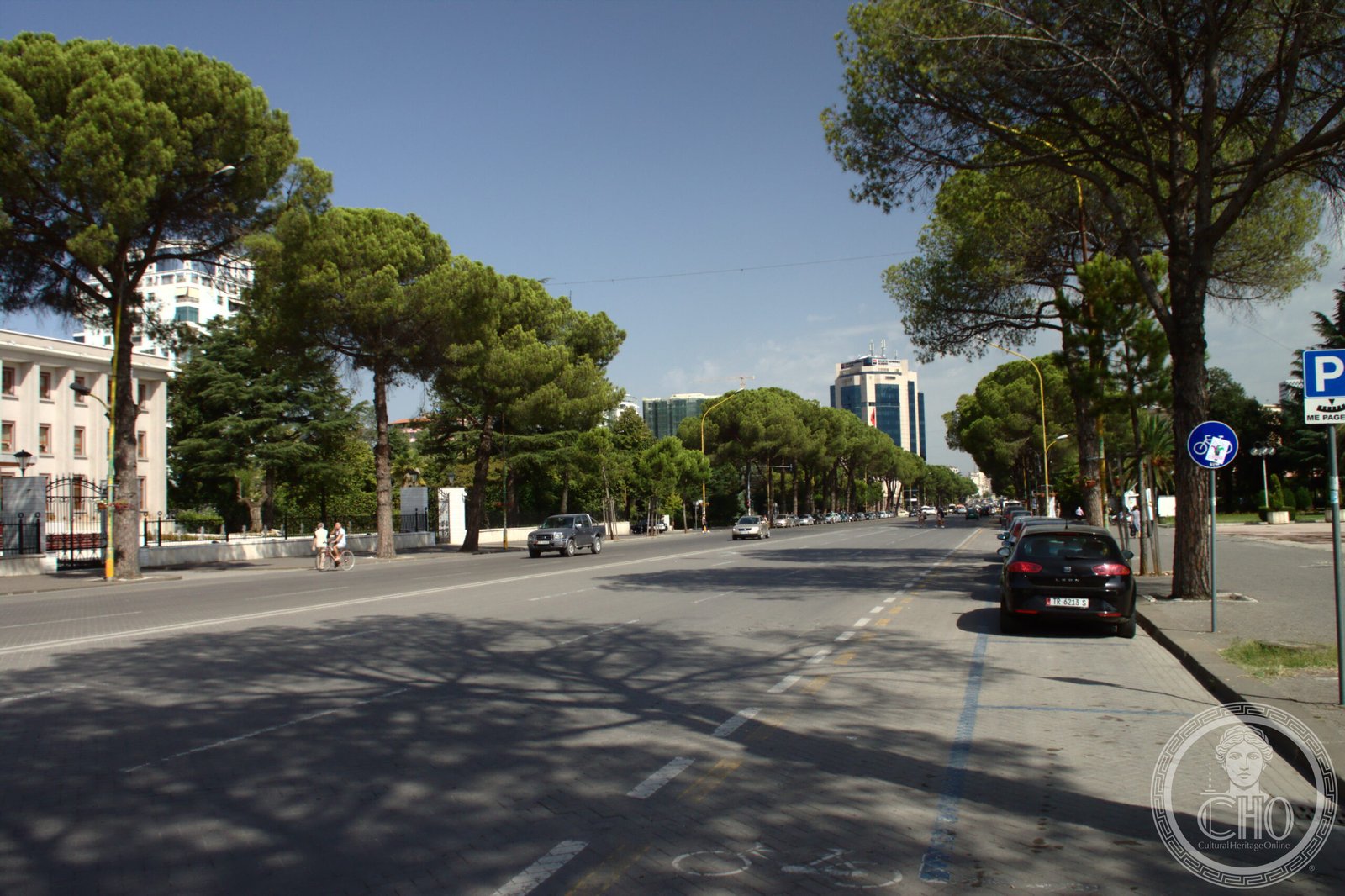
Bosio’s work in Tirana is more systematic. The Dëshmorët e Kombit Boulevard — known under the occupation as Viale del Impero — runs two kilometres from Skanderbeg Square in the north to Mother Teresa Square in the south, with ministry and government buildings set back on both sides behind planted medians. The buildings along the boulevard are not all by Bosio and not all Italian — the sequence includes earlier structures reworked into the Italian planning scheme — but the ensemble reads as a coherent piece of Rationalist urban design, and its legibility as a planned axis survives the renaming and reuse of the last eighty years.
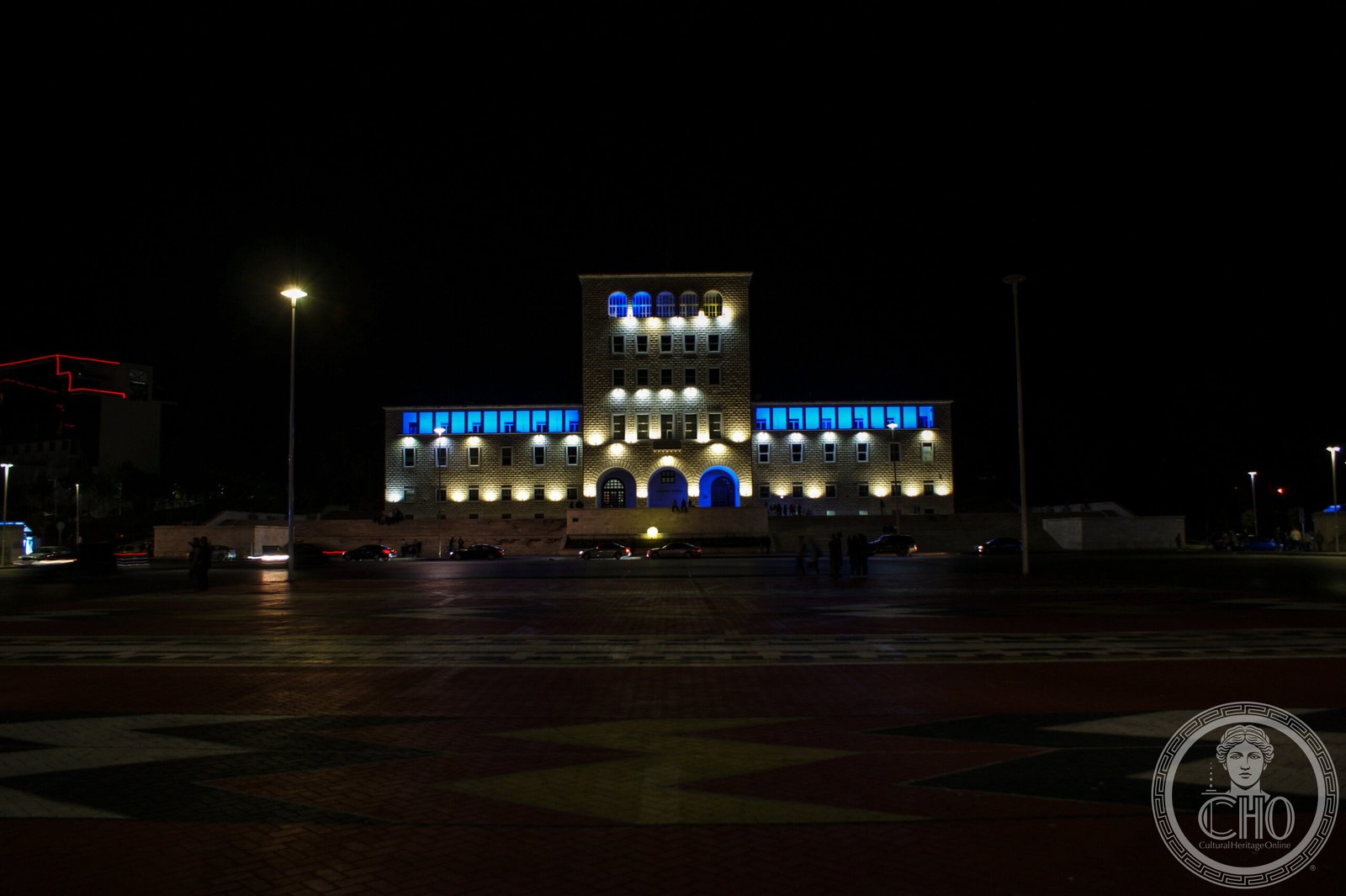
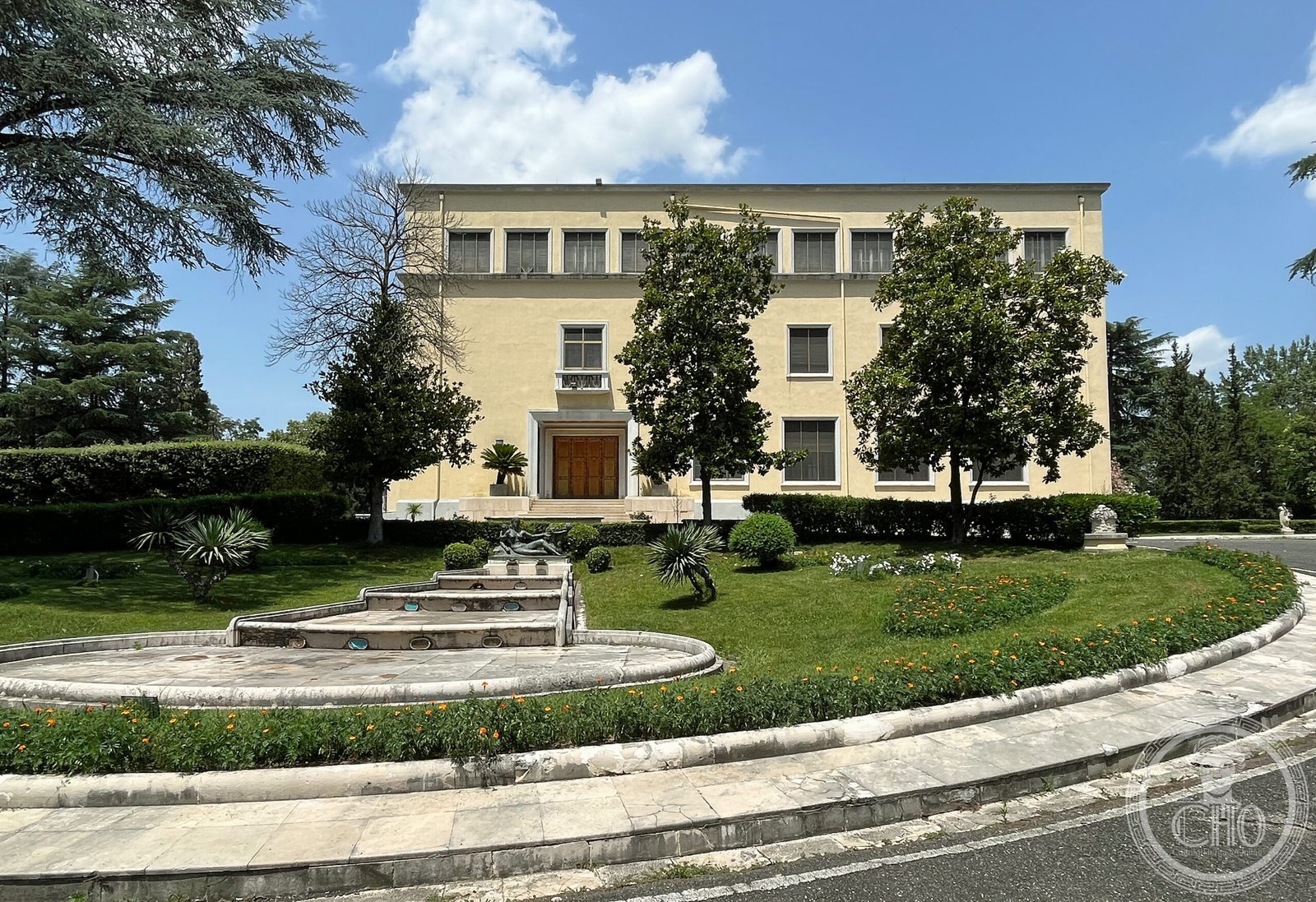
The four individual buildings Bosio designed for the institutional quarter represent a range of programme types within a consistent stylistic approach. The Prime Minister’s Office (1941) is the strictest: a three-storey block with stone-clad ground floor, horizontal window groupings, and a minimal entrance composition that owes more to Giuseppe Terragni’s Como Casa del Fascio than to anything in the local building tradition. The University of Tirana’s main building (1940) anchors the south end of the boulevard with a slightly more open composition — a wider facade with a pronounced central entrance bay — that suits its role as a public academic institution rather than a government office. The Presidential Palace (1939–1941), set within grounds near the Grand Park rather than directly on the boulevard, is the most formally elaborate, with a stone-framed entrance portal and a residential scale that distinguishes it from the government buildings despite sharing their Rationalist vocabulary.
The political context
None of this building happened in political innocence, and it would be dishonest to discuss the architecture without acknowledging what it was for. Italy’s relationship with Albania between 1925 and 1939 was a client-state relationship disguised as collaboration: Italian capital funded Albanian infrastructure, Italian advisers occupied senior positions in the Albanian administration, and the architectural programme in Tirana was a direct expression of Italian political ambition in the Balkans. When Mussolini ordered the military invasion of April 1939 — a three-day operation that encountered minimal resistance — the Albanian state that Italy had been redesigning was simply absorbed into the Italian empire, and the buildings that had been built for Albanian institutions became Italian colonial administration buildings.
Bosio’s architects’ drawings for the Tirana institutional quarter were produced within this context: they were not designs for a sovereign Albanian state commissioning international architecture, but designs for an Italian administration reshaping a subject territory according to Italian planning principles. The buildings that resulted are often good — sometimes very good — and their survival and continued use are a fact of Albanian history rather than a tribute to their political origins. But the political origins are part of what they are, and they appear in the details: the Rationalist stripped classicism that Bosio used in Tirana is the same vocabulary that the Italian state used in Addis Ababa, Asmara, and Tripoli. It is the architecture of a particular kind of political project.
Post-1944, communist Albania handled this inheritance pragmatically: the buildings were renamed, their Italian institutional identities replaced with Albanian ones, and their use continued. The boulevard became the Martyrs of the Nation Boulevard; the Royal Palace became the Palace of the Brigades. The new names were a counter-narrative applied to the same physical facts. What was not done — because it was not practical — was demolition or replacement. The Italian buildings were solid, well-constructed, and suited to their institutional programmes. They remained in use.
Why it matters now
The Albanian Rationalist ensemble is interesting for several reasons that go beyond its status as a historical curiosity. First, it is the most intact surviving example of Italian colonial Rationalism in the Balkans — comparable in scale and coherence to what survives in Rhodes and Tripoli, but less studied and less visited than either. Second, the buildings are in active use, which means they are maintained, and maintenance in active-use government buildings is more reliable than in museums or listed monuments with dedicated preservation programmes. Third, the political trajectory from Italian colonial planning to Albanian independence to communist use to post-communist democratic use gives the buildings a biographical richness that purely architectural analysis cannot capture.
For visitors, the trail from the boulevard through the four Tirana buildings to the Durrës villa is walkable and coherent in a way that similar trails in Rhodes or Tripoli are not — Albania is a small country and Tirana a compact capital. The buildings are there, the streets are safe and increasingly well served by cafes and public transport, and the historical narrative — empire, occupation, resistance, repurposing — is vivid enough to make the walk more than a sightseeing exercise. The full itinerary with practical information is here.