
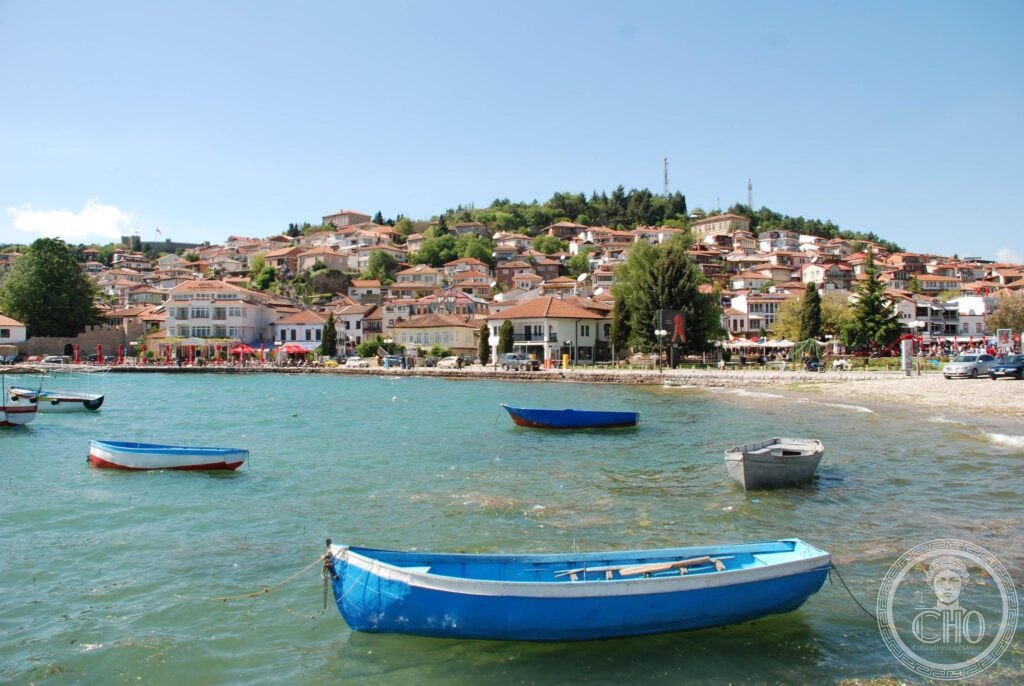
Ohrid Region
The most important center of Byzantine cultural heritage in the Balkans, the birthplace of the Cyrillic alphabet, and one of the world’s oldest lakes — Ohrid (North Macedonia; UNESCO WHS 1979 and 1980 as mixed cultural and natural site) was the “Jerusalem of the Balkans” for medieval Slavic Christianity, possessing 365 churches (one for every day of the year) and the monastery where Saints Cyril and Methodius’ disciples created the Glagolitic (and subsequently the Cyrillic) alphabet.
At a glance
Ohrid (the most precisely Ohrid single 2-3 million years Lake Ohrid 3rd oldest lake deepest Balkans 365 Byzantine churches Sveti Kliment Naum Cyrillic Glagolitic alphabet Sam Samuil fortress Slavic Bulgarian Macedonia 9th century CE UNESCO heritage: the dual significance (the site has both cultural and natural UNESCO significance, making it one of the few mixed WHS in Europe): the cultural significance (the city of Ohrid: a small city of approximately 42,000 people on the northeastern shore of Lake Ohrid; the historic old town (the area from the Samuel’s Fortress on the hill down to the lake shore is the UNESCO zone; the density of Byzantine churches is extraordinary — 365 have been documented historically, of which approximately 40 still stand (some in ruins))); the natural significance (Lake Ohrid: one of the three oldest lakes in the world (with Lake Tanganyika and the Caspian Sea; approximately 2-3 million years old; the isolation of the lake over this period has produced extraordinary endemism: at least 200 endemic species have been identified, including 17 endemic fish species, 71 endemic benthic invertebrates, 2 endemic molluscs, 1 endemic leech, and the Ohrid pearl (a freshwater imitation pearl made from the scales of the endemic Ohrid bleak fish))); the Cyrillic connection (the 9th century CE disciples of Saints Cyril and Methodius established a school in Ohrid under Sveti Kliment (Saint Clement) and Sveti Naum (Saint Naum); these two scholars developed the Glagolitic script (the first writing system designed for the Slavic languages, c. 863 CE) into the more practical Cyrillic alphabet (which replaced Glagolitic throughout the Orthodox Slavic world and is still used today by Bulgarian, Serbian, Macedonian, Russian, Ukrainian, Belarusian, Mongolian, and several other languages)) — the most precisely Ohrid single 2-3 million years Lake Ohrid 3rd oldest lake deepest Balkans 365 Byzantine churches Sveti Kliment Naum Cyrillic Glagolitic alphabet Sam Samuil fortress Slavic Bulgarian Macedonia 9th century CE UNESCO heritage in any UNESCO world heritage site)).
Key facts
- The Cyrillic Alphabet: the most precisely Ohrid single Sveti Kliment Naum 9th century Glagolitic Cyrillic alphabet Saints Cyril Methodius disciples Ohrid Literary School UNESCO heritage — one of the most consequential intellectual achievements of the medieval Balkans: the creation of the Cyrillic alphabet in Ohrid (the background: Saints Cyril (Constantine) and Methodius were Byzantine Greek scholars from Thessaloniki who were sent on a mission to Moravia (modern Czechia/Slovakia) in 863 CE to translate Christian texts into Slavic; they created the Glagolitic script (the first alphabet ever designed specifically for a Slavic language) for this purpose); the Ohrid school (after Cyril and Methodius died, their disciples Kliment (Clement) and Naum came to Ohrid (approximately 886 CE; the Bulgarian Tsar Boris I sent them there after expelling them from Moravia); Kliment founded a literary school at Ohrid that eventually had over 3,500 students; Kliment is credited with the development of the more practical Cyrillic script from the more complex Glagolitic (Cyrillic is named for Cyril but was probably created after his death by Kliment; the scholarly debate about who created Cyrillic continues; what is certain is that the Ohrid school produced the first Cyrillic texts)); the legacy (the Cyrillic alphabet is used today by approximately 250 million people in at least 50 languages; its development in Ohrid in the 9th century CE is the most important intellectual event in Macedonian history)
- GPS: 41.1133° N, 20.8022° E
History
From Lychnidos to Sam’s fortress (the most precisely Ohrid single Lychnidos ancient Greek colony 6th century BCE Philip II Macedonia Roman Via Egnatia Byzantine Justinian Bulgarian Tsar Samuil fortress 976 1018 Ottoman 1394 Patriarchate Ohrid 1766 Ottoman abolish UNESCO heritage: the historical sequence: the ancient city (the site of Ohrid has been continuously inhabited for at least 6,000 years; the ancient city was called Lychnidos (City of Lights); the ancient name refers to the extraordinary quality of light at the lake — the lake’s calm surface reflects the mountains and sky to create an unusually bright light environment; Philip II of Macedonia (father of Alexander the Great) conquered Lychnidos in 353 BCE; the Roman Via Egnatia (the main road from Rome to Constantinople) passed through the city; Justinian I (the Byzantine Emperor; 527-565 CE) is believed to have been born near Ohrid)); the Bulgarian and Byzantine period (893 CE: the Bulgarian Tsar Simeon I moved the seat of the Bulgarian Patriarchate to Ohrid, making it the religious capital of Bulgaria; 976 CE: Tsar Samuil (Samuel; the most important Bulgarian/Macedonian ruler of the First Bulgarian Empire; ruled 976-1014 CE) made Ohrid his capital; Samuil’s fortress (the fortress on the hilltop above the old town; partially reconstructed; the walls up to 10m high; the viewpoint over the lake from the fortress is the finest in the old town)); the Ottoman period (1394 CE; Ottoman conquest; the Archbishopric of Ohrid (one of the most important religious institutions in the Orthodox world; the Patriarchate of Ohrid had jurisdiction over all of Macedonia, Albania, and parts of Greece) was abolished by the Ottoman Sultan Mustafa III in 1766 CE at the request of the Ecumenical Patriarchate of Constantinople) — the most precisely Ohrid single Lychnidos ancient Greek colony 6th century BCE Philip II Macedonia Roman Via Egnatia Byzantine Justinian Bulgarian Tsar Samuil fortress 976 1018 Ottoman 1394 Patriarchate Ohrid 1766 Ottoman abolish UNESCO heritage in any UNESCO world heritage site)).
What you see
Churches, fortress, and the lake (the most precisely Ohrid single Sveti Jovan Kaneo 13th century promontory lake Sveti Sofija Cathedral Sveti Kliment Naum monastery border Albania Samuel fortress walls Ancient theater amphitheater Ohrid pearl UNESCO heritage: the visitor highlights: Sveti Jovan Kaneo (the Church of Saint John the Theologian at Kaneo; the most photographed church in all of the Balkans; 13th century CE Byzantine church on a promontory above the lake; accessible via a 15-minute walk along the lake shore from the old town; the characteristic octagonal drum and dome; the interior frescoes (14th century CE; partially surviving)); the Cathedral of Saint Sophia (the largest and most important church in Ohrid; 11th century CE Byzantine basilica; the most complete Byzantine fresco programme in North Macedonia; the most important surviving Byzantine frescoes in the central nave depicting the figures of the apostles and bishops)); Samuel’s Fortress (the medieval walls on the hilltop; 10 towers remaining; the view of the lake from the fortress battlements is the best panorama in the old town; the fortress walls are freely walkable at the top); the ancient theater (the Greek theater from the Hellenistic period (3rd-2nd century BCE); rediscovered in 1980 CE; partially excavated; the best-preserved ancient theater in North Macedonia; used for summer theatrical performances)); Lake Ohrid cruise (2h boat trip to the Monastery of Saint Naum (29 km south; on the Albanian border; the monastery of Sveti Naum (905 CE; the founding date; the current church is 16th-17th century CE; the springs of the Black Drim River surface here); the boat continues along the Albanian shore) — the most precisely Ohrid single Sveti Jovan Kaneo 13th century promontory lake Sveti Sofija Cathedral Sveti Kliment Naum monastery border Albania Samuel fortress walls Ancient theater amphitheater Ohrid pearl UNESCO heritage in any UNESCO world heritage site)).
Practical information
- Getting there: Ohrid Airport (OHD; international; direct flights from London (LTN; Wizz Air; 3h), Istanbul (SAW; Pegasus; 2h), Vienna (VIE; Wizz Air; 1h45m), Rome (FCO; Wizz Air; 1h30m); seasonal charters from many European cities (July-August)); from Skopje (170 km east; the North Macedonia capital; Skopje Alexander the Great Airport (SKP); more international connections; bus to Ohrid 3h or car 2h30m on the E65 road via the Kičevo mountain pass)); accommodation (the old town has numerous guesthouses and small hotels; the stone-paved streets of the old town are pedestrianized; the lake-front hotels have the best views; the best summer lake swimming (the public beaches along the lake shore; the average summer water temperature 24-26°C); the water is crystal-clear (Ohrid is the world’s clearest lake in terms of underwater light penetration — a Secchi disk is visible at 22m depth)); visa (not required for EU/US/UK/CA citizens; part of the Schengen application process)
Getting there
Ohrid Airport (OHD). Flights from London (3h), Istanbul (2h), Rome (1h30m). Or Skopje (SKP), 170 km, 2h30m by car. GPS: 41.1133, 20.8022.
Nearby
- Monastery of Saint Naum — 29 km south (on the Albanian border; the monastery founded by Saint Naum in 905 CE; the boat trip from Ohrid town along the lake shore is the classic approach (1h each way); the springs of the Black Drim River rising from the ground (spring-fed, crystal-clear water); the peacocks in the monastery garden (a tradition since the 15th century CE))
- Albania/Lake Ohrid (Albanian side) — accessible via the border crossing at Sveti Naum (the Albanian shore of Lake Ohrid; the town of Pogradec (the main Albanian lakeside town); less visited than the Macedonian side; the Lin Peninsula (the Byzantine church and frescoes at Lin; not UNESCO but extraordinary; easily visited in a day from Ohrid))
Sources
- Wikipedia, Ohrid; Lake Ohrid; Sveti Jovan Kaneo; Clement of Ohrid, accessed June 2026
- UNESCO, Natural and Cultural Heritage of the Ohrid region, WHS reference 99, inscribed 1979 (extended 1980)
Find it on the map
See this place and what’s around it →📷 Diventa un fotografo di Cultural Heritage Online
Condividi le tue foto dei luoghi: restano pubblicate con la tua firma come autore. Più vengono viste, più ti fai conoscere — e presto un concorso premierà le foto più apprezzate.
Accedi o registrati gratis per aggiungere una foto