
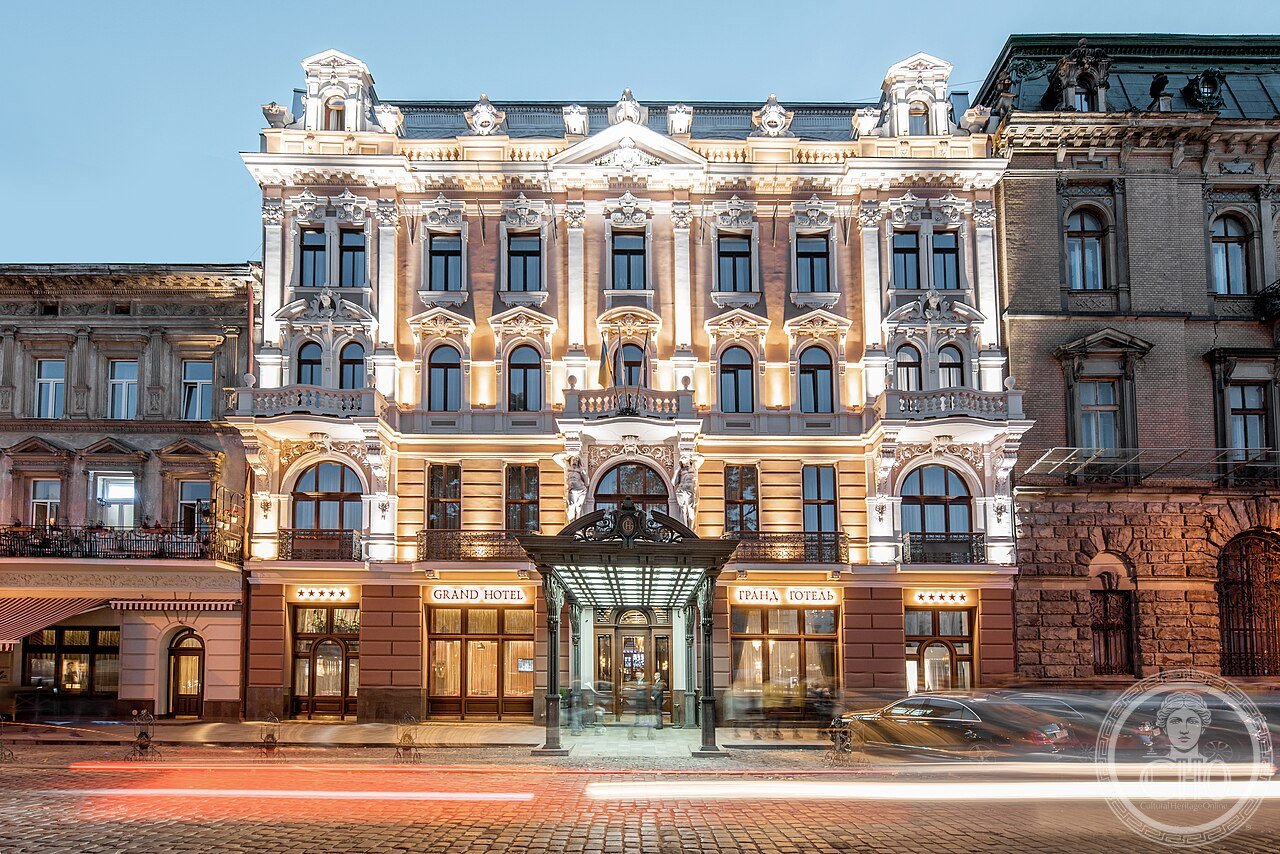
Commissioned by entrepreneur Efraim Hausmann and opened in 1894, the Grand Hotel stands as one of only two surviving Austro-Hungarian-era hotels in Lviv still operating as a luxury property.
At a glance
The Grand Hotel commands the southern end of Svobody Prospekt — Lviv’s central boulevard — in the heart of the city’s UNESCO-inscribed historic centre. Designed by Erazm Hermatnik in the Baroque Revival style, it was completed in 1894 under the supervision of Zygmunt Kędzierski after Hermatnik’s death the previous year. Decorative sculpture by Leonard Marconi enriches the facade with an exuberance typical of Habsburg civic ambition. Renovated between 2014 and 2018, the hotel today offers 121 rooms and suites alongside a spa, casino, and conference facilities, preserving its position as the prestige address on Lviv’s grandest boulevard.
Key facts
- Built: 1892–1894 by Erazm Hermatnik (completed by Zygmunt Kędzierski)
- Style: Neo-Baroque (Baroque Revival); facade sculpture by Leonard Marconi
- Status: Operating luxury hotel, 121 rooms and suites; spa and casino
- Address: 13 Svobody Prospekt, Lviv 79008, Ukraine
- GPS: 49.8406, 24.0269 — Open in Google Maps
- UNESCO/Listed: Located within the UNESCO World Heritage historic centre of Lviv (inscribed 1998)
History
The site on which the Grand Hotel stands was previously occupied by an Empire-style police headquarters — the building where the writer Leopold von Sacher-Masoch was born in 1836. Efraim Hausmann, a Lviv entrepreneur, commissioned Erazm Hermatnik to replace it with a hotel that would match the standards of the great European grand hotels of the era. When the Grand Hotel opened in 1894 it offered electric light throughout — in all public rooms and in every guestroom — as well as running hot and cold water and a central heating system: amenities that set a new standard for the city. An adjoining covered shopping passage, known as Hausmann Passage, connected Svobody Prospekt through to Doroshenka Street and Sichovych Striltsiv Street, turning the hotel block into a miniature commercial galleria.
The communist period brought two successive renamings: first as the Hotel Lviv, then as the Verkhovyna from 1964. The building survived Soviet rule intact and underwent a first post-independence renovation in 1991–1992. A more thorough reconstruction carried out between 2014 and 2018 restored the Neo-Baroque exterior and modernised the interior to contemporary luxury standards. A stained glass panel by Hryhorii Komskyi, installed during the earlier renovation, was preserved throughout the second restoration.
The 2018 reopening introduced one of the hotel’s more attention-grabbing details: a suite with BDSM-inspired theming, referencing the literary legacy of Sacher-Masoch, whose name and work gave rise to the word masochism. The hotel is one of just two of the 25 luxury hotels of the Austro-Hungarian and Polish interwar periods in Lviv that still function as operating hotels.
What you see
The facade rises four storeys above Svobody Prospekt in a confident display of late-Habsburg Baroque Revival: rusticated ground floor, piano nobile windows framed by pilasters and elaborate keystones, and Leonard Marconi’s sculptural ornament — atlantes, cartouches, and figurative reliefs — punctuating the upper storeys. The corner treatment where the hotel meets the passage entrance is particularly rich, drawing the eye down both street frontages simultaneously.
Inside, the recent renovation balanced heritage preservation with luxury expectations. The grand staircase and public hall retain their fin-de-siècle proportions; the restaurant and bar spaces have been updated while respecting the original room sequence. Komskyi’s stained glass panel, a survivor from the 1991 restoration, remains a notable interior feature.
Practical information
- Open to hotel guests; restaurant and bar accessible to non-guests; casino with separate entry
- Best season: late spring and early autumn; Lviv’s summer cultural season (June–August) is lively
- Guided tours available: no dedicated heritage tour; hotel reception can provide historical overview
- Estimated visit time: 1–2 hours for a meal or a walk through the public areas
Getting there
Lviv Danylo Halytskyi International Airport is approximately 6 km west of the city centre; taxis take 15–25 minutes. The hotel sits directly on Svobody Prospekt, a 10-minute walk from the main railway station (Lviv Central). Trams 1, 6, and 9 stop on the adjacent streets.
Nearby
- Lviv Theatre of Opera and Ballet: The Neo-Baroque opera house by Zygmunt Gorgolewski stands at the northern end of Svobody Prospekt, a 3-minute walk from the hotel.
- Rynok Square (Market Square): The UNESCO-listed medieval market square at the heart of the old city, 5 minutes on foot east of the hotel.
- Dominican Church and Monastery: A Baroque church of outstanding quality, a 7-minute walk into the old town.
- Boim Chapel: A richly carved Renaissance funerary chapel, one of the finest in Central Europe, within the same walking cluster.
Sources
Find it on the map
See this place and what’s around it →📷 Become a Cultural Heritage Online photographer
Share your photos of places: they stay published under your name as the author. The more they're seen, the more you get noticed — and soon a contest will reward the most appreciated photos.
Log in or sign up free to add a photoIs this page about you?
This page is read by travellers and heritage enthusiasts who find it on Google. Tell us how you are connected to this place and we will take it from there.