
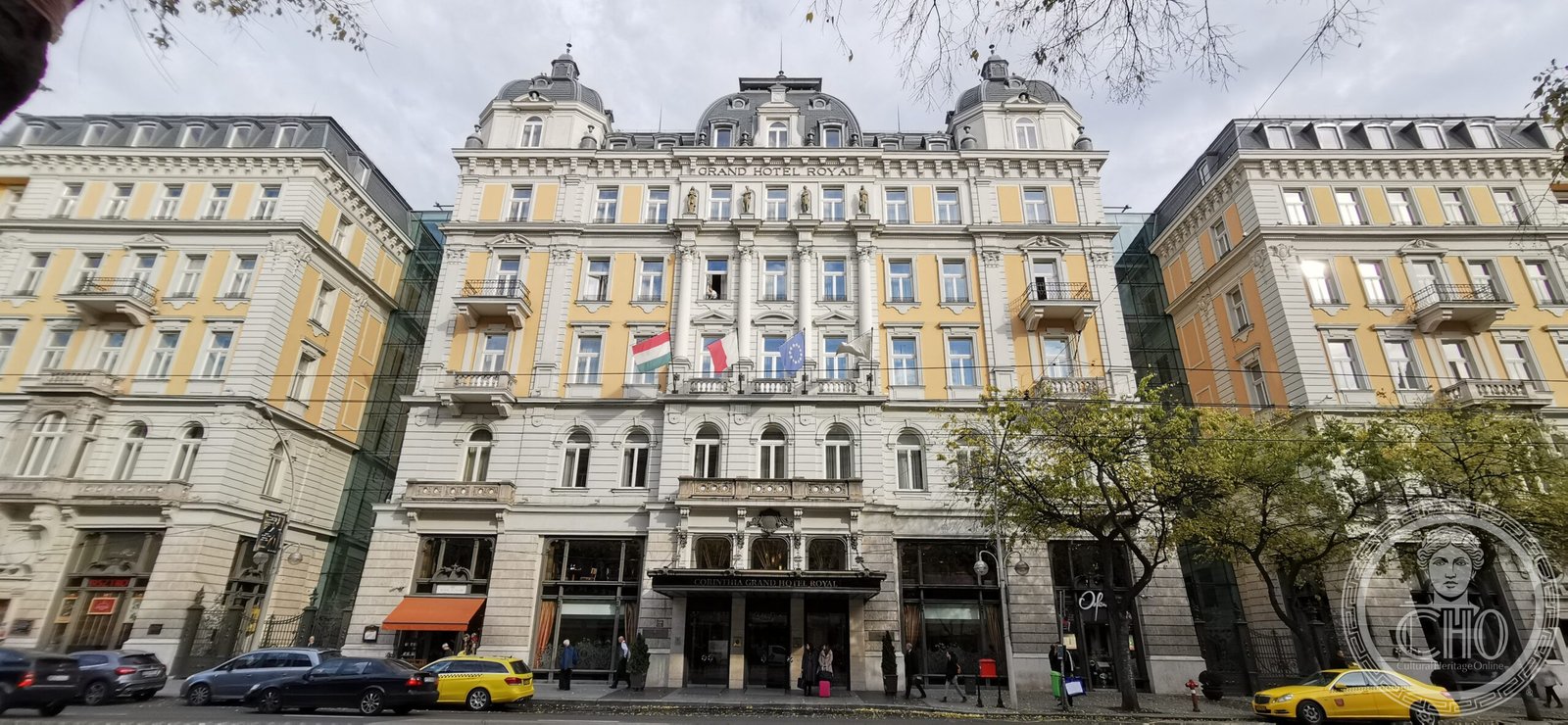
Opened on 30 April 1896 to receive visitors flooding into Budapest for the Hungarian Millennium Exhibition, the Grand Hotel Royal gave the city one of its most exuberant Belle Époque addresses — and after a century of wars, revolutions, and communist neglect, it remains so.
At a glance
Designed by architect Rezső Ray and completed in 1896, the Grand Hotel Royal anchored the newly built Erzsébet körút — Budapest’s Grand Boulevard — with six floors of French Renaissance grandeur. It opened in time for the Millennium Exhibition celebrating Hungary’s 1,000 years of statehood and quickly became the social heart of fin-de-siècle Budapest. Damaged in the Second World War and rebuilt in modernist austerity in 1961, the building was rescued by the Corinthia Group, which invested €100 million in a restoration that recovered the historic ballroom, rebuilt the ornate spa, and reopened the hotel on 30 April 2003 — exactly 107 years after its original debut.
Key facts
- Built: 1895–1896 by Rezső Ray
- Style: French Renaissance / Neo-Baroque
- Status: Luxury hotel — Corinthia Budapest (414 rooms, 31 suites)
- Address: Erzsébet körút 43–49, 1073 Budapest, Hungary
- GPS: 47.5027, 19.0668 — Open in Google Maps
- Listed: No specific national monument designation confirmed; located within Budapest’s historic urban fabric
History
A joint-stock company formed by architect Rezső Ray purchased land on the newly constructed Erzsébet körút and raised the Grand Hotel Royal in time for Hungary’s Millennial celebrations of 1896. With around 400 rooms at opening and a staff of 200, it was one of the largest hotels in Central Europe. The Lumière brothers used the hotel for the first motion-picture screening in Budapest; composer Béla Bartók performed here; and in 1909, Hungary’s first aeroplane was displayed in the courtyard. Josephine Baker sang at the hotel’s Orfeum Club stage in 1928.
The Second World War left the building severely damaged, and Soviet shelling during the 1956 Hungarian Revolution inflicted further destruction. A state-funded rebuild completed in 1961 restored room capacity but stripped much of the original ornament in favour of socialist-modernist interiors. The hotel limped on until October 1991, when it closed as an obsolete state enterprise following the collapse of communism.
In 2000, IHI (International Hotel Investments) acquired the vacant shell and entrusted its reconstruction to a team that retained the historic façade and the surviving nineteenth-century Grand Ballroom while rebuilding the interior entirely — 60,000 square metres in all. The €100 million project remains the largest hotel restoration in Hungarian history. Director Wes Anderson visited in 2012 while researching the visual world that inspired The Grand Budapest Hotel (2014).
What you see
The six-storey façade on Erzsébet körút deploys French Renaissance vocabulary with confident scale: rusticated base, rhythmic pilastered bays, elaborate window surrounds, and a roofline punctuated by mansard dormers and sculpted cartouches. The street elevation stretches across two city lots, giving the building a commanding horizontal presence on Budapest’s sweeping Grand Boulevard.
Inside, the Grand Ballroom is the centrepiece of the historic fabric — a double-height space with gilded mouldings and a coved ceiling that survived both war and communist redecoration. The Royal Spa occupies a lower level where the original late-nineteenth-century pool hall, with its ornate ironwork and mosaic floor, has been restored. The main lobby, rebuilt in the 2003 renovation, uses warm stone and coffered vaulting to evoke the hotel’s Belle Époque origins without resorting to pastiche.
Practical information
- Hotel guests only for rooms and spa; lobby, bars, and restaurants open to the public
- Year-round destination; spring and autumn best for the boulevard streetscape
- Guided heritage tours available on request through the concierge
- Estimated visit (lobby, bar, ballroom glimpse): 30–45 minutes; full spa day available to non-guests by appointment
Getting there
Budapest Ferenc Liszt International Airport is approximately 25 km east; the 100E airport bus reaches Deák Ferenc tér in 35 minutes. The hotel stands on Erzsébet körút, served by Metro line M4 at Keleti pályaudvar (800 m) and tram lines 4 and 6 running along the boulevard directly in front of the building. Deák tér, the city’s central transport hub, is a seven-minute tram ride or a 15-minute walk through the Jewish Quarter.
Nearby
- Great Synagogue on Dohány Street: The largest synagogue in Europe, a Moorish-Byzantine landmark — 400 m south-west
- New York Palace (Anantara Hotel): The equally opulent 1894 palazzo by Flóris Korb and Kálmán Giergl, home to the famed New York Café — 600 m north-east
- Franz Liszt Academy of Music: Art Nouveau concert hall and conservatoire — 600 m west
- Hungarian State Opera House: Neo-Renaissance opera house on Andrássy út — 900 m west
Sources
Find it on the map
See this place and what’s around it →📷 Become a Cultural Heritage Online photographer
Share your photos of places: they stay published under your name as the author. The more they're seen, the more you get noticed — and soon a contest will reward the most appreciated photos.
Log in or sign up free to add a photoIs this page about you?
This page is read by travellers and heritage enthusiasts who find it on Google. Tell us how you are connected to this place and we will take it from there.