
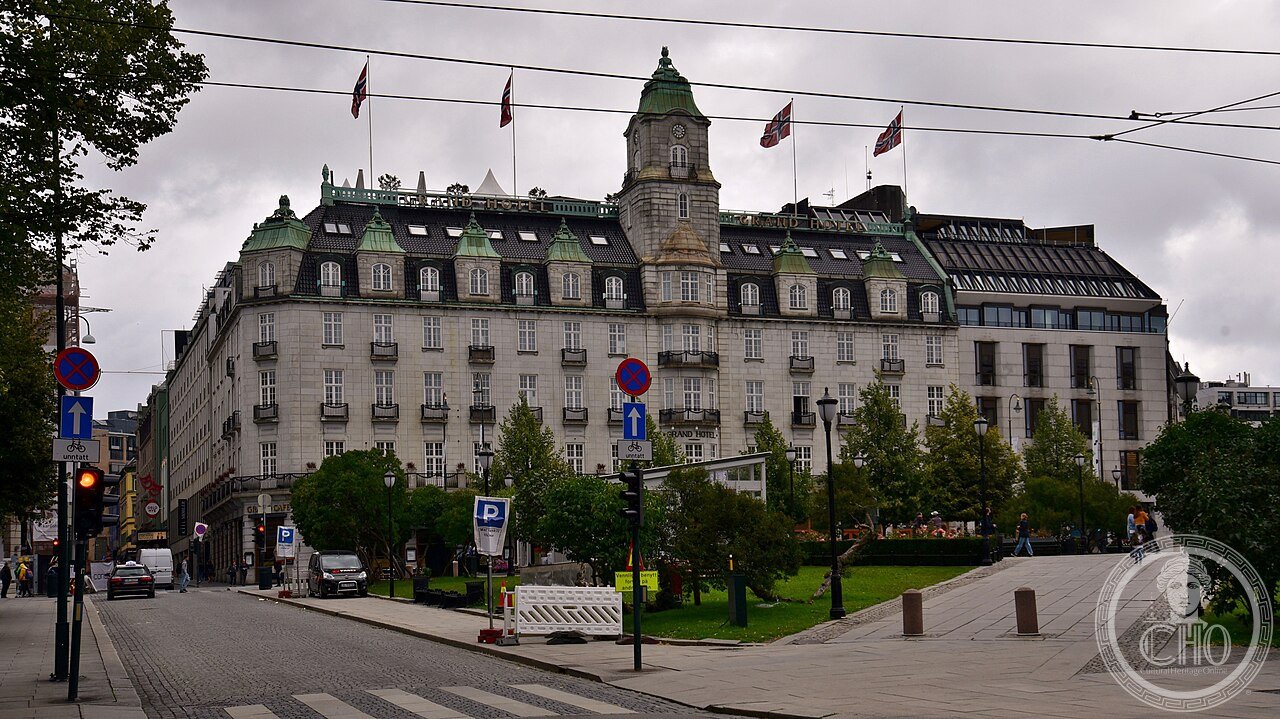
Norway’s most celebrated hotel has stood at the heart of Karl Johans gate since 1874, a white granite landmark where Nobel Peace Prize laureates and literary giants have left their mark on every room.
At a glance
The Grand Hotel is Norway’s pre-eminent historic hotel, occupying a converted private residence redesigned by Danish-Norwegian architect Jacob Nordan (1824–1892) and dramatically rebuilt in 1911–13 with a white granite facade quarried from the Sognefjord. Its characteristic clock tower with copper roof remains a fixed point on Oslo’s main parade avenue. Today the hotel operates 290 rooms and serves as the official residence of Nobel Peace Prize laureates during their visit to Oslo each December. The Neoclassical Belle Époque interior — including the mirrored Speilen ballroom and the glass-veranda Palmen Restaurant — survives largely intact as a document of late-nineteenth-century Scandinavian luxury.
Key facts
- Built: 1874 (remodelling by Jacob Nordan); rebuilt 1911–1913
- Style: Neoclassical / Belle Époque
- Status: Operating luxury hotel (Grand Hotel Oslo by Scandic)
- Address: Karl Johans gate 31, 0159 Oslo, Norway
- GPS: 59.9137, 10.7396 — Open in Google Maps
- UNESCO/Listed: No national listing
History
Julius Fritzner opened the Grand Hotel in 1874 by converting the three-storey private residence of Professor Chr. Heiberg into Oslo’s most ambitious hotel. Architect Jacob Nordan oversaw the remodelling, and the decoration painter Wilhelm Krogh, who worked at the Kristiania Theater, embellished the interiors. The hotel immediately established itself as the social centre of the Norwegian capital.
The ballroom Speilen opened in 1886 with a ceiling of painted ornament, old-pink columns and wall panels filled entirely with mirrors. Eight years later the two-storey Rococo hall was added, its walls covered with further paintings by Krogh. From 1891 until 1899 playwright Henrik Ibsen made the Grand Café his daily dining room, occupying an armchair formally reserved with a placard reading “Reserved for Dr. Ibsen.” The hotel staff presented him with four engraved glasses at Christmas 1899 — one for each of his favourite drinks. A complete reconstruction between 1911 and 1913 gave the hotel its present granite facade and the copper-roofed clock tower.
The Nobel Peace Prize Committee chose the hotel as the official banquet venue and laureates’ residence, a tradition that has continued to the present day. Roald Dahl, who stayed at the Grand as a young man, credited the hotel with sparking the material that would later appear in his 1984 memoir Boy: Tales of Childhood. Today the property operates under the Scandic Hotels group.
What you see
The 1911–13 facade is faced entirely in white Sognefjord granite — a material whose cold brilliance sets the hotel apart from the brick and plaster neighbours lining Karl Johans gate. A symmetrical composition of bays and arched windows rises to a corner clock tower finished in oxidised copper, visible from both the Storting and the Royal Palace. The overall register is Neoclassical, disciplined and restrained, without the decorative excess of contemporary Viennese hotel architecture.
Inside, the Speilen ballroom preserves its 1886 character: a low-ceilinged salon lined with gilt-framed mirrors, pink columns and Krogh’s original painted frieze. The Palmen Restaurant occupies the glass veranda that Ibsen favoured in summer for its “shady, cool” atmosphere. A chandelier by contemporary artist Cerith Wyn Evans titled Ca’ Rezzonico hangs in the space, positioning the heritage interior against a strand of contemporary art patronage.
Practical information
- Open to hotel guests and restaurant diners; Grand Café open to the public
- Best visited year-round; December is Nobel season with ceremonies at Oslo City Hall nearby
- Guided heritage tours available on request
- Allow 1–2 hours for the public spaces and Grand Café
Getting there
Oslo Gardermoen Airport is approximately 50 minutes by express train (Flytoget) to Oslo Central Station, a five-minute walk from the hotel. The hotel sits directly on Karl Johans gate, a ten-minute walk from the Central Station and equidistant from the Storting and the Royal Palace. Trams stop at Stortinget, one block away.
Nearby
- Stortinget (Norwegian Parliament), 200 m — Henrik Bull’s 1866 neoclassical chamber, open for public tours
- Oslo City Hall, 700 m — monumental 1950 brick building where the Nobel Peace Prize ceremony is held each December
- National Museum, 900 m — Norway’s largest art museum, housing Edvard Munch’s The Scream
- Akershus Fortress, 1 km — medieval castle and citadel overlooking the Oslofjord
Sources
Find it on the map
See this place and what’s around it →Events here — now on & upcoming
- Nobel Peace Prize Ceremony & Banquet 202610 Dec 2026See the event →
📷 Become a Cultural Heritage Online photographer
Share your photos of places: they stay published under your name as the author. The more they're seen, the more you get noticed — and soon a contest will reward the most appreciated photos.
Log in or sign up free to add a photoIs this page about you?
This page is read by travellers and heritage enthusiasts who find it on Google. Tell us how you are connected to this place and we will take it from there.