
Hector Guimard is Paris’s most ubiquitous architect. Every person who has taken the Métro has passed through one of his entrances. But beyond the green cast-iron édicules — which became the visual shorthand for Paris in the twentieth century — there is a body of residential and civic work spread across the western arrondissements that most visitors never find. This itinerary combines seven addresses: two Métro stations, two private residences, one synagogue, one department store, and one restaurant. Together, they outline the full range of what Art Nouveau meant in Paris between 1898 and 1913, and why it mattered.
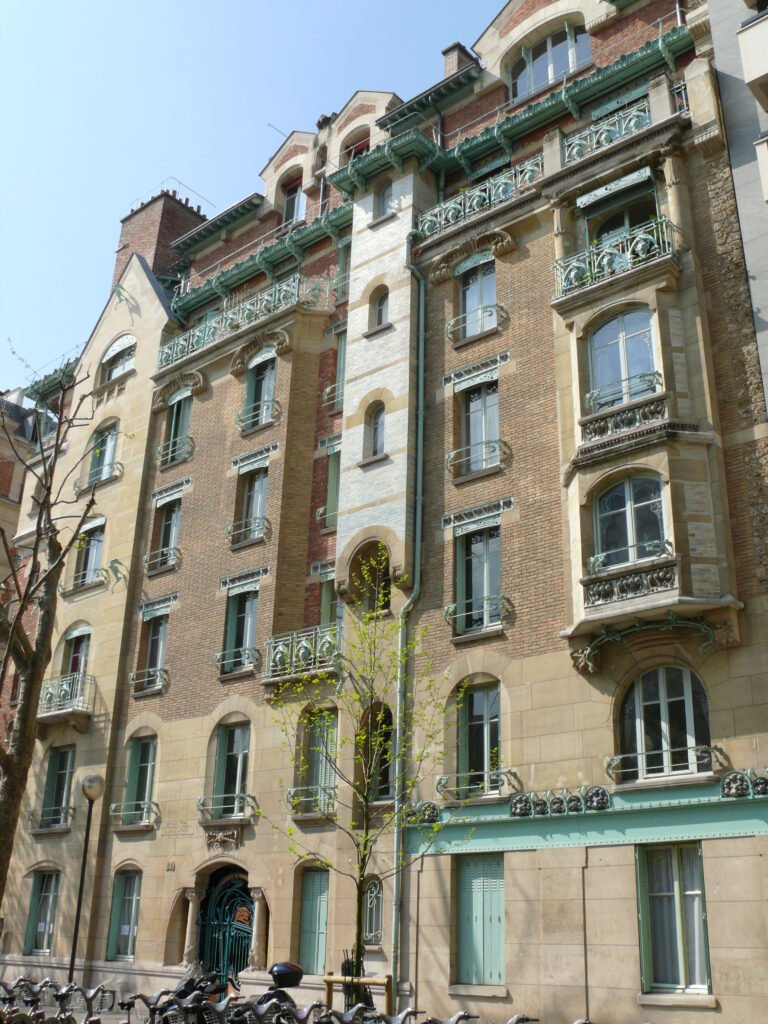
Castel Béranger — The House That Started It
Guimard was twenty-seven years old when he began designing Castel Béranger at 14 rue La Fontaine in 1895. Completed in 1898, it won the Concours des façades de Paris the same year — the city’s annual prize for the most beautiful new building facade. The prize was partly ironic: the neighbourhood was appalled. The building’s organic ornament, its asymmetrical massing, the ironwork gate that resembles seaweed pressed into metal — it was unlike anything that had been built in Paris before. Journalists called it the “Maison Cocagne,” somewhere between the dream house and the haunted house. At least one tenant moved out in protest.
The commission had come through the landowner, Madame Fournier, who gave Guimard almost complete freedom. The programme included thirty-six apartments, studios, and a caretaker’s lodge — a large social mix for a single building in 1898. Guimard used the formal complexity to push his ornamental system: no two door frames are identical, no two ironwork panels repeat. The building is classified as a monument historique and can be entered from the street — the courtyard and original staircase ironwork are intact.
Hôtel Mezzara — The Architect’s Own Street
Walk fifty metres south on rue La Fontaine and you are in Guimard’s neighbourhood. He lived at number 122, in a house he designed for himself in 1909. Hôtel Mezzara, at number 60, was built the following year for Paul Mezzara, a textile industrialist who made his fortune in the Paris lace trade. The commission gave Guimard a rare chance to design an entire private house — not an apartment block — for a client who trusted his complete programme.
The building is more restrained than Castel Béranger. A decade had passed, and the ornamental confidence of 1898 had modulated into something quieter: the plant-form curves concentrated at the window surrounds and the roofline, the facade otherwise composed in subdued stone. By 1914, Mezzara had sold the house. The fashion for organic ornament was over. The building was later a girls’ boarding school, then ceded to the French state in 1956. It is today classified as a monument historique — the inscription dates from 1994 — and is destined to become the future Musée Guimard.
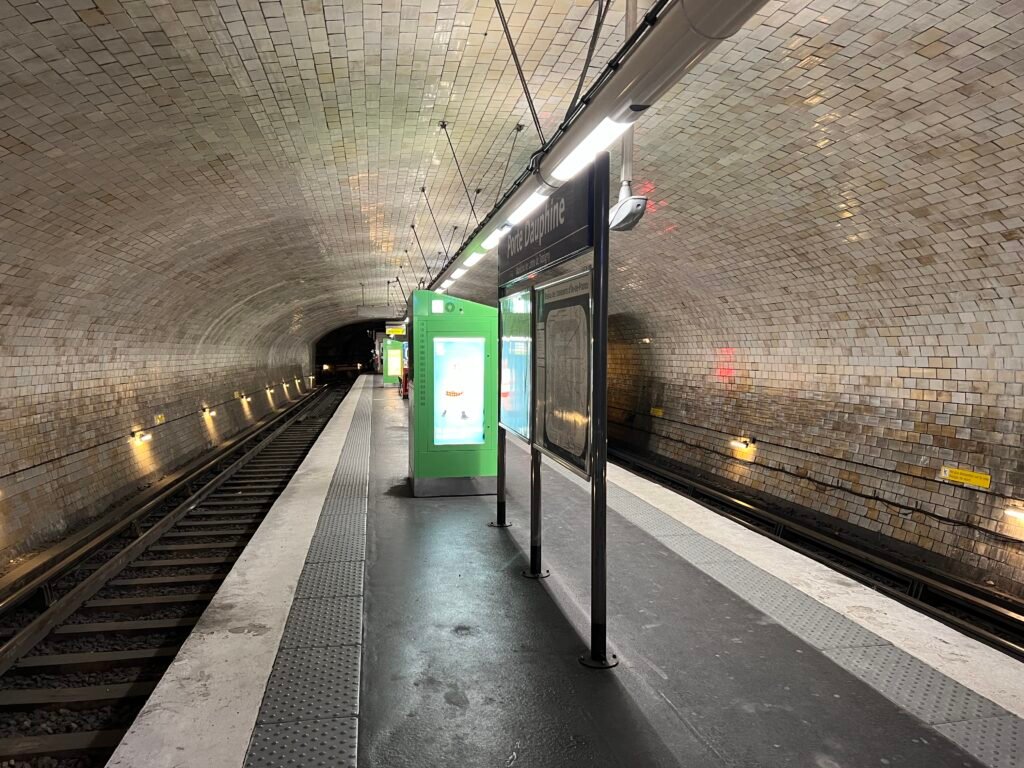
Porte Dauphine — The Underground Made Visible
The Paris Métro was built for the 1900 Exposition Universelle and opened in July of that year. Guimard was commissioned to design a system of covered entrances — édicules — for the stations. The brief was to make the underground visible from the street: to give each entrance a distinctive form that a traveller could recognise from a distance. He created a system of standardised cast-iron components — posts, railings, lamps, canopy ribs — that could be assembled in different combinations depending on the importance of the station.
Porte Dauphine, at the western terminus of line 2, received one of the full covered versions: a glass canopy carried on green cast-iron ribs, with Guimard’s organic lettering on the entrance sign. It is one of only two surviving complete édicules — the other is at Abbesses — and it is the more intact of the two in its original location. The design was nicknamed “style nouille” (noodle style) by critics in 1900. It became the primary visual export of Paris to the rest of the world across the following century.
Abbesses — Art Nouveau at Rush Hour
The Abbesses édicule is not where Guimard designed it to be. The original covered structure was built for Hôtel de Ville station in 1900 and demolished in 1974 when the station was modernised. The structure was carefully dismantled, transported to Montmartre, and re-erected at Abbesses — which had a station but no édicule. This transfer is the story of how Paris decided it valued Guimard after decades of regarding his Métro entrances as an embarrassment to be managed.
Abbesses is 36 metres below ground, and the descent by elevator takes you through a tiled tube — hand-laid ceramic in off-white and mustard green — that is one of the most complete surviving examples of original Métro interior design. At street level, the green édicule sits in the Place des Abbesses against the hill of Montmartre behind it: a composition that appears on more postcards than almost any other single view in Paris.
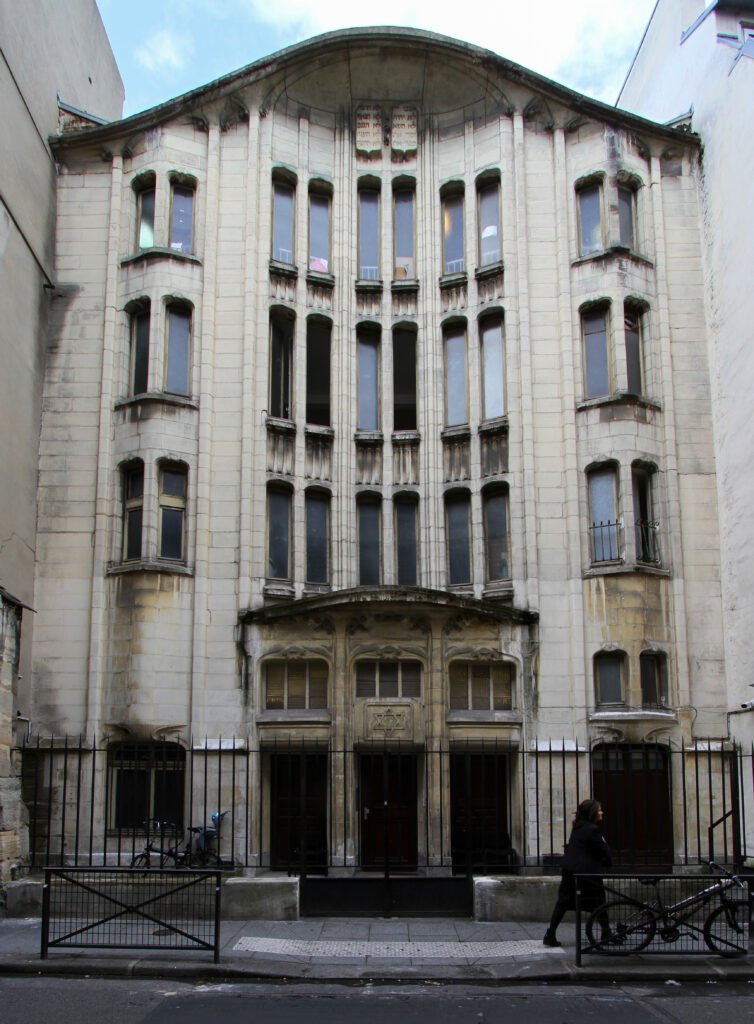
The Synagogue on Rue Pavée — Sacred Curves
Guimard designed the Agoudas Hakehilos synagogue in the Marais in 1913, the same year he married the American Jewish painter Adeline Oppenheim. The building is on a street under eight metres wide, and the facade works within a compressed vertical format, concentrating the organic ornamental vocabulary into a tight column of curves. It is one of the most unusual religious buildings in Paris, and one of the most easily missed: it sits among apartment blocks on rue Pavée without announcing itself from a distance.
The building survived the Second World War: the Gestapo entered in 1942, but the community had hidden the Torah scrolls and some interior fittings. A plaque on the exterior records this. The synagogue remains active and closes on Saturdays. What you see from the street is the full programme: a facade that is simultaneously a statement of identity, an exercise in structural geometry, and the last significant commission of Guimard’s Art Nouveau period. By 1920, the style was over.
La Samaritaine — Iron, Glass, and Commerce
Ernest Cognacq founded La Samaritaine in 1870 with a declared ambition to sell “everything to everyone.” Architect Frantz Jourdain designed the central building — magasin 2, facing the Seine — between 1905 and 1910, the same years Guimard was at work on private residential commissions. Jourdain’s problem was different: not how to ornament a house for a single patron, but how to make a building that could receive thousands of customers daily and still project the visual confidence of a civic institution.
His answer was a steel structural frame carried on ornate cast-iron columns, with glazed roof panels flooding the central atrium with natural light. The exterior, facing the quay, has peacock-motif iron balconies and enamelled ceramic panels in greens and yellows. La Samaritaine was closed in 2005 for safety reasons and reopened in June 2021 after a sixteen-year renovation led by the Japanese architects SANAA. The atrium and the river facade are intact. Entry is free.
Maxim’s — The Interior as Theatre
Maxim’s was founded in 1893, and its Art Nouveau interior was created in 1899, in time for the Exposition Universelle. The total-design approach that Art Nouveau required left no surface untouched: mahogany panelling, copper ceiling murals, painted glass panels depicting female figures in flowing garments, upholstered banquettes — all coordinated in the ground-floor room of a restaurant on one of the smartest streets in Paris. The interior is classified as a monument historique.
By 1905, Maxim’s had become the required social location for the Belle Époque elite. Franz Lehár acknowledged this by setting the third act of The Merry Widow at Maxim’s — a recognition that the restaurant had become as symbolic as any building in the city. Pierre Cardin bought Maxim’s in 1981 and added a museum of Belle Époque objects, costumes, and decorative arts on the first floor. The museum is the practical option for the heritage visitor: it gives access to the interior without the cost of a full meal, and the collection documents the social world that Art Nouveau both expressed and served.