
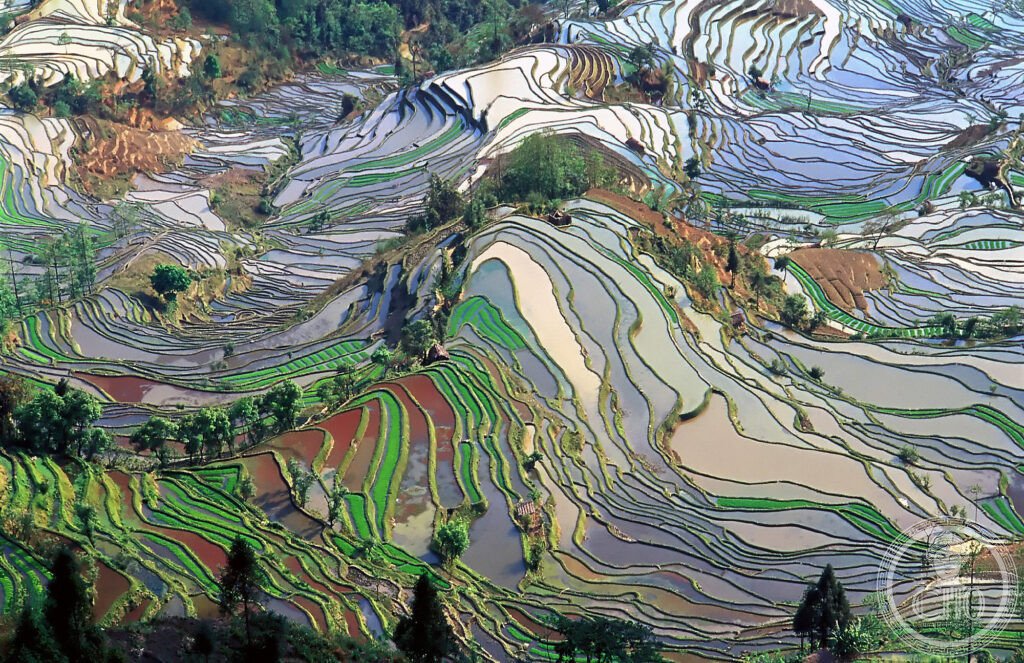
Carved by hand into the Ailao Mountains over some 1,300 years, the Honghe Hani terraces are still worked by the people who built them. Forest, village, terrace and water channel form a single self-sustaining system, and at dawn the flooded paddies turn into mirrors of the sky.
At a glance
The Honghe Hani Rice Terraces cover the steep slopes of Yuanyang County, where the Hani people have shaped the hillsides into a continuous cascade of paddy fields. The system rests on four interlocking elements: forest, village, terrace and water network. The Hani protect the forest above their villages because it is the source of every spring that feeds the terraces below, and a long-standing taboo forbids cutting it. Villages sit on the mid-slope, drawing water from the forest and passing it down by gravity through the terraces beneath them.
The terraces themselves are the accumulated work of many generations, each one relatively small but together forming a landscape of tens of thousands of hectares. A network of irrigation channels running for thousands of kilometres moves water from spring to terrace to terrace with no pumps at all, each field feeding the one below it in a continuous chain.
Key facts
- Location: Yuanyang County, Honghe Hani and Yi Autonomous Prefecture, Yunnan Province, China
- Builders: the Hani people, a Tibeto-Burman-speaking ethnic minority related to the Akha of Thailand, Myanmar and Laos
- Scale: around 70,000 hectares of terraced hillside between roughly 600 and 2,000 metres altitude
- Water system: an irrigation network of several thousand kilometres of gravity-fed channels linking forest springs to individual terraces
- Recognition: inscribed as a UNESCO World Heritage Site in 2013, as the Cultural Landscape of Honghe Hani Rice Terraces
History
The Hani are thought to have reached the Ailao Mountains around the 7th or 8th century, during the early Tang dynasty, after a long migration south. Their oral tradition, carried through ritual sung poetry known as habo, recounts this migration and the gradual building of the terrace system as the community adapted to land with almost no flat ground. Chinese historical sources from the Tang and Song periods refer to the terraced fields of the people they called the Heiman, an older name for the Hani, as one of the most distinctive features of the Yunnan frontier.
What you see
The protected landscape spans several terrace clusters across Yuanyang and neighbouring Lüchun county. Most visitors base themselves in Xinjie, the main town of Yuanyang, and travel out to a series of viewpoints. Duoyishu is the best known, with terraces fanning out below the Hani village and views best caught in the early morning. Bada offers a wide panorama across thousands of individual terraces, often wrapped in mist through the winter months, while Laohuzui, or Tiger’s Mouth, gives the deepest valley views and suits late-afternoon light.
Below the viewpoints, mushroom-shaped thatched Hani houses called tuku cluster on the mid-slope, and a weekly market in Xinjie draws Hani, Yi, Miao and Dai traders selling wild mushrooms, local rice, silver jewellery and other produce from across the Ailao Mountains.
Practical information
- Best time to visit: the terraces are flooded for transplanting between January and April, when the water mirrors the sky at dawn; the harvest in October and November brings a golden landscape instead
- Where to stay: Xinjie town has guesthouses, including traditional-style options in its old town area; check current rates locally
- Viewpoint access: Duoyishu, Bada and Laohuzui are the three principal viewpoints, generally reached by hired car or motorcycle from Xinjie; confirm current entry arrangements with the local tourism authority before travelling
Getting there
Kunming, the capital of Yunnan, has the nearest international airport and onward connections to most Chinese cities and to Hong Kong, Bangkok, Singapore, Seoul and Kuala Lumpur. From Kunming, express buses run to Xinjie in Yuanyang, or travellers can drive via the Yuanyang expressway; the historic town of Jianshui also offers an alternative approach by road.
Nearby
- Jianshui — around 1.5 hours by road; a well-preserved classical Chinese town with the Zhu Family Garden, a large Qing-dynasty merchant residence, a Confucian temple ranked second in size in China after Qufu, and the Twin Dragon Bridge over the confluence of two rivers
- Xinjie Old Town — a short walk from most guesthouses; hosts the region’s principal weekly market, where Hani, Yi, Miao and Dai traders sell mushrooms, rice, silver jewellery and other local goods
Sources
- Wikipedia, Honghe Hani Rice Terraces
- Wikipedia, Hani people
- Wikipedia, Ailao Mountains
- UNESCO, Cultural Landscape of Honghe Hani Rice Terraces
Find it on the map
See this place and what’s around it →📷 Become a Cultural Heritage Online photographer
Share your photos of places: they stay published under your name as the author. The more they're seen, the more you get noticed — and soon a contest will reward the most appreciated photos.
Log in or sign up free to add a photo