
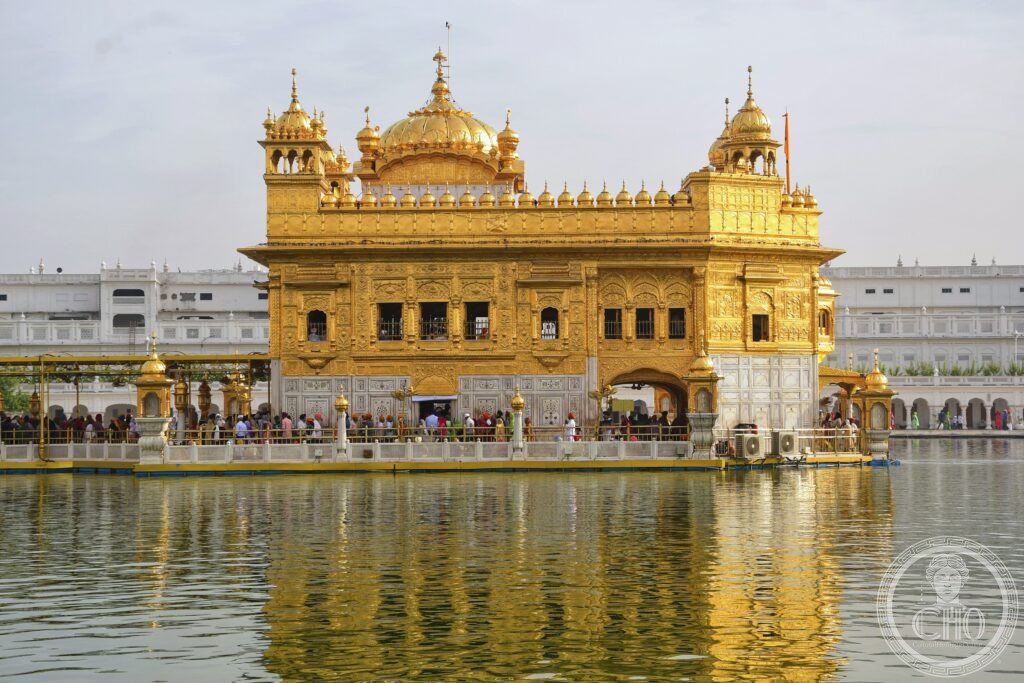
The central shrine of Sikhism sits lower than the ground around it, reached by walking down rather than up, and opens on all four sides so that no direction and no caste has precedence. Beside it, in a kitchen that has run for four centuries, tens of thousands of people are fed free every day, seated on the floor in rows, whoever they are.
At a glance
Harmandir Sahib — the House of God, known in English as the Golden Temple — stands on a platform in the middle of a rectangular sacred pool, the Amrit Sarovar, in the old city of Amritsar. The pool came first: Guru Ram Das, the fourth Sikh Guru, began the tank and the settlement around it together in 1570, and both were finished by 1577; the town takes its name from the water. His successor, Guru Arjan, laid the foundation of the shrine in 1604 and installed in it the scripture that Sikhs regard as their living Guru. The architecture states the theology plainly: the building is set below the level of its surroundings, so that worshippers descend to reach it, and it has an entrance on each of the four sides.
Key facts
- The gold: the shrine was not golden at first. Maharaja Ranjit Singh, ruler of the Sikh Empire, had the upper structure covered in gilded copper in 1830; the temple’s own account puts the gold at around 750 kg, though other estimates are lower. The gilding has been renewed since, most recently in the 1990s.
- The building: small, and deliberately so — a shrine of roughly 40 feet square standing on a platform of about 67 feet square, reached by a marble causeway from the walkway that rings the pool.
- The langar: the free communal kitchen serves on the order of 50,000 meals on an ordinary day, and more than 100,000 on festivals, to anyone who comes. It is cooked and served largely by volunteers, and everyone eats seated on the floor in the same rows — the point of the institution since the second Guru introduced it, as a refusal of caste.
- Akal Takht: built facing the shrine in 1606 by Guru Hargobind, the Throne of the Timeless is the seat of Sikh temporal authority; its edicts are binding on Sikhs worldwide. Shrine and Takht together express the Sikh pairing of spiritual and worldly authority.
- Status: not a UNESCO World Heritage Site. India has kept Harmandir Sahib on its Tentative List since 2004, but it has never been inscribed.
- GPS: 31.6200° N, 74.8765° E
History
Sikhism took shape in the Punjab from the teaching of Guru Nanak (1469–1539). Amritsar became its centre under the fourth Guru, and the shrine its focus under the fifth, Guru Arjan, who compiled the scripture and installed it here in 1604. The Guru Granth Sahib is still carried into the shrine each morning in procession and returned at night to rest — a daily ceremony that is one of the reasons to come early.
The shrine was destroyed and rebuilt more than once during the eighteenth century, when Afghan invasions repeatedly targeted it; the present building dates from the rebuilding that followed, and the gilding from the reign of Ranjit Singh. Two later events shaped how the site is understood today. In 1919, in a walled garden 500 metres away at Jallianwala Bagh, British troops fired on a penned-in crowd; estimates of the dead run from around 400 in the official British count to roughly a thousand in Indian accounts, and the bullet marks are still in the walls. In 1984 the Indian Army entered the complex in Operation Blue Star, an assault on militants who had fortified themselves inside; the Akal Takht was badly damaged, and the operation’s consequences — including the assassination of Indira Gandhi — remain a wound in Sikh memory.
What you see
You enter barefoot, head covered, after stepping through a shallow channel of water. The Parikrama, a wide marble walkway, runs right around the pool, and most visitors walk it clockwise before crossing the causeway to the shrine itself. The reflection in the water is the image everyone knows, and it is best before sunrise, when the recitation carries across the tank and the crowd is thinner.
Facing the shrine across the walkway stands the Akal Takht. Around the complex are the pilgrim dormitories, the vast langar hall with its steel trays and its washing lines of volunteers, and the community’s own museum. Nothing charges admission, and nothing closes: the shrine keeps going through the night.
Practical information
- Entry: free, at any hour, for anyone of any religion. Heads must be covered (scarves are handed out at the entrance), shoes and socks are left at the free cloakroom, and feet are washed on the way in. Alcohol, tobacco and meat are not permitted inside the complex.
- When to come: before dawn for the procession of the scripture and the light on the water; late evening for its return. The middle of the day is hot and crowded.
- Eating: the langar is open to visitors on the same terms as everyone else — sit in the row, eat what is served, hand the tray back. Volunteering in the kitchen, usually at the washing-up, is normal and welcomed.
Getting there
Amritsar has its own international airport (ATQ), about 11 km from the centre, with flights from Delhi in roughly an hour and direct services from several cities abroad. The overnight and daytime trains from Delhi take around six to eight hours. The temple stands in the old city and the last stretch is on foot through a pedestrianised approach. GPS: 31.6200, 74.8765.
Nearby
- Jallianwala Bagh — 500 metres; the walled garden of the 1919 massacre, now a memorial.
- Wagah–Attari border ceremony — 30 km west; the theatrical flag-lowering drill performed each evening by Indian and Pakistani border guards facing each other across the gate.
- Partition Museum — in the old town hall, ten minutes’ walk; the first museum devoted to the 1947 partition, built largely on survivors’ testimony.
Sources
- Shiromani Gurdwara Parbandhak Committee (SGPC), the body that administers the shrine — Sri Harmandir Sahib and The City: Amritsar
- Sri Darbar Sahib official visitor information, including the langar and daily routine
- Encyclopaedia Britannica, Golden Temple
- District Administration of Amritsar, Government of Punjab — Places of Interest
Find it on the map
See this place and what’s around it →📷 Become a Cultural Heritage Online photographer
Share your photos of places: they stay published under your name as the author. The more they're seen, the more you get noticed — and soon a contest will reward the most appreciated photos.
Log in or sign up free to add a photoIs this page about you?
This page is read by travellers and heritage enthusiasts who find it on Google. Tell us how you are connected to this place and we will take it from there.