
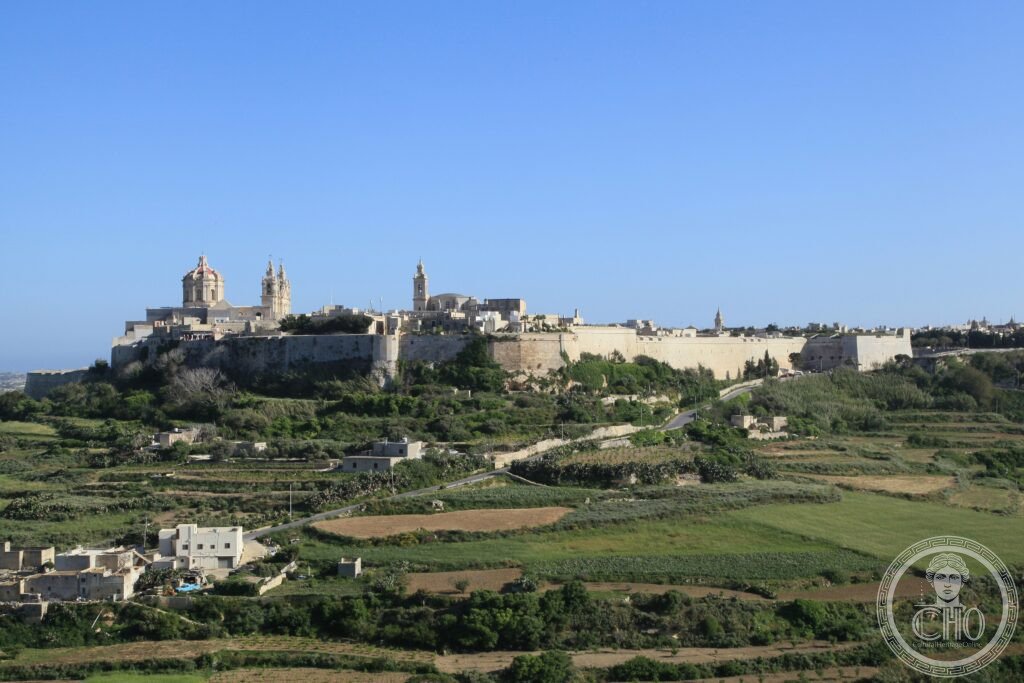
Mdina is Malta’s old capital, a fortified town on a limestone plateau inland from Valletta whose walls enclose a nearly unbroken sequence of medieval and Baroque streets. Known as the Silent City for its near-absence of traffic, it carries the island’s layered history in miniature: Roman Melita, the Arab Medina that gave it its name, the Norman conquest of 1091, and the Baroque rebuilding that followed the earthquake of 1693.
At a glance
Mdina occupies a naturally defensible plateau near the centre of the island of Malta, with terraced fields below and views that stretch across much of the island. It served as Malta’s capital until the arrival of the Knights of St John, who were granted the islands by Holy Roman Emperor Charles V in 1530 and later moved the seat of power to the coast, founding Valletta in 1566. Mdina remained the home of the Maltese nobility and acquired the names Città Notabile and, after Valletta rose, Città Vecchia — the old city.
Today only a few hundred people live inside the walls. Mdina has been on Malta’s UNESCO Tentative List since 1998; it is not an inscribed World Heritage Site.
Key facts
- Names through history: Melita under Rome, Medina under Arab rule, Città Notabile under the Knights, Città Vecchia after Valletta became capital
- Arab period: from 870 to the Norman conquest; the town’s southern wall was drawn in, leaving part of the old Roman city in what is now Rabat
- Norman conquest: 1091, under Count Roger I of Sicily
- Cathedral: the medieval cathedral was wrecked by the earthquake of 11 January 1693 and rebuilt to the design of Maltese architect Lorenzo Gafà, dedicated to St Paul
- Palazzo Vilhena: commissioned in 1724 by Grand Master Antonio Manoel de Vilhena, designed by French architect Charles François de Mondion
- Heritage status: on Malta’s UNESCO Tentative List since 1998 (not an inscribed site)
History
The plateau has carried a walled town since antiquity. Under Rome the city was known as Melita, and tradition holds that St Paul, shipwrecked on Malta around 60 CE, was received by the Roman governor Publius here — the cathedral is said to stand on the site of Publius’s house. The Arab rulers who took the island in 870 gave the town its present name, from the Arabic word for city, and reduced its circuit by moving the southern wall; the district left outside the new line grew into neighbouring Rabat.
Count Roger I of Sicily took Malta from the Arabs in 1091, and for the following centuries Mdina was the capital and the stronghold of the island’s noble families. The arrival of the Knights of St John in 1530 shifted Malta’s centre of gravity to the harbours, definitively so after the founding of Valletta in 1566, and Mdina settled into its long afterlife as the quiet, aristocratic old city.
The earthquake of 11 January 1693, which devastated eastern Sicily, badly damaged Mdina’s medieval fabric. The rebuilding that followed gave the city its Baroque accents: Lorenzo Gafà’s cathedral of St Paul, and, a generation later, Grand Master Vilhena’s remodelling of the entrance front, including Palazzo Vilhena and the Baroque Main Gate of 1724.
What you see
The Main Gate leads into a town where the two chief layers — medieval lanes and Baroque set pieces — sit side by side. The narrow, shaded streets that bend and double back are the town’s medieval and Arab inheritance; the open squares and palace fronts belong to the post-1693 rebuilding. Many palaces are still privately owned by Maltese noble families, so the city reads from the street: carved doorways, coats of arms, closed courtyards.
The Cathedral of St Paul dominates the central square, its restrained facade and dome the signature of Lorenzo Gafà. Palazzo Vilhena, just inside the gate, is French Baroque in manner and now houses the National Museum of Natural History. From the bastions at the town’s edge, the view takes in a wide sweep of the island, with Valletta visible in the distance.
Just outside the walls, in Rabat, the Domvs Romana preserves the remains of a rich townhouse of the early first century BC, discovered by accident in 1881; its polychrome mosaics are counted among the finest in the central Mediterranean.
Practical information
- Access: the walled city is free to walk; the cathedral, its museum and the Domvs Romana are ticketed separately
- When to go: early morning and after dark are the quietest hours, when the Silent City best earns its name
- Official information: see Heritage Malta (heritagemalta.mt) for the Domvs Romana and Palazzo Vilhena, and the Metropolitan Chapter (metropolitanchapter.com) for the cathedral and its museum
Getting there
Mdina stands inland, adjoining the town of Rabat, and is reached by road from Valletta in around half an hour; public buses from Valletta stop near the Main Gate. Vehicle access inside the walls is restricted to residents, which is much of the reason for the city’s quiet.
Nearby
- Rabat — immediately outside the walls, with the Domvs Romana and St Paul’s Catacombs
- Mosta — a short drive east, known for the great dome of its Rotunda church
- Valletta — the Knights’ capital of 1566 and a UNESCO World Heritage Site, visible from Mdina’s bastions
- Ħaġar Qim and Mnajdra — prehistoric temples on the southern coast, part of the UNESCO-listed Megalithic Temples of Malta
Sources
- UNESCO World Heritage Centre, Tentative Lists — Mdina (Città Vecchia)
- Heritage Malta — Domvs Romana; National Museum of Natural History (Palazzo Vilhena)
- Metropolitan Chapter of Malta — Mdina Cathedral
- Encyclopaedia Britannica — Mdina; Malta
Find it on the map
See this place and what’s around it →📷 Become a Cultural Heritage Online photographer
Share your photos of places: they stay published under your name as the author. The more they're seen, the more you get noticed — and soon a contest will reward the most appreciated photos.
Log in or sign up free to add a photo