
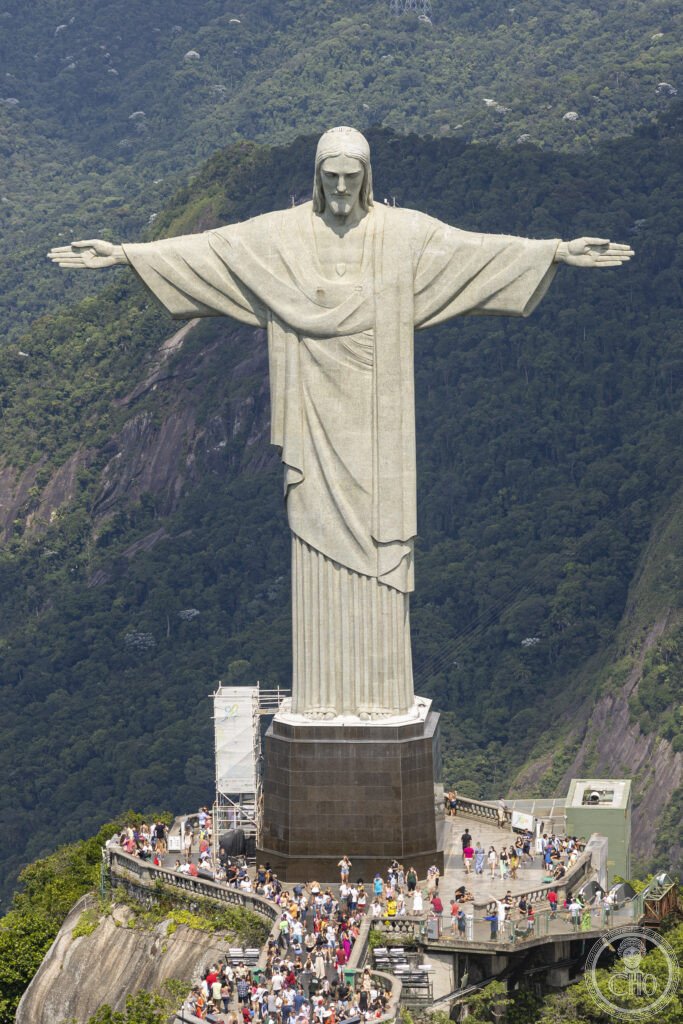
High above Rio de Janeiro on the 710-metre peak of Corcovado, the outstretched figure of Christ the Redeemer has watched over the city since 1931. Designed by Heitor da Silva Costa and sculpted by Paul Landowski, it remains the world’s largest Art Deco statue and one of the most recognised religious monuments anywhere.
At a glance
Cristo Redentor stands on the summit of Corcovado, within Tijuca National Park, its arms spread 28 metres across the skyline of Rio de Janeiro. The statue itself rises 30 metres on an 8-metre pedestal, its soapstone surface a permanent target for maintenance work and, on occasion, for lightning strikes.
Cloud cover frequently hides the statue from view; visitors are advised that early morning offers the clearest conditions. On a good day the summit gives out over Guanabara Bay, Sugarloaf Mountain, the beach arc of Copacabana and Ipanema, the Lagoa Rodrigo de Freitas and the Serra da Carioca range. The mountain sits inside Tijuca National Park, an urban forest of some 3,953 hectares and one of the largest of its kind in the world.
Key facts
- Location: Summit of Corcovado (710m), Tijuca National Park, Rio de Janeiro
- Completed: 12 October 1931
- Designer and sculptor: Heitor da Silva Costa, with sculpture by Paul Landowski; the face was modelled by the Romanian sculptor Gheorghe Leonida
- Dimensions: 30-metre statue on an 8-metre pedestal, arms spanning 28 metres
- Material: Exterior clad in hand-cut soapstone tiles from Ouro Preto, Minas Gerais
- Recognition: Voted one of the Seven Wonders of the Modern World by the New7Wonders Foundation in 2007
History
The idea of placing a Christian monument on Corcovado circulated as early as the 1850s, in a proposal attributed to the mathematician Vincentius Scherer, but gained little traction. It was revived after Brazil became a republic in 1889, as the Catholic Church sought a visible reaffirmation of its presence, and again around the 1922 centenary of Brazilian independence, when the Archdiocese of Rio de Janeiro formally proposed the statue in 1921. Construction was funded by donations from Brazilian Catholics.
Heitor da Silva Costa showed a maquette of his design at the Paris Salon d’Automne in 1923, where the sculptor Paul Landowski saw it and agreed to take on the work. The head and hands were modelled in Landowski’s studio in Boulogne-Billancourt before being shipped to Brazil in pieces. The finished statue was inaugurated on 12 October 1931, in a ceremony presided over by Getúlio Vargas.
What you see
The scale of the statue is easy to underestimate from photographs; standing on the platform beneath it, visitors are often struck by how large the 30-metre figure appears against the sky. The face has a notably calm, serene expression, the work of the Romanian sculptor Gheorghe Leonida, while the open palms and extended fingers remain the statue’s most recognisable gesture, read universally as one of welcome rather than judgement.
Cristo Redentor is visible from much of Rio de Janeiro on clear days, presiding over beaches, favelas and the city centre alike, and from the air the outstretched arms appear to embrace the whole bay.
Practical information
- Access: Reached by cogwheel train from Cosme Velho station through Tijuca Forest, by van shuttle from Paineiras, or on foot along a forest trail; the train is the most scenic option and the hike the most demanding.
- Timing: Arriving as early as possible in the day gives the best chance of clear views before cloud typically builds up later in the morning.
- Booking: Cogwheel train tickets are best arranged online in advance through the official service.
- Weather: The summit is often shrouded in cloud; check conditions before setting out.
Getting there
The cogwheel train from Cosme Velho station is the classic route up through the Tijuca Forest to the statue, and booking ahead is recommended. Arriving early in the morning offers the best chance of a clear summit before cloud sets in later in the day.
Nearby
- Sugarloaf Mountain (Pão de Açúcar) — a granite peak at the entrance to Guanabara Bay, reached by a two-stage cable car via Morro da Urca; sunset brings views back towards a lit Cristo Redentor.
- Tijuca National Park — the forest surrounding Corcovado itself, with hiking trails, the Cascatinha Taunay waterfall, the granite monolith of Pedra da Gávea, and wildlife including toucans, marmosets and capybaras, set within the fast-shrinking Atlantic Forest biome.
- Lapa Aqueduct and Selarón Steps — in the historic centre and Santa Teresa, an eighteenth-century aqueduct turned viaduct beside Rio’s nightlife district, and the tiled staircase created by the Chilean artist Jorge Selarón using tiles gathered from many countries.
Sources
- Wikipedia, Christ the Redeemer (statue)
- Wikipedia, Heitor da Silva Costa
- Wikipedia, Paul Landowski
- Wikipedia, Tijuca National Park
- New7Wonders Foundation, Seven Wonders of the Modern World
Find it on the map
See this place and what’s around it →📷 Become a Cultural Heritage Online photographer
Share your photos of places: they stay published under your name as the author. The more they're seen, the more you get noticed — and soon a contest will reward the most appreciated photos.
Log in or sign up free to add a photoDo you manage this place?
This page is read by travellers and heritage enthusiasts who find it on Google. Keep it accurate — and make it work for you. Free for non-profit heritage institutions.