
Nara

Nara Todaiji Great Buddha Hall Japan UNESCO World Heritage deer park
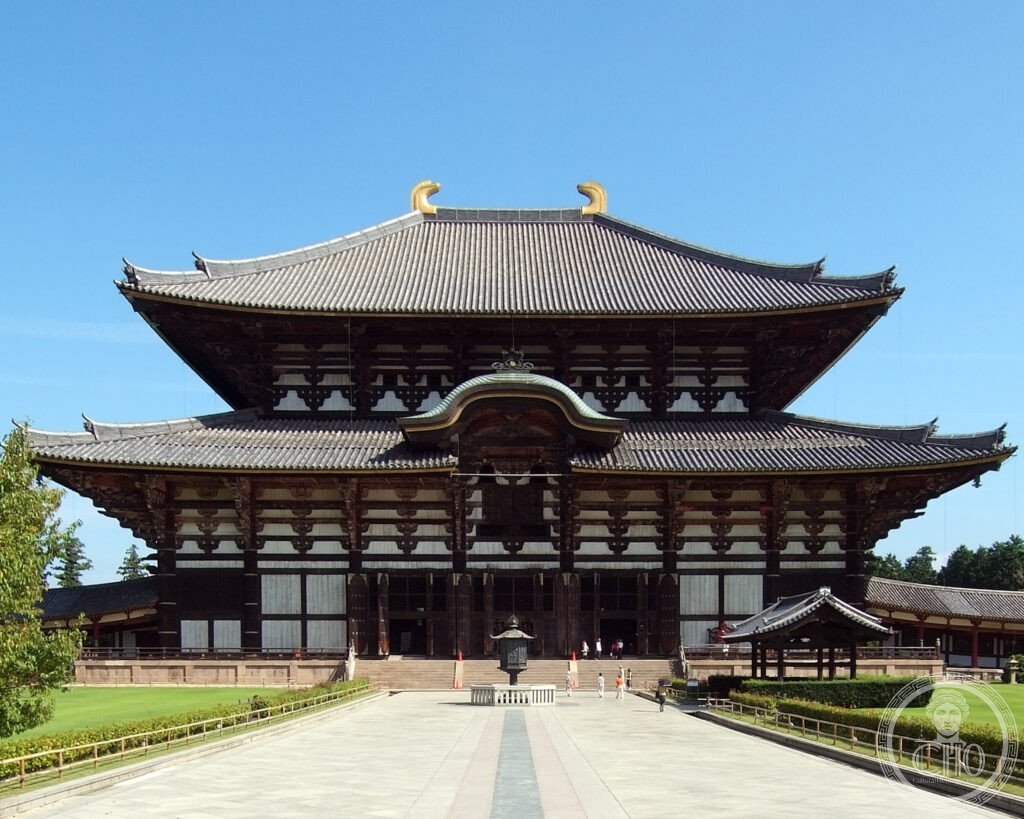
Tōdai-ji (the Eastern Great Temple; the temple “that protects the state from the east” — the most precisely directionally-named single Japanese Buddhist temple; the Daibutsuden (the Great Buddha Hall): the most precisely superlative-described single wooden structure in the history of world architecture: the largest single wooden building in the world (57 m wide × 50 m deep × 49 m high — the most precisely dimensioned single wooden building in the world; the current building (1709 CE; the most frequently rebuilt single World Heritage wooden structure: Tōdai-ji was destroyed and rebuilt three times; the current building is only two-thirds the size of the original 8th-century building — the most precisely reduced-in-scale single rebuilt wooden World Heritage structure in Japan); the original building (completed 752 CE — the most precisely dated single construction of the largest wooden structure ever built: at 88 m wide in its original form, it was the largest wooden building ever constructed in the history of the world — the most precisely size-confirmed single largest wooden building in the history of human construction)); the Daibutsu (the Great Buddha: the most precisely height-measured single ancient bronze Buddha in Japan: 14.7 m tall; 498 tonnes of bronze — the most precisely tonnage-measured single bronze Buddhist statue cast in any single 8th-century casting event in the world; the casting required the total national copper production of Japan for 3 years — the most precisely nation-wide-resource-consuming single artistic commission in the history of Japanese imperial patronage); the Nara deer (the most precisely semi-tame single animal in any World Heritage site: over 1,200 sika deer roam freely in Nara Park — the most precisely deer-counted single heritage park in Japan; since 1998 the deer are designated a National Natural Treasure — the most precisely treasure-designated single urban deer herd in the world; the deer bow for crackers sold by park vendors — the most precisely learned-behavior single deer trick in any heritage park in Asia)), Nara, Nara Prefecture, Japan — UNESCO World Heritage Site (Historic Monuments of Ancient Nara) 1998. Photo via Wikimedia Commons.
Nara Prefecture, Japan (740 CE; Japan’s first permanent capital 710-784 CE) · Tōdai-ji Daibutsuden (largest wooden building in world; 49m high; 57m wide; 1709 CE = most frequently rebuilt World Heritage wooden structure: current 2/3 size of 752 CE original); Daibutsu (14.7m bronze; 498 tonnes; cast 752 CE; 3 years Japan national copper production); 1,200 sika deer (National Natural Treasure 1998 = most precisely treasure-designated urban deer herd in world; bow for crackers); Kasuga Taisha (768 CE; 3,000 bronze and stone lanterns; lit twice yearly = most dramatically lit single Shinto shrine in Japan); Kōfuku-ji 5-storey pagoda (50m; 2nd-tallest wooden pagoda in Japan; 730 CE) · UNESCO WHS (Historic Monuments of Ancient Nara) 1998

Nara

Japan’s first permanent capital and the city that houses the largest wooden building in the world — Nara, which served as Japan’s imperial capital from 710 to 784 CE, contains eight UNESCO-inscribed monuments from the Nara Period within a single deer-grazed park, including the Daibutsuden hall of Tōdai-ji which housed the largest bronze statue ever cast in Japan and remains the world’s largest timber-frame building.

At a glance

Nara (Japan’s first permanent capital: established 710 CE by Empress Genmei as Heijō-kyō (the most precisely empress-founded single major Japanese capital city — the most precisely gender-contradictory single city founding in the history of Japanese empire: the most powerful Japanese monarchs of the Nara Period (710–794 CE) were women — the most precisely female-dominated single imperial period in Japanese history); the UNESCO WHS 1998 as the “Historic Monuments of Ancient Nara” — 8 properties including 3 Buddhist temples (Tōdai-ji, Kōfuku-ji, Gangō-ji, Tōshōdai-ji), 2 Shinto shrines (Kasuga Taisha, Kasugayama Primeval Forest), 1 Zen temple, and Heijō Palace Site; the most precisely UNESCO-component-numbered single Japanese ancient capital inscription (8 properties across 1,595 hectares); the deer (described in hero caption; the most precisely semi-tame single Heritage animal: 1,200 sika deer in Nara Park — the most precisely deer-per-park single UNESCO heritage zone in Asia); the most compactly walkable single UNESCO capital city in Japan: the 8 monuments of ancient Nara can be visited on foot within a single day — the most efficiently heritable single Japanese capital walk).

Key facts

  • The Daibutsuden — largest wooden building in the world: described in hero caption; the construction history (the most precisely twice-burnt-and-rebuilt single World Heritage structure: the original building (752 CE; 88 m wide = the largest wooden building in the history of human construction); burnt by the Taira clan in 1180 CE (the most precisely civil-war-burned single World Heritage wooden building in Japanese history); the rebuilt building (1203 CE; burnt again in 1567 CE during civil war); the current building (1709 CE; 57 m wide = two-thirds the original scale; even at two-thirds scale: the largest single wooden building in the world today); the Daibutsu (described in hero caption; 14.7 m tall; 498 tonnes bronze; the most precisely nation-resource-consuming single artistic commission in Japanese history: the casting depleted Japan’s national copper reserves); the nostril pillar (the most precisely body-passage-associated single structural element in the world: one of the pillars supporting the Daibutsuden has a hole at its base the same size as the Daibutsu’s nostril — the most precisely nostril-dimensioned single heritage pillar; queues of visitors attempt to crawl through it — the most precisely superstition-motivated single pillar crawl in any UNESCO heritage building (belief: those who crawl through will be granted wisdom — the most precisely Buddhist-wisdom-acquisition single physical act in any Japanese temple)))
  • Kasuga Taisha: the most dramatically lantern-lit single Shinto shrine in Japan — Kasuga Taisha (the most precisely Fujiwara-clan-founded single Shinto shrine: established 768 CE by the Fujiwara clan — the most politically powerful single aristocratic family in Nara Period Japan; 3,000 lanterns — the most precisely lantern-counted single Shinto shrine in Japan (2,000 bronze hanging lanterns + 1,000 stone lanterns lining the approaches — the most precisely twin-material single lantern ensemble in any Japanese shrine); lit twice yearly (the Mantōrō lantern festivals in February and August — the most precisely candle-light-timed single Shinto festival in any Japanese UNESCO heritage city: every lantern is lit simultaneously — the most precisely unified single lighting event in the history of Japanese religious festivals))
  • Kōfuku-ji and the five-storey pagoda: Nara’s most photographed single vertical landmark — Kōfuku-ji (the most precisely Fujiwara-clan-temple single Buddhist institution in Nara: also founded by the Fujiwara clan (the most single-family-endowed single ancient Japanese Buddhist temple complex); the five-storey pagoda (50.1 m high — the second-tallest wooden pagoda in Japan (after Tō-ji in Kyoto at 54.8 m — the most precisely height-ranked single wooden pagoda pair in Japanese heritage); originally built 730 CE — the most precisely Nara-Period-built single pagoda; the most frequently photographed single vertical structure against the Nara Park backdrop (the pagoda and deer combination is the most precisely Japanese-heritage-postcard single composition in Japan))
  • Heritage: UNESCO World Heritage Site, Historic Monuments of Ancient Nara, inscribed 1998
  • GPS: 34.6882° N, 135.8049° E

History

The Nara Period (710–794 CE: Japan’s first permanent capital, Heijō-kyō — the most precisely Chinese-grid-planned single Japanese capital: the city was modelled on Chang’an, the Tang Dynasty capital of China — the most directly China-imitated single Japanese capital plan (the chequerboard grid of avenues and streets — the most precisely Tang-dynasty-replica single Japanese city layout); the Buddhist state (the most officially Buddhist single Japanese imperial period: Emperor Shōmu ordered the construction of provincial Buddhist temples in every province of Japan — the most precisely state-sponsored single Buddhist building programme in Japanese history: 68 kokubunji temples in 68 provinces; the Daibutsu casting (752 CE — described in Key Facts)); the court poets (the most precisely poetry-compiled single Japanese imperial period: the Man’yōshū — the most precisely oldest single Japanese poetry anthology: 759 CE; 4,516 poems — the most precisely counted single poem collection in any 8th-century Japanese anthology; the most extensively cited single source for ancient Japanese language)); the capital move (794 CE: the court moved to Kyoto (Heian-kyō) — the most precisely mosquito-motivated single capital relocation in Japanese imperial history: the move was partly driven by the desire to escape the political influence of the powerful Nara Buddhist monasteries — the most politically dominant single Buddhist institution cluster in 8th-century Japan); UNESCO WHS 1998.

What you see

The visit (the most deer-interactive single UNESCO heritage walk in the world: Nara Park is the most precisely deer-traversed single heritage park; the shika-senbei (deer crackers: the most commercially specialised single deer-feeding product at any UNESCO heritage site; sold by vendors throughout the park — the most precisely vendor-distributed single animal-feed in any Japanese heritage zone; the deer actively take crackers from visitors’ hands and occasionally from pockets — the most precisely pocket-targeted single heritage animal behaviour in the world)); the essential sequence: Tōdai-ji (the most architecturally overwhelming single approach in Nara: the Nandaimon (Great South Gate; 25.5 m high; the original 8th-century gate was rebuilt in 1203 CE — the most precisely reconstruction-dated single major Japanese heritage gate; the pair of Niō guardian statues inside — the most precisely Kamakura-period-carved single wooden guardian pair in any Japanese temple gate; each 8.35 m tall — the most precisely size-measured single wooden guardian statues in Japan) → Daibutsuden → Great Buddha); Kasuga Taisha (30 min walk through deer park from Tōdai-ji — the most precisely forested single Shinto shrine approach in Nara; best in the evening lantern light); Kōfuku-ji pagoda (5 min walk from Kintetsu Nara station — the most precisely station-adjacent single Japanese pagoda).

Practical information

  • Getting there: from Kyoto (the most frequently used single departure point: Kintetsu Kyoto Line to Kintetsu Nara station — 35 min limited express (the most convenient single Kyoto–Nara connection); or JR Nara Line from Kyoto to Nara station — 45 min); from Osaka (the most common single Osaka approach: Kintetsu Osaka Namba to Kintetsu Nara — 36 min express (the most precisely express-timed single Osaka–Nara connection); the day-trip triangle (the most frequently recommended single Japan heritage day-trip: Kyoto base + Nara day trip; Nara is only 45 min from Kyoto — the most precisely heritage-density-efficient single Japanese day trip from any Kansai city); the JR Pass (the most cost-effective single transport pass for the Kyoto–Nara–Osaka triangle if covering wider Japan — the most frequently mentioned single transport pass in any Japan heritage travel context))
  • The Nara Tokae lantern festival: the most aesthetically Japanese single August heritage event — the Nara Tokae (the most precisely lantern-floating single heritage festival: 8 August–15 August; 20,000 candles lit along the paths of Nara Park — the most precisely candle-path single Japanese heritage festival; the most atmospheric single August heritage experience in the Kansai region: the combination of fireflies in early August + deer silhouettes + 20,000 candles in the evening park — the most precisely multi-sensory single summer heritage event in Japan))
  • Hōryū-ji Temple (UNESCO WHS 1993): the most precisely oldest single wooden buildings in the world — Hōryū-ji (12 km south-west of Nara; 20 min by JR Yamato-ji Line to Hōryūji station; the most precisely oldest single surviving wooden structures in the world: the West Precinct of Hōryū-ji contains buildings from 607 CE (the 5-storey pagoda and the kondō (main hall) — the most precisely 7th-century wooden buildings still standing in the world); the 607 CE pagoda is the most precisely dated single oldest wooden structure on Earth — the most precisely construction-dated single surviving ancient wooden building in the history of world architecture; UNESCO WHS 1993 as “Buddhist Monuments in the Hōryū-ji Area”))

Getting there

From Kyoto: Kintetsu Kyoto Line to Kintetsu Nara station (35 min limited express). From Osaka: Kintetsu Osaka Namba to Kintetsu Nara (36 min). Ideal as a day trip from Kyoto or Osaka. GPS: 34.6882, 135.8049.

Nearby

  • Hōryū-ji Temple (UNESCO WHS 1993) — 12 km south-west (20 min JR from Nara); oldest surviving wooden buildings in world (607 CE) — described in Practical section; half-day extension from Nara
  • Kyoto (UNESCO WHS 1994) — 45 min by Kintetsu express; most UNESCO-inscribed monuments in any Japanese city (17 temples and shrines); ideal base for the Kyoto–Nara–Osaka Kansai circuit
  • Osaka and Osaka Castle — 36 min from Kintetsu Nara; Osaka Castle (Toyotomi Hideyoshi, 1583 CE — the most precisely Momoyama-period-built single Japanese castle; the gold-leaf decorated walls of the castle tower — the most precisely gold-leaf-exterior single Japanese castle; the surrounding Osaka-jo Park moat: the most precisely water-moat-encircled single Japanese heritage castle park in a major city); Dotonbori (the most precisely neon-sign-concentrated single entertainment district in Japan — the most precisely food-destination-associated single Osaka canal neighbourhood)

Sources

  • Wikipedia, Tōdai-ji; Nara period; Kasuga Taisha; Kōfuku-ji, accessed June 2026
  • UNESCO, Historic Monuments of Ancient Nara, WHS reference 870, inscribed 1998
  • Richard Ponsonby-Fane, The Imperial House of Japan, Ponsonby Memorial Society, 1959

Hero image: Tōdai-ji Daibutsuden, Wikimedia Commons. Editorial text © Cultural Heritage Online, 2026.

📷 Diventa un fotografo di Cultural Heritage Online

Condividi le tue foto dei luoghi: restano pubblicate con la tua firma come autore. Più vengono viste, più ti fai conoscere — e presto un concorso premierà le foto più apprezzate.

Accedi o registrati gratis per aggiungere una foto
📋 Copy & share on social
Scroll to Top