
Most cities borrowed Art Nouveau. Brussels invented it. In 1893 a young Belgian architect named Victor Horta finished a townhouse for a scientist called Tassel, and the curling iron and pooled daylight inside it became, almost overnight, a European language: Art Nouveau in France and Belgium, Jugendstil in Vienna and Germany, Stile Liberty in Italy, Modernisme in Barcelona. This walk stays at the source. It is a day spent reading the streets of the city that started it, façade by façade.
The house that started everything
The Hôtel Tassel on rue Paul-Émile Janson is, by common agreement, the first true Art Nouveau building in the world. From the pavement it looks almost calm — a curved stone bay, some fine ironwork around the door. The revolution was inside, where Horta hid a slender iron column and let it flower into tendrils across the walls and up a top-lit staircase. Contemporaries had never seen structure treated as decoration so openly. It is a private house and you cannot go in, but stand here knowing this is where it all began.
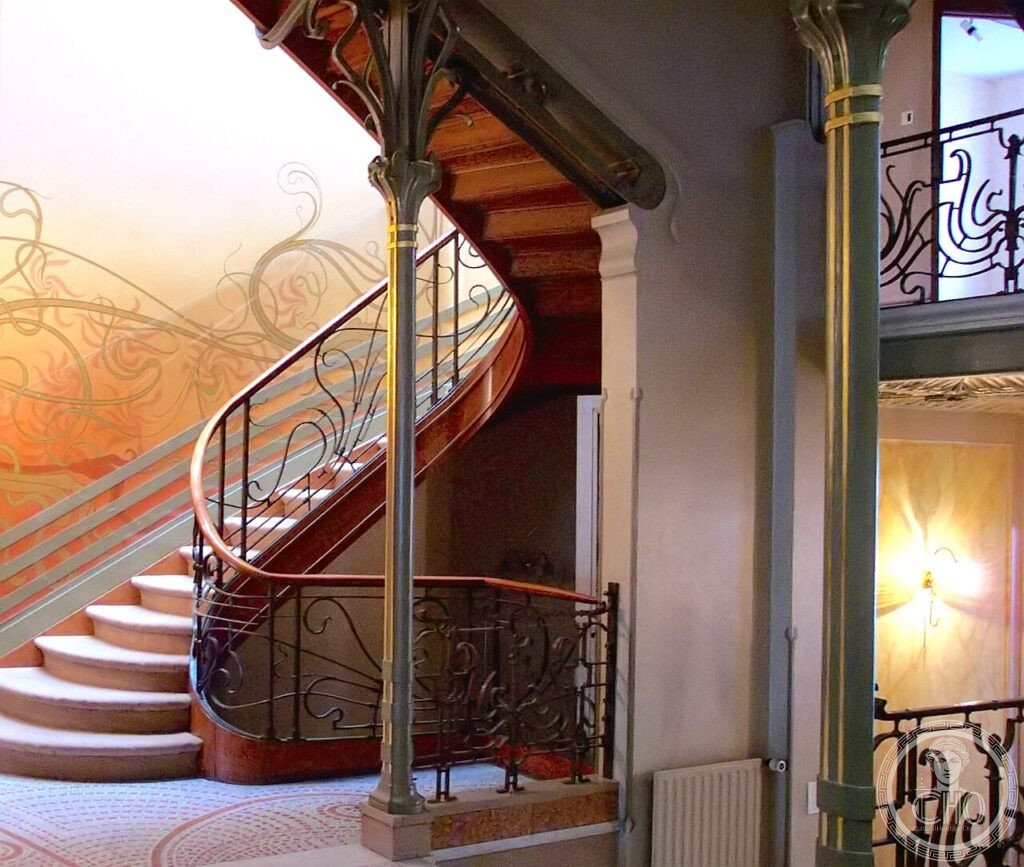
Horta was thirty-two and trained as an engineer, which is the key to everything he did. He treated iron and glass, the materials of factories and railway sheds, as things of beauty, and he bent them into the shapes of stems and whiplashes. Within ten years architects from Glasgow to Riga were doing versions of the same thing.
It is no accident that this happened in Brussels. The Belgium of the 1890s was rich, industrial and politically liberal, with a confident professional class — scientists, lawyers, engineers — who wanted houses that announced they were modern rather than aristocratic. Horta gave them exactly that. The city was also small and dense enough that a single street could become a showcase, and tolerant enough of the new that a façade like the Tassel’s could go up at all.
Horta’s Brussels
Four of Horta’s houses are now UNESCO World Heritage, listed together in 2000, and three of them sit within a short walk of the Tassel. The Hôtel Solvay on Avenue Louise, built for a chemical dynasty with what was effectively an unlimited budget, survives almost untouched down to its door handles and carpets — Horta designed all of it. The Hôtel van Eetvelde, out in the eastern Squares district, is the most daring: its façade hangs on a frankly exposed iron frame and its central hall glows under a stained-glass dome. It was built for the administrator of the Congo Free State, and the colonial fortune behind it is part of the harder history Brussels is still reckoning with.
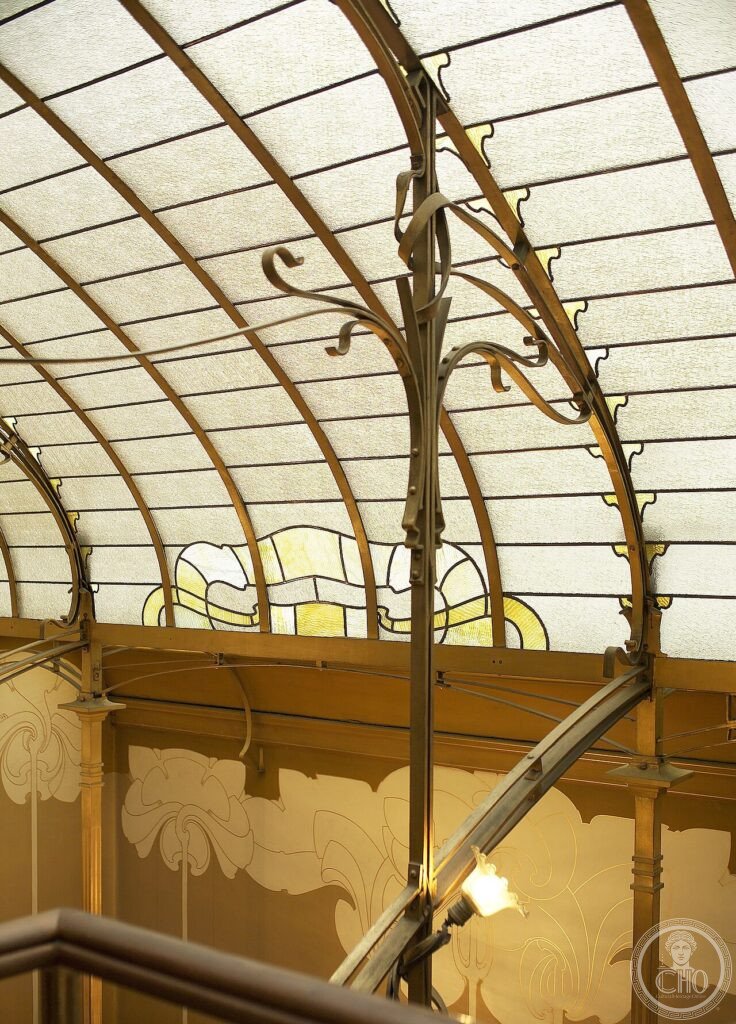
The fourth, and the one you can actually enter, is the architect’s own home and studio, now the Horta Museum in Saint-Gilles. If you visit one interior on this walk, make it this one. The stairwell, washed in light from above and wrapped in iron and mosaic, is the clearest statement Horta ever made of what he was after.
Rivals and heirs
Horta was not alone. In the very same year, 1893, Paul Hankar was building his own house a few streets away on rue Defacqz, using exposed iron and sgraffito — coloured plaster scratched into pattern — rather than Horta’s flowing stone. Historians still argue about which man was first. Nearby, Hankar’s Hôtel Ciamberlani carries a great sgraffito frieze of birds and butterflies across its whole front.
The movement’s wildest note was struck by a pupil. Around 1903 Gustave Strauven, who had trained in Horta’s office and was barely into his twenties, built the Saint-Cyr House on Square Ambiorix. On a plot only four metres wide he covered the entire narrow façade in curling wrought iron that erupts into a huge circular window at the top — Art Nouveau pushed to the edge of excess. Out in Etterbeek, the Cauchie House of 1905 answers in a different key, its front a single enormous sgraffito mural by the decorator Paul Cauchie.
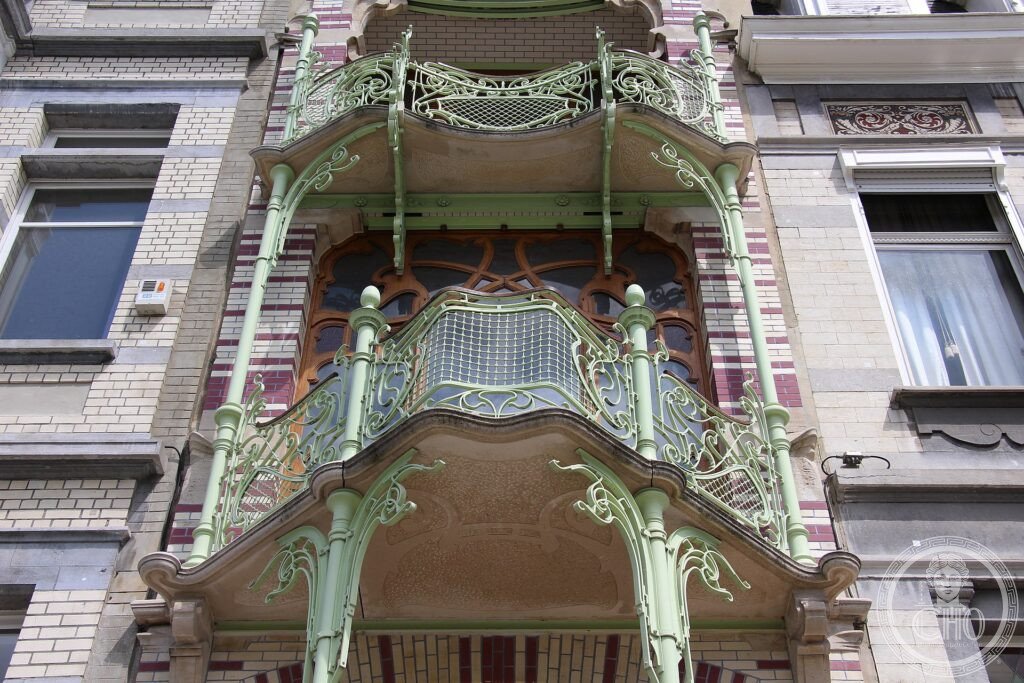
The real pleasure of Art Nouveau in Brussels, though, is that it never stayed inside the famous addresses. Once your eye is tuned, you start seeing it everywhere the guidebooks ignore: a curling iron balcony on an ordinary apartment block, a stained-glass transom over a butcher’s door, a sinuous house number, a tiled shopfront still in daily use. Whole streets in Saint-Gilles, Ixelles and Schaerbeek were built in the style for ordinary families, and most are still lived in. Walking between the landmarks, with no particular plan, is how you meet the city the residents actually use — which is the best reason to come.
Iron in the centre
The style was not only for private mansions. On the Mont des Arts, the Old England building of 1899 by Paul Saintenoy is a former department store built in iron and glass painted black, a daring shopfront onto the city; it now holds the Musical Instruments Museum and a rooftop café with one of the best free views in Brussels. A short walk north, Horta’s Magasins Waucquez of 1906 — a luminous iron-and-glass textile warehouse — was saved from demolition and reopened in 1989 as the Belgian Comic Strip Center. The pairing is perfectly Belgian: Horta’s daylight architecture housing the home country of Tintin and the Smurfs.
That the Waucquez warehouse survived at all is a kind of luck, because Brussels has been careless with its inheritance. Horta’s own masterpiece, the Maison du Peuple — a soaring iron-and-glass hall built in 1899 for the Belgian Workers’ Party — was demolished in 1965 despite protest from architects around the world, and is still mourned as one of the great architectural losses of the century. Horta himself had long since moved on: fashion turned against Art Nouveau after the First World War, and his later buildings, like the Centre for Fine Arts, are in a sober, stripped classicism. The man who started the style spent his last decades disowning it. Part of what makes a walk like this worth doing is that not all of it is guaranteed to be here forever.
The Vienna connection
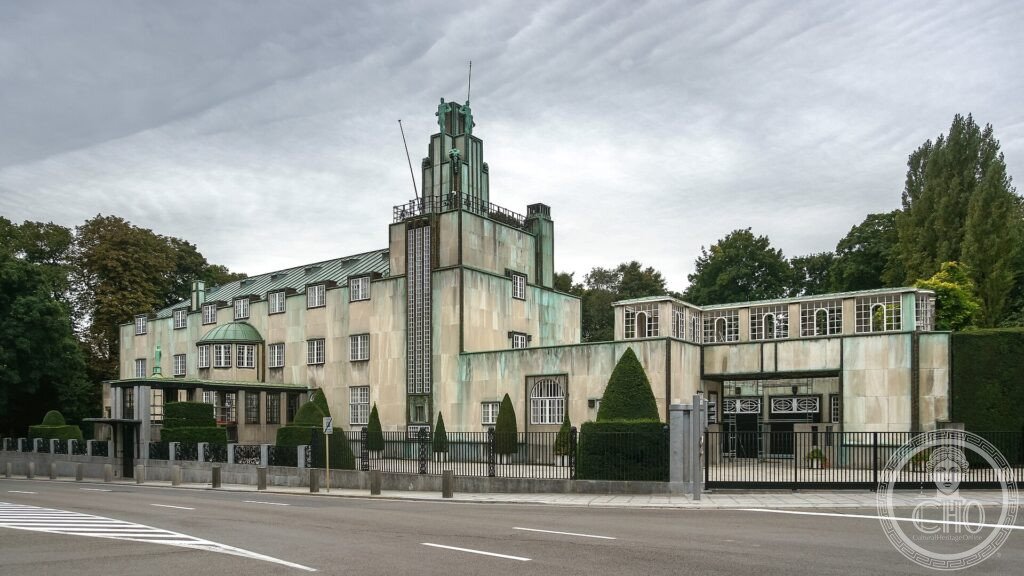
One Brussels masterpiece looks not to Horta but to Austria. The Stoclet Palace, built between 1905 and 1911 for the financier Adolphe Stoclet, was designed not by a Belgian at all but by the Viennese architect Josef Hoffmann of the Wiener Werkstätte, and its dining room holds a mosaic frieze by Gustav Klimt. It is the single richest meeting point of the two great Art Nouveau capitals — and it is still a private home, so it can only be admired, like so much here, from the street. If this is your thread, follow it east to its source: our Vienna 1900 Secession walk ends in the same gold.
How to walk it
Brussels is more spread out than its reputation suggests, so this route mixes walking with a tram and a metro hop, all covered by one STIB day ticket from any machine. The southern cluster in Saint-Gilles and Ixelles is walkable end to end; save the tram and metro for the centre and the eastern Squares. Villo! city bikes and e-scooters fill the gaps — use the cycle lanes. And eat as the locals do between stops: a cone of double-fried frites from a stand, a waffle, a Trappist or lambic beer chosen by the waiter. Two historic Art Nouveau brasseries, La Porteuse d’Eau in Saint-Gilles and Le Falstaff near the Bourse, let you sit inside the period rather than just look at it.
Is Art Nouveau in Brussels free to see?
Mostly, yes. The great majority of these buildings are private houses you read from the pavement, which costs nothing. The two interiors worth paying for are the Horta Museum and the Hôtel Hannon, both of which keep museum hours and reward booking ahead. The Old England rooftop is free with a coffee.
Can you go inside the Horta houses?
Only some. The Horta Museum, the architect’s own home, is fully open. The Hôtel Tassel, Hôtel Solvay and Hôtel van Eetvelde are private; the Solvay and van Eetvelde open only on occasional guided visits, so check ahead if interiors matter to you. The Stoclet Palace is closed to the public entirely.
How long does the Brussels Art Nouveau walk take?
A full day. The walking is moderate and broken by a tram and a metro ride, but the southern houses, the central museums and the eastern squares each deserve unhurried time. If you have only a half-day, do the Saint-Gilles cluster around the Horta Museum.
When is the best time to go?
Spring and early autumn give the kindest light for façade-gazing and photography. Brussels weather is changeable year-round, so carry a light raincoat whatever the forecast. Note that the two museum interiors close one day a week.
Walk it yourself. We have turned this route into a free CHO RoadBook — the nine stops in order, a map, and downloadable GPX and KML tracks for your phone: the Brussels Art Nouveau RoadBook.
Sources
- UNESCO World Heritage — Major Town Houses of the Architect Victor Horta (Brussels).
- Horta Museum, Saint-Gilles — biography and house history.
- Musical Instruments Museum (MIM), Brussels — the Old England building.
- Belgian Comic Strip Center — the former Magasins Waucquez.