
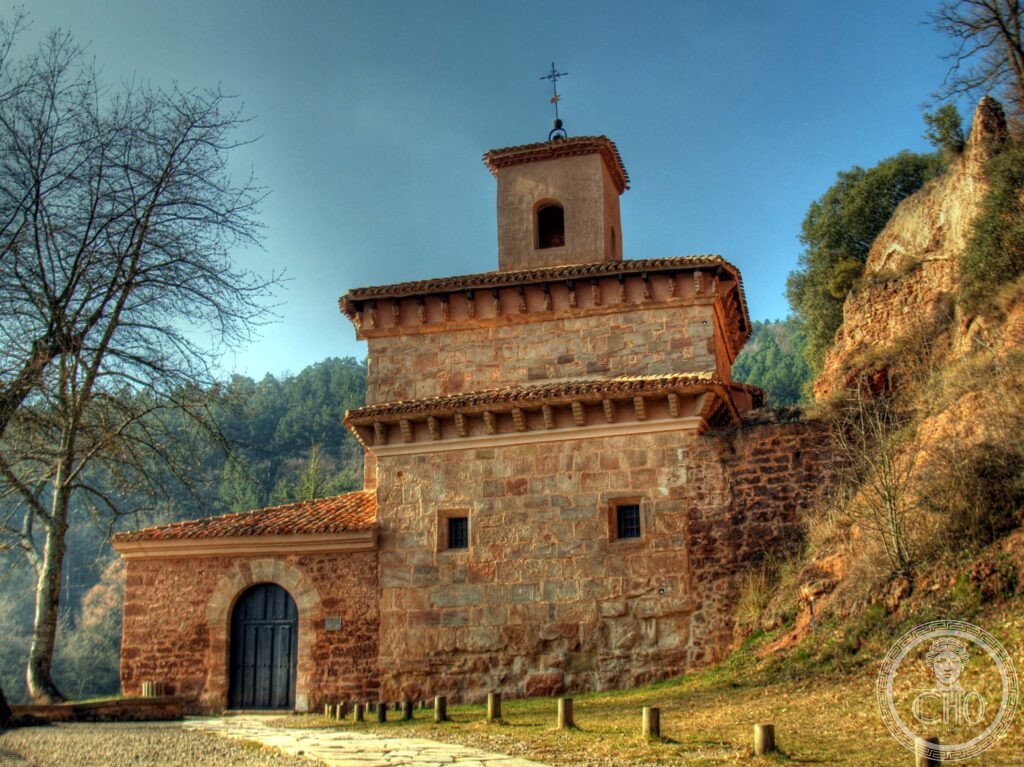
The birthplace of the Spanish language. Two monasteries in a narrow valley of La Rioja, separated by 400 metres of altitude, together representing eleven centuries of continuous Christian monastic life on the Iberian Peninsula and the site where a 10th-century monk’s marginal glosses on a Latin text produced the first known written words in proto-Spanish and proto-Basque.
At a glance
The monasteries of San Millán de la Cogolla are located in the Cárdenas Valley in the Sierra de la Demanda (a mountain range in the southern part of La Rioja province), 27 km south of the city of Nájera and approximately 70 km south-west of Logroño (the capital of La Rioja). The name “San Millán de la Cogolla” refers both to the village (population approximately 180) and to the saint, Millán (or Aemilianus; c. 473–574), a Visigothic hermit-monk who founded the first monastic community here in a cave above the valley. The upper monastery, San Millán de Suso (suso = “above” in old Castilian), is the oldest surviving structure and is built partly in natural caves and partly in pre-Romanesque masonry (Visigothic and Mozarabic arches; the 7th–10th century construction layers are visible in the fabric of the building). The lower monastery, San Millán de Yuso (yuso = “below” in old Castilian), is the grander and more visited of the two (a large complex with Renaissance, Gothic, and Baroque elements; still inhabited by Augustinian monks; the library, cloister, and reliquary are open to guided tours).
Key facts
- The Glosas Emilianenses and the birth of the Spanish language: the most important manuscript in the history of the Castilian language. The Glosas Emilianenses (Emilian Glosses; “Emilian” referring to the original Latin name of the monastery, Monasteriense Emilianense, named after St. Emilianus/Millán) are a series of marginal and interlinear annotations (glosses) added by a monk to a Latin text (a collection of sermons and Church texts) in the library of the Monastery of Suso in approximately the 10th century. The glosses. Explanatory notes translating or paraphrasing difficult Latin words and passages into a language that the monks or readers could understand. Are in Old Castilian and Basque. They are considered the oldest surviving written examples of a recognisable proto-Castilian (proto-Spanish) language and proto-Basque language in the world. Glosa 89 of the collection (the most famous) reads, in modern Castilian transliteration: “cono ajutorio de nuestro dueno, dueno Santi agatio, dueno Christo, dueno Salbatore, qual dueno get ena honore et qual duenno tienete ela mandatione con Patre con Spiritu Sancto”. This translates approximately as “With the help of our Lord, Lord Saint Agathius, Lord Christ, Lord Saviour, what Lord there is in glory and what Lord holds the power with the Father with the Holy Spirit”. The language is clearly proto-Castilian Spanish rather than Latin (dueno = dueño = Lord/master; ajutorio = ayuda = help; the word order is already Spanish rather than Latin). The manuscript is now in the Real Academia de la Historia in Madrid (not in the monastery — visitors see a facsimile).
- The Monastery of Suso (6th–10th century): the oldest surviving Christian monument in La Rioja. The Monastery of Suso is built around the hermit caves in which St. Millán (c. 473–574) lived and meditated. The visible fabric of the building dates primarily from the 9th–10th centuries (the Mozarabic arches and the horseshoe-shaped doorways reflect the Moorish architectural influence that spread into northern Spain during the Al-Andalus period; the Visigothic inscriptions on some capitals date from before the Islamic conquest). The alabaster tomb of St. Millán, originally in the monastery (now replaced by a 12th-century copy in the monastery; the original was taken to Nájera by King García de Nájera in the 11th century in an attempt to steal the saint’s relics for his own kingdom’s use; he was said to have been struck blind for the attempted sacrilege), is the most venerated element. The monastery is accessible only on guided tours (maximum 10 people; 45 minutes; in Spanish).
- The Monastery of Yuso (11th century–present): the treasure-house of the site. The Monastery of Yuso was built from the 11th century onward as a larger replacement for the cave church of Suso. It is still inhabited by approximately 12 Augustinian monks (Agustinos Recoletos). The most important elements: the Renaissance cloister (1549; golden limestone; graceful columns with carved capitals; one of the finest Renaissance cloisters in La Rioja), the Library (with approximately 10,000 volumes; the original home of the Glosas Emilianenses before their transfer to Madrid), the Reliquary (with the jewelled caskets said to contain the remains of St. Millán; the Romanesque ivory carvings on the caskets are among the finest examples of 11th-century ivory work in Spain), and the Baroque church (17th century; a single-nave space of austere elegance).
- Heritage: UNESCO World Heritage Site, Monasteries of San Millán de la Cogolla, inscribed 1997.
- GPS: 42.3219° N, -2.8623° W.
History
St. Millán (Aemilianus) born approximately 473 in Berceo (a village 5 km from the monastery site). He lived as a hermit in a cave above the Cárdenas Valley. A community of monks formed around him. He died approximately 574. The cave church was built in the 6th–7th centuries over the site of his hermitage. The Visigothic monastery was sacked by the Moorish forces in the 8th century. The Mozarabic-Romanesque complex of Suso was built in the 9th–10th centuries during the Christian Reconquista (the monastery was within the emerging Kingdom of Navarre). The Glosas Emilianenses were written by an anonymous monk approximately in the 10th century. King García de Nájera attempted to steal the relics in the 11th century. The Monastery of Yuso was founded in the 11th century. Gonzalo de Berceo (c. 1196–c. 1264), the first named author in Castilian literature, was born in Berceo and educated at San Millán de Yuso. UNESCO WHS 1997.
What you see
Visits to both monasteries require separate guided tours (in Spanish only; Yuso tour approximately 1h; Suso tour approximately 45 min; book in advance, especially for Suso which has a group size limit of 10). The walk between Yuso and Suso (approximately 30 minutes uphill on a path through the valley wood) is part of the experience. From the terrace in front of Suso, the view down the valley to the lower monastery and the red-tile roofs of the tiny village is one of the most peaceful panoramas in La Rioja. The cloister of Yuso, seen in its full Renaissance elegance in the afternoon light, is the architectural high point. The most emotionally resonant moment is in the library (or the facsimile display) seeing the reproduction of the Glosas Emilianenses. The first written words in a language that 500 million people today speak as their mother tongue.
Practical information
- Admission and tours: Monastery of Yuso: approximately €6 adults. Guided tours in Spanish (some English tours available with advance notice; confirm by email). Tuesday–Sunday. Closed Monday. Tours depart approximately every 40 minutes. Monastery of Suso: approximately €4 adults. Guided tours in Spanish only (maximum 10 people; the most atmospheric part of the visit — the cave church and the Visigothic arches — is not accessible independently). Book at the visitor centre in the village of San Millán or at the Yuso monastery reception. Both monasteries are closed in August for the annual monastic retreat of the Augustinian community (the only month of the year when access is not possible; verify dates before visiting).
- Getting there: by car from Logroño (70 km south-west; 1h by the LR-113 road via Nájera and Berceo; a very beautiful drive through the Cárdenas Valley with vineyards and wheat fields giving way to forested gorges). By car from Burgos (90 km north-west; 1h via Nájera). There is no convenient public transport. A car is required for this site. The nearest town with accommodation and services is Nájera (27 km north; famous for the Royal Monastery of Santa María de Nájera, where the early Kings of Navarre are buried) or Logroño (the La Rioja capital, with excellent infrastructure for wine tourism).
- La Rioja wine tourism: San Millán de la Cogolla is located in the heart of La Rioja Baja (the upper/south section of the La Rioja wine appellation; primarily Tempranillo wines; the most prestigious single-estate wines of La Rioja Alta are in the northern part of the appellation, near Haro). The combination of the monasteries with La Rioja wine estate visits (Bodegas Muga, Marqués de Riscal — whose spectacular Frank Gehry building is a major sight in its own right, see below — CVNE, Roda, López de Heredia) makes a 2-day La Rioja–San Millán circuit one of the most rewarding detours from the Camino de Santiago or from a Basque Country–Castile road trip.
Getting there
By car only: from Logroño (70 km, 1h) or Burgos (90 km, 1h). No public transport. GPS: 42.3219, -2.8623.
Nearby
- Marqués de Riscal Bodega and Frank Gehry Hotel. 55 km north-west of San Millán de la Cogolla (1h by car; the town of Elciego in the Basque Country Rioja Alavesa appellation, just across the La Rioja–Álava provincial border). The Guggenheim Bilbao of the wine world. The Marqués de Riscal winery (founded 1858; one of the oldest and most prestigious Rioja producers) commissioned the American architect Frank Gehry (the designer of the Guggenheim Bilbao) to design a new visitor centre and hotel for their 150th anniversary. The result (completed 2006) is a canopy of titanium, gold, and pink steel ribbons draped over the historic stone winery buildings like a crumpled piece of metallic fabric. It is one of the most remarkable pieces of contemporary architecture in Spain. The Marqués de Riscal hotel (part of the Luxury Collection) is inside and around the Gehry building. The restaurant (Richard Camarena, two Michelin stars) serves the most sophisticated food in La Rioja. The winery tours and wine tastings are available daily.
- Nájera and the Royal Monastery of Santa María. 27 km north of San Millán de la Cogolla (30 min by car). The royal necropolis of the medieval Kingdom of Navarre. Nájera was the capital of the Kingdom of Navarre in the 10th–11th centuries (before the seat of power moved to Pamplona). The Royal Monastery of Santa María de Nájera (founded 1052 by King García de Nájera; rebuilt in the 15th century in the Gothic style; still inhabited by Benedictine nuns) contains the royal pantheon of the Kings of Navarre (12 royal tombs, including García de Nájera himself; carved Romanesque and Gothic sarcophagi of extraordinary craftsmanship). The 12th-century cloister (the Claustro de los Caballeros; the most elaborate Plateresque cloister in La Rioja, with 24 Gothic tracery arches) is one of the finest in northern Spain. The monastery is open for guided visits.
- Sierra de la Demanda and trekking. The mountains immediately surrounding San Millán de la Cogolla (the Sierra de la Demanda; peak altitude 2,271 metres at Pico Urbión; beech and oak forests; streams; the headwaters of the Oja and Nájera rivers) are one of the most beautiful and least visited mountain landscapes in northern Spain. The GR 93 long-distance route traverses the sierra. The forest above the Suso monastery (the walk from the monastery to the Cruz de San Millán; approximately 1h return; superb views over the valley and down towards the La Rioja plain) is a recommended complement to the monastery visits.
Sources
- Wikipedia, Monasteries of San Millán de la Cogolla. Glosas Emilianenses. Gonzalo de Berceo, accessed June 2026.
- UNESCO, Monasteries of San Millán de la Cogolla, WHS reference 805, inscribed 1997.
- Roger Wright, Late Latin and Early Romance in Spain and Carolingian France, Francis Cairns, 1982.
Find it on the map
See this place and what’s around it →📷 Become a Cultural Heritage Online photographer
Share your photos of places: they stay published under your name as the author. The more they're seen, the more you get noticed — and soon a contest will reward the most appreciated photos.
Log in or sign up free to add a photo